Copywriting psychology is the set of mental shortcuts that decide whether a reader clicks: loss aversion, social proof, curiosity, authority, specificity and primacy. A headline that pulls one of these triggers beats a headline that only informs.
Why does copywriting psychology drive headlines?
Your headline has two seconds to make someone care. That's enough time for an emotional reaction and not enough for logic.
A headline that works triggers a psychological response: the reader feels something before they think anything. Knowing the psychology behind headlines helps you write ones that work, and our guide to emotional headlines shows which feelings move B2B SaaS buyers.
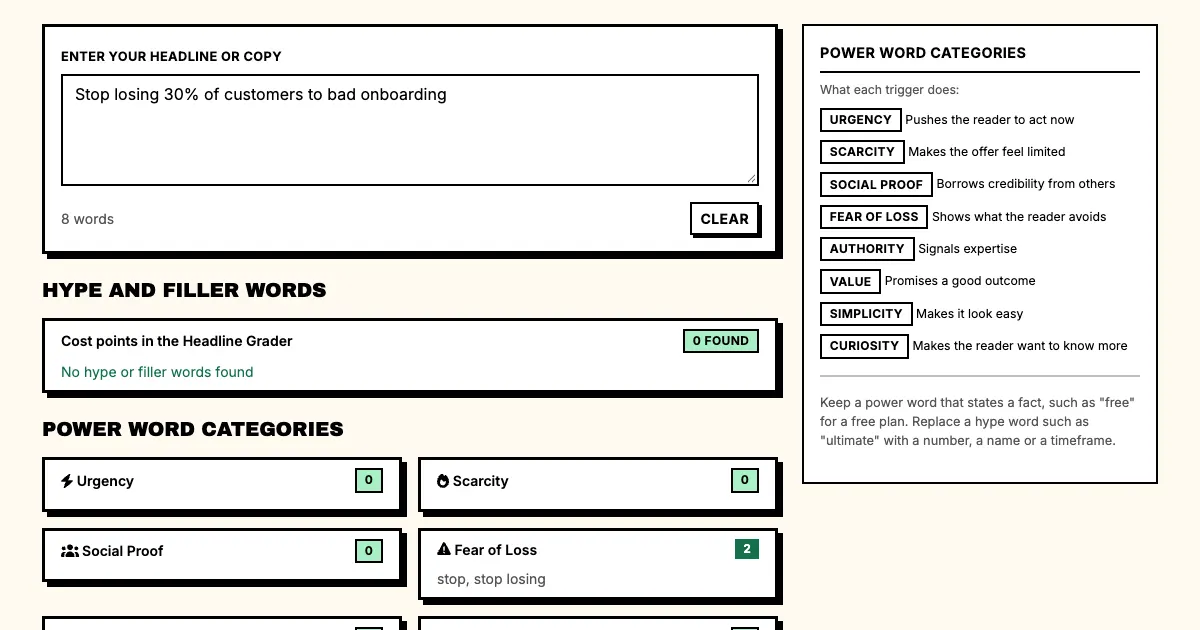
What is loss aversion and why does fear of loss beat hope of gain?
Loss aversion means losses loom larger than gains. Losing $100 feels worse than gaining $100 feels good.
Headlines that frame the outcome as avoiding a loss outperform headlines that frame it as gaining something.
Gain framing: "Cut your churn with better onboarding"
Loss framing: "Stop losing 30% of customers to bad onboarding"
The loss framing is stronger because it triggers loss aversion: a reader who's losing customers feels the pain immediately.
Use loss framing when your audience is actively experiencing the problem. Use gain framing when you're introducing a new opportunity to an audience that's not in pain.
How does social proof work in a headline?
Social proof is the tendency to copy what other people do. People look to others to guide their decisions, so headlines that imply social proof are more credible than headlines that make unsupported claims.
Without social proof: "The best onboarding tool for SaaS"
With social proof: "Why 500+ SaaS companies switched to our onboarding tool"
The second headline implies that 500 companies have already validated the choice, so the buyer isn't relying on the claim alone.
Use social proof when you have real numbers or recognizable customers. Fabricated social proof destroys trust once someone finds out.
What is the curiosity gap?
Curiosity is the desire to close an information gap. When you sense there's something you don't know, you feel a tension that you want to resolve.
Headlines that open an information gap drive clicks because the reader has to know the answer.
Without curiosity: "How to write headlines"
With curiosity: "The headline mistake costing SaaS companies 30% of clicks"
The second headline leaves two questions open: what the mistake is, and how it costs 30% of clicks. The reader has to click to find out.
Use curiosity only when your content delivers a specific, surprising answer. Clickbait headlines open curiosity gaps and never fill them.
How does authority build credibility?
People trust experts, and an authority signal tells the reader that someone with knowledge has validated a claim. That makes the headline more credible than an unsupported claim.
Without authority: "This tool will cut your churn"
With authority: "The framework Intercom uses to reduce churn by 40%"
The second headline names a company (the authority) and a specific result, so the claim reads as validated by someone with expertise.
Use authority when you have real expertise to cite. Named companies, specific credentials, or quantified results all add authority. Name a company only if it uses your product or method: a reader who checks and finds no link stops trusting the rest of the page.
Why do numbers beat vague language?
Readers forget vague language and remember specific language.
Vague: "Increase your revenue"
Specific: "Increase your revenue by 25%"
The number makes the specific headline concrete and easier to remember. The reader knows exactly what they're getting.
Be specific in every claim. Readers ignore vague promises and consider specific ones.
What is the primacy effect and why do first words matter most?
In any headline, the first few words get the most attention and set the frame for everything that follows.
Weak lead: "Our analytics platform helps teams make better decisions"
Strong lead: "Know exactly when customers are about to churn"
The strong lead puts the most important word ("Know") and the most compelling outcome ("when customers are about to churn") first.
Lead with your most important word instead of saving it for the middle. The same rule applies to buttons, where the action verb comes first, as our comparison of CTA generator tools explains.
FAQ: Copy psychology
Q: Which psychological trigger should I use?
A: Match the trigger to your audience: loss aversion for audiences in pain, curiosity for awareness content, authority for decision content.
Q: Can I combine triggers?
A: Yes, when each one rests on a fact. "The onboarding checklist 500 SaaS teams use" pairs specificity with social proof, and it works only if 500 teams do use it.
Q: Do these triggers work differently for B2B vs. B2C?
A: Yes. B2B audiences respond more strongly to authority and specificity, and B2C audiences to emotion and urgency, though both respond to every trigger to some degree.
What should you do now?
- Pick one headline on your site.
- Identify which psychological triggers it uses.
- Write one alternative using loss aversion.
- Write one alternative using curiosity.
- Test which triggers your audience responds to.
For ready-made structures that combine these triggers, start from one of the seven copywriting frameworks we break down separately.
Each trigger depends on a true claim. Real numbers, real customers and real deadlines give the reader a reason to believe the rest of the page.
Sources
See which psychological triggers your headline pulls: the Power Word Checker sorts its power words by trigger and flags the hype words the Headline Grader takes points off for.