CTA Generator for Buttons and Links
This CTA generator writes the short phrase on a button or link that tells the reader what to do next, such as "Start your free trial". Pick the intent of your click below and get call to action phrases written for it.
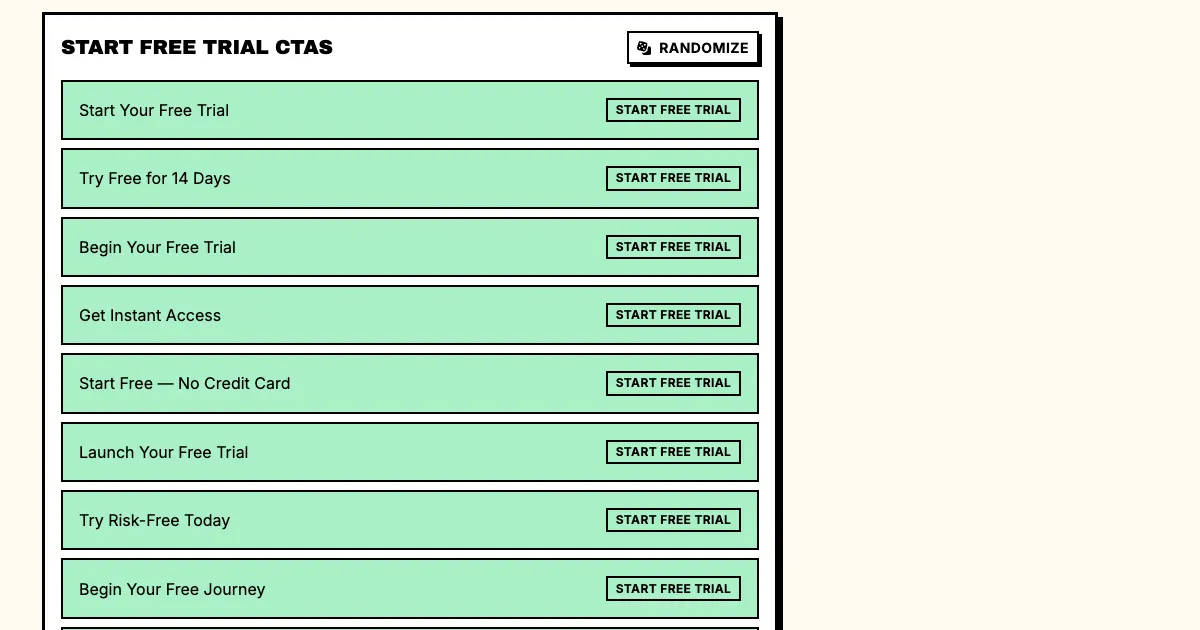
Start Free Trial CTAs
Match intent to funnel stage:
- Trial / Signup: Top of funnel, low friction
- Demo / Contact: Mid funnel, personal touch
- Download / Learn: Lead capture, value exchange
- Upgrade: In the product, focused on features
Click any CTA to copy it to your clipboard.
How do you write a call to action that converts?
Call-to-action copy decides whether visitors take the next step or leave without converting. Good CTAs say exactly what happens next, use as much urgency as the offer justifies, and remove friction wherever they can. Few changes in conversion optimization pay off as much as better CTA copy.
Start by matching the CTA to what the user wants to do. A user ready to start a trial needs a path to activation with no friction. A user still researching needs information before committing, and a user comparing options needs a way to compare before deciding. A CTA that doesn't match the intent adds friction just when the user is deciding, and loses the conversion.
Grammatical person changes how a CTA reads. "Get Your Free Trial" speaks to the user directly and names the benefit, so it feels more complete. A bare "Get Started" still works but feels slightly less personal. The most effective CTAs address the user and state the benefit.
The verb changes how much effort the click seems to take. Action verbs like "Start," "Get," "Try" and "Launch" feel active and doable. Nouns like "Access," "Entry" and "Download" read as outcomes instead of actions. The best CTA verbs pair an action with a benefit: something happens when the user clicks, and it is worth having.
A clear benefit is what lifts a CTA above a mediocre one. "Start Your Free Trial" names the action (start) and the benefit (free trial). "Submit" names an action and no benefit. "Get Your Free Trial" puts the weight on receiving the benefit. When there is room, a clear benefit beats a minimal label.
Removing friction raises conversion rates a lot. "No credit card required," "No commitment" and "Cancel anytime" make the click feel less risky. Put these lines as small text near the button, not on the button itself, so the button stays short and about the action while the text around it answers objections.
Use urgency only when the offer really has a limit. A trial period that is actually limited justifies urgent wording; a freemium tier that is always available does not. False urgency damages trust and teaches users to ignore urgency. When the urgency is real, say so clearly. When it isn't, lead with the value.
Button design affects click rates separately from the copy. The button needs contrast with what surrounds it, a color that signals action without confusing the eye, and a size large enough to tap easily on mobile without taking over the design. A well-designed button fits the visual hierarchy and still looks clearly clickable.
Test CTA variations to see what works on your audience. Headline tests get more attention, but CTA tests measure conversion intent directly. Test in sequence: copy first, then color, then placement, then size. Change one thing per test so you know what caused the result.
Mobile CTAs need different handling from desktop ones. Touch targets need to be at least 44 pixels tall, and the small screen means shorter button text. Every scroll to reach the CTA costs engagement, so on mobile the CTA often needs to sit above the fold or stick to the bottom of the screen. Test on real devices as well as emulators.
Where the CTA leads matters as much as what it says. A "Start Free Trial" button should go to a trial signup page, not the homepage. When the button and the page it opens don't match, users get confused and bounce rates go up. Give every CTA a specific destination, planned in advance, that continues what the user set out to do.
Social proof near the CTA raises conversion rates a lot. "Join 10,000+ users" next to a signup CTA reassures the reader, "Used by teams at Stripe, Notion, and Figma" lends authority, and "4.8 rating from 2,000+ reviews" adds credibility. These work best as a short line right next to the button.
Test how often CTAs appear across the funnel so they show up at the right moment. A user who hasn't engaged with any content needs information first, not a conversion CTA. A user who has viewed several pages is considering you and is ready for a conversion prompt. Showing CTAs based on behavior works better than showing them everywhere all the time.
The common CTA mistakes are easy to avoid. Vague copy like "Submit" or "Click Here" wastes clicks. Leaving out the benefit leaves the value proposition incomplete. Too many CTAs split the reader's attention. Copy full of friction, like "Sign up for an account to continue", puts needless barriers in the way. Each has a simple fix that most teams know and forget when deadlines press.
Frequently asked questions
What is a call to action?
A call to action (CTA) is the phrase on a button or link that tells the reader what to do next, such as "Start your free trial" or "Book a demo".
What is the best CTA text?
The one that names what happens after the click. "Get my report" beats "Submit" because the reader knows what they get. Specific verbs and a visible benefit win.
How many CTAs should a landing page have?
One primary CTA, repeated two or three times down the page. A second, softer CTA ("See pricing") can serve readers who are not ready.
Should a CTA create urgency?
Only when the urgency is real, such as a closing date or limited seats. Fake urgency lowers trust and repeat conversions.
Related reading
- How to write CTAs that convert
- CTA copy generator tools compared
- Five landing page mistakes that kill conversions
- SaaS Value Proposition Generator
Sources
- Wikipedia: Call to action (marketing)
- Nielsen Norman Group: first impressions matter
- Nielsen Norman Group: a link is a promise
Written by Punchd Team: Growth and content marketers who have run copy and conversion work at SaaS companies from seed stage to Series C. We built Punchd for that work. Last updated 2026-10-16.