The rule for how to write headlines that get clicks is simple: state a specific benefit, pull one emotional trigger and fit the platform the headline runs on. This guide covers the psychology, the structure and the platform rules, with examples for each.
Why do most headlines fail to get clicks?
Your headline is competing against thousands of others. In your email inbox alone, you see dozens of headlines every day. On Google, you're competing against millions of pages, and on social media every post is a headline fighting for attention.
Most headlines fail because they're written for the writer instead of the reader. They describe the product, use category language and make vague promises.
The principles below work on every platform. For finished headlines to study, see our headline examples.
What is the three-second rule?
You have three seconds to make someone care. That's how long it takes to decide whether to click, scroll past, or close the page.
Three seconds is too short for an explanation but long enough for a feeling, so your headline has to create an emotional response in that time.
The best headlines trigger one of these responses:
- Recognition: the reader sees themselves in your headline. "Is your onboarding killing your retention?" makes the SaaS founder think "that's me."
- Curiosity: the reader wants to know more. "The real reason your headlines aren't getting clicks" creates an information gap.
- Urgency: the reader feels they need to act now. "Stop losing customers before your next billing cycle" creates that pressure.
What is in a click-worthy headline?
Every headline that gets clicks has three components.
Component 1: A specific promise
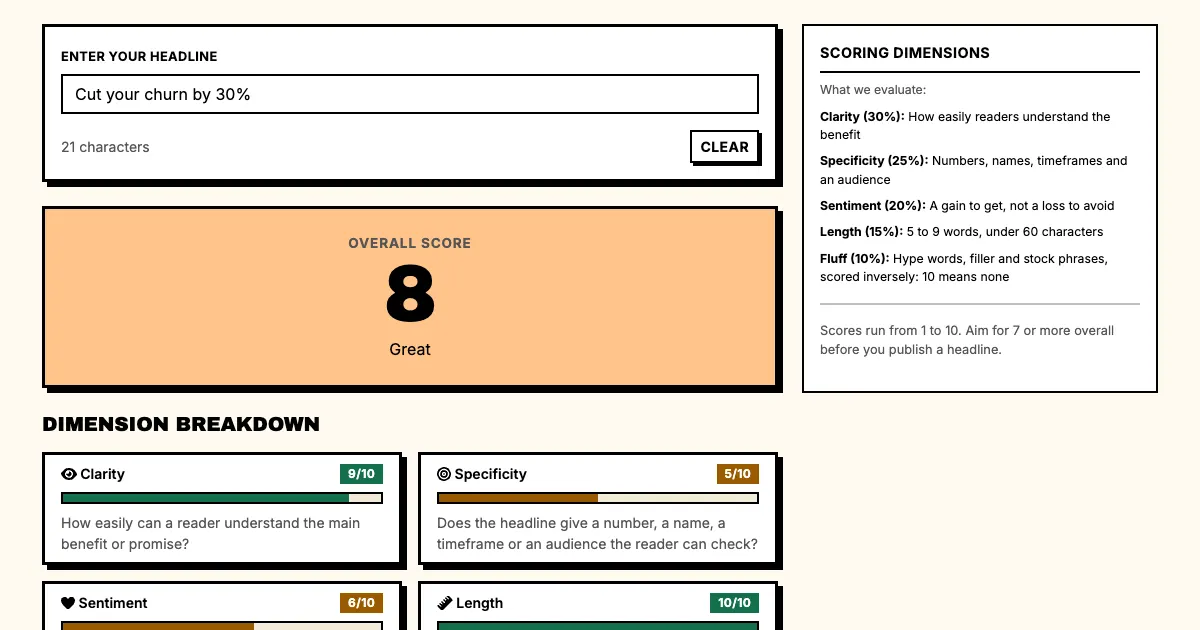
Vague headlines don't get clicks. "Get better results" is vague. "Cut your churn by 30%" is specific.
Specific promises are more credible because they can be verified. A reader can test "cut churn by 30%" and prove it right or wrong, but there is nothing to test in "get better results."
The promise should also be something the reader can picture. You can see "cut churn by 30%." You can't see "improve retention."
Component 2: A recognizable audience
"The best project management tool for any team" could describe any tool, so no reader feels it was written for them.
"The best project management tool for remote teams who ship fast" is specific: only remote teams who ship fast recognize themselves, and to them it's relevant.
The more specific the audience you name, the more the right readers feel seen.
Component 3: An emotional trigger
Emotion drives clicks more than logic does, and loss aversion is one of the strongest emotional triggers. People feel the pain of losing something more intensely than the pleasure of gaining something equivalent. It's one of the core principles of copywriting psychology, and knowing it helps you write headlines that get clicked.
Logical framing: "Our tool helps you retain more customers"
Emotional framing: "Stop losing 30% of customers to bad onboarding"
The emotional version is stronger because it triggers loss aversion. A reader who's losing customers feels the pain immediately.
How do you write headlines for each platform?
Each platform sets its own limits. Paid ads have the tightest ones, covered in our guide to ad headlines.
Google search results
Google shows about 60 characters of your title tag, so your headline has to work in that space. It should:
- Include your primary keyword
- Make a specific promise
- Fit within 50-60 characters
Formula: "[Primary keyword]: [Specific outcome]"
Example: "How to Write Headlines: Get More Clicks in 2026"
The rest of the rules are in our Google title tags guide.
Email subject lines
Subject lines compete in a crowded inbox, where questions and curiosity gaps perform well. A subject line should:
- Create curiosity or urgency
- Be specific enough to feel personal
- Keep under 50 characters for mobile
Formula: "[Question] + [Specific detail]"
Example: "Are your headlines losing you clicks?"
For five more techniques and four formulas, read how to write email subject lines.
Landing pages
Landing page headlines have more room but more competition for attention, and they have to stop the scroll. They should:
- Lead with the most important word
- Make a specific promise
- Address the reader's primary objection
Formula: "[Outcome] for [specific audience] without [common obstacle]"
Example: "Cut churn by 30% for SaaS teams without a customer success manager"
For more, see our guides on how to write landing page headlines and on SaaS headlines.
Social media
Social headlines have to stop the scroll quickly, and bold claims and questions do that well. They should:
- Create immediate curiosity
- Use platform-specific conventions
- Be ready for truncation
Formula: "[Bold claim]: [specific proof]"
Example: "This headline formula tripled our email open rate"
What is the headline writing process?
Write headlines in stages instead of in one pass.
Stage 1: Brainstorm
Write 20 possible headlines without editing or judging them, or let our AI headline generator draft 20 from a short brief about your product. Use a different angle for each:
- Numbers and data
- Questions
- Commands
- Contrast (before/after)
- Social proof
Stage 2: Evaluate
Score each headline on:
- Clarity: Can the reader understand the promise immediately?
- Specificity: Is the outcome quantified or concrete?
- Emotion: Does it trigger a feeling?
- Audience: Does it speak to a specific person?
Drop any headline that scores low on one of these.
Stage 3: Refine
Take your best 3-5 headlines and refine them: add specifics, remove vague words and make every word earn its place.
Stage 4: Test
If you have the traffic, test your top headlines against each other, then A/B test the winner against your current headline.
What are the common headline writing mistakes?
Mistake 1: Writing before knowing your audience
"Write for your audience" sounds obvious, yet most writers write for themselves.
Before you write, ask: "Who is this for? What do they already know? What do they believe that's wrong?"
Mistake 2: Making vague promises
"Better results," "more success," "improved performance" can't be verified and are easy to forget.
Replace them with specific promises. "Cut churn by 30%" is verifiable. "Get better results" is not.
Mistake 3: Using category language
"CRM," "marketing automation," "productivity tool" are category language. They describe what you are instead of what you do.
Replace category language with outcome language. "Stop losing customers to bad onboarding" is more compelling than "Improve customer success."
Mistake 4: Not testing
Your first headline is rarely your best. Every headline is a hypothesis, and testing is how you find the winner.
FAQ: Writing headlines that get clicks
Q: How long should a headline be?
A: It depends on the platform: 50-60 characters for Google title tags, 40-50 characters for email subject lines and 6-10 words for landing page H1s.
Q: Should I use numbers in headlines?
A: Yes. Specific numbers create credibility: "5 headline formulas" is more compelling than "headline formulas."
Q: How do I make my headlines more emotional?
A: Name the specific pain your reader is experiencing. "Stop losing customers" is emotional; "Reduce customer churn" is not.
Q: Should every headline be urgent?
A: No. Urgency works for decision-stage content. Awareness-stage content needs recognition first, urgency second.
What should you do now?
- Pick one piece of content that needs a better headline.
- Write 10 possible headlines using different angles.
- Score each on clarity, specificity, emotion, and audience fit.
- Pick your top 3 and refine them.
- Test the best against your current headline.
Sources
- Nielsen Norman Group: headings as pickup lines
- Wikipedia: Loss aversion
- Google Search Central: title links
Generate headlines that get clicks. Try the AI headline generator: one punch writes 20 headlines.