Headline optimization means improving a headline you already have, one trait at a time: clarity, specificity, emotion, word choice, length and format. The 15 tips below each come with a before and after.
Why does optimization beat writing from scratch?
Most headline problems follow patterns, and the same issues appear again and again. Once you can recognize them, fixing the headlines you have is faster than starting from scratch every time. Spotting them is a skill of its own, covered in our guide to headline analysis.
The 15 techniques below work on any headline. Use them as a checklist every time you review one, and see our headline rewrites for the same moves applied one pass at a time.
How do you make a headline clearer?
Tip 1: Make the promise specific
Vague promises don't create belief. "Improve your results" is vague; "Cut churn by 30%" is specific.
Before: "Improve your landing page performance"
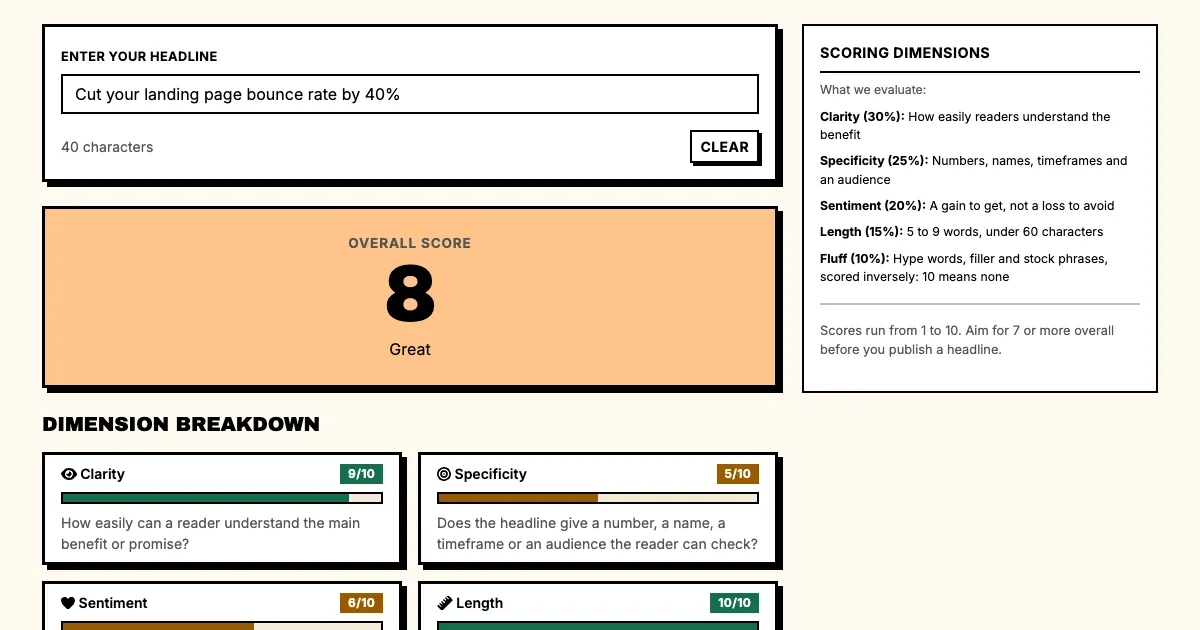
After: "Cut your landing page bounce rate by 40%"
Why it works: The reader can verify "cut bounce rate by 40%." They can't verify "improve performance."
Tip 2: Name the audience
"For teams" is too broad for anyone to feel addressed. "For remote SaaS teams" is specific.
Before: "Analytics for growing businesses"
After: "Analytics for SaaS startups between Series A and Series B"
Why it works: Only SaaS startups in that funding range recognize themselves, so the headline is relevant to exactly the readers it wants.
Tip 3: Lead with the most important word
The first words get the most attention. Don't waste them on filler.
Before: "Introducing our new headline generator"
After: "Generate headlines that convert in 30 seconds"
Why it works: "Generate" and "headlines that convert" are the most important words, and they come first.
How do you make a headline more specific?
Tip 4: Add a number
Numbers create credibility. "Several ways" is vague; "7 ways" is specific.
Before: "Ways to improve your headlines"
After: "7 ways to improve your headline click-through rate"
Why it works: "7" and "click-through rate" tell the reader exactly what they're getting.
Tip 5: Add a timeframe
Timeframes add urgency and make the promise more specific.
Before: "Cut your churn with better onboarding"
After: "Cut churn by 30% in your first 60 days"
Why it works: "First 60 days" puts a time limit on the promise, which creates urgency without false pressure.
Tip 6: Name the mechanism
Saying how the outcome is achieved makes it more credible.
Before: "Better headlines for your landing pages"
After: "Better landing page headlines using conversion psychology"
Why it works: "Conversion psychology" names the mechanism, so the promise is easier to believe.
How do you add an emotional trigger?
Tip 7: Trigger loss aversion
People feel a loss more strongly than a gain of the same size, so frame the outcome as avoiding a loss.
Before: "Keep more customers with better onboarding"
After: "Stop losing 30% of customers to bad onboarding"
Why it works: "Stop losing" triggers loss aversion. A reader who's losing customers feels the pain immediately.
Tip 8: Add curiosity
A curiosity gap creates clicks. Hold back a piece of information to create tension.
Before: "Headline writing tips"
After: "The headline mistake costing SaaS companies 30% of clicks"
Why it works: The reader wants to know what "the mistake costing 30% of clicks" is.
Tip 9: Name the specific problem
A specific problem creates recognition. A generic one doesn't.
Before: "Fix your email subject lines"
After: "Stop writing email subject lines that get ignored"
Why it works: "Get ignored" is a specific problem, while "Fix your subject lines" is vague.
How do you choose stronger words?
Tip 10: Add urgency
Urgency pushes the reader to act.
Before: "Try our headline tool"
After: "Start generating headlines before your next campaign launches"
Why it works: "Before your next campaign launches" gives the reader a real deadline.
Tip 11: Replace exclusive claims with facts
"The only" and "the best" make a product sound valuable, but readers can't check either claim, so most discount them. Name the fact that sets the product apart.
Before: "The only headline tool built for SaaS conversion"
After: "20 SaaS landing page headlines from one product description"
Why it works: The reader can check "20 headlines" and "from one product description". Nobody can check "the only", and if a competitor has the same feature, the claim is false.
Tip 12: Replace filler words
Most headlines contain filler words that add nothing.
Before: "The powerful headline generator for your business"
After: "Generate 20 landing page headlines from your product page"
Why it works: "Powerful" is a hype word and "your business" fits any reader. The after version puts a number and a kind of page in their place. Filler adverbs such as "actually", "really" and "just" add nothing either, and our free headline grader takes points off for each one.
How do you fix headline length?
Tip 13: Cut the extra words
Every word should earn its place, so remove the ones that don't add meaning.
Before: "The comprehensive guide to writing better headlines"
After: "The guide to writing headlines that convert"
Why it works: "Better" is vague and "that convert" is specific. "Comprehensive" is a filler adjective.
Tip 14: Adjust for platform
Each platform has its own limit, and the headline length guide explains the numbers:
- Google title tag: 50-60 characters
- Email subject: 40-50 characters
- LinkedIn post: under 100 characters
- Landing page H1: 6-10 words
Before: "How to write compelling email subject lines that get opened"
After (email version): "Are your email subject lines getting ignored?"
Why it works: The email version is 45 characters. The original is 59 characters, too long for a subject line, so it had to be shortened.
How do you fix headline format?
Tip 15: Change the format
Sometimes the content is good but the format is wrong.
Statement to Question: "Headlines that work" → "Do your headlines work?"
Question to Command: "Why are you losing clicks?" → "Stop losing clicks with better headlines"
Plain to Numbered: "Ways to improve headlines" → "7 ways to improve headline clicks"
Why it works: A new format gets the reader's attention again, and the same content performs differently in a different format.
What is the headline optimization checklist?
Run every headline through this checklist:
- Is the promise specific?
- Is the audience identified?
- Does it trigger emotion?
- Is it free of hype and filler words?
- Does it fit the platform limit?
- Is the format appropriate for the funnel stage?
Each "no" is something to fix.
FAQ: Headline optimization
Q: Which tip should I apply first?
A: Clarity. A headline that is unclear fails no matter how emotional or short it is. Fix the promise, then the rest.
Q: How many tips should I apply to one headline?
A: Two or three. Apply one, regrade, apply the next. Changing everything at once hides which change helped.
Q: Does optimization replace testing?
A: No. Optimization produces better candidates; a test on live traffic decides between them. The steps are in our A/B testing headlines framework.
What should you do now?
- Pick one headline you want to optimize.
- Run it through the checklist above.
- Identify the three weakest points.
- Rewrite the headline to address those three points.
- Compare the original to the optimized version.
- Test the optimized version against your original.
Sources
Optimize your headlines with Punchd. Use the Headline Grader: score headlines on clarity, specificity, sentiment, length and fluff.