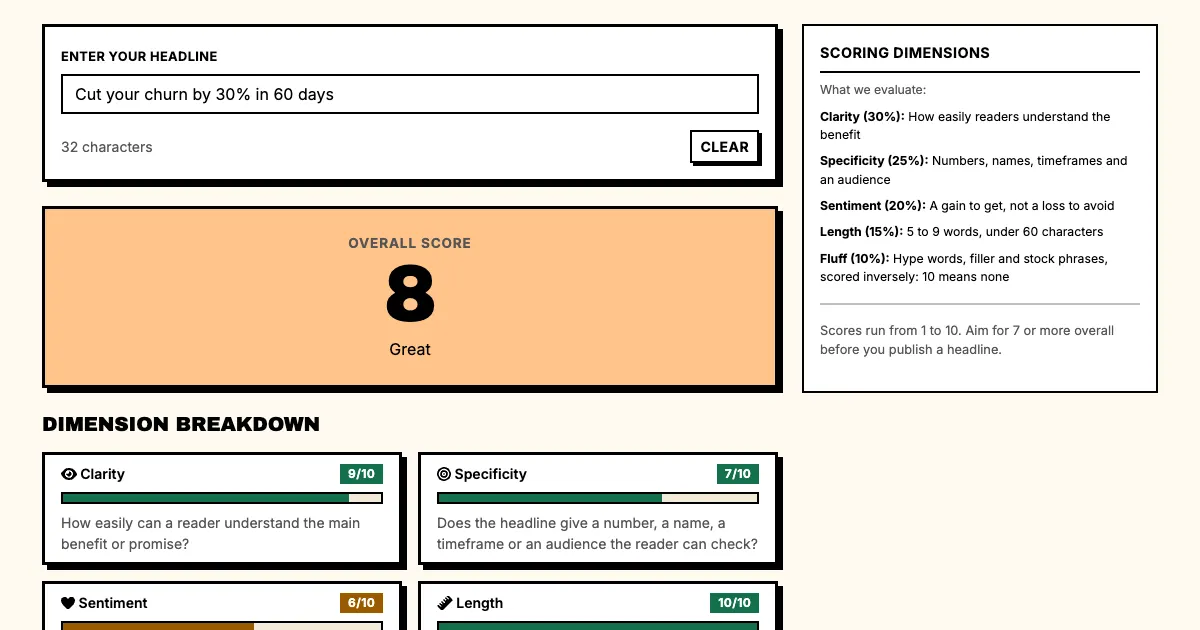
Headline analysis scores a headline on four traits before you rewrite it: clarity, length, specificity and fluff. The scorecard below shows which trait is weak, so you fix the right thing.
Why analyze a headline before rewriting it?
You can't fix a headline until you know what's wrong with it.
Most teams skip that step. They either accept a headline or replace it, and neither teaches them why some headlines work and others don't. Analysis connects your data to the fix: it tells you why you're getting the results you're getting.
What is the headline audit framework?
Score your headline from 1 to 3 on each of four dimensions, for a total out of 12. Punchd's free headline grader runs a similar check automatically and adds sentiment.
Dimension 1: Clarity
Can the reader understand your promise immediately? To test it, read your headline and try to summarize the promise in one sentence.
Scorecard:
- Clear promise: 3 points
- Vague promise: 2 points
- Unclear promise: 1 point
Common clarity problems:
- Using category language instead of benefit language
- Burying the promise in the middle
- Using jargon the audience won't understand
Dimension 2: Length
Can the reader take in the headline at a glance? Count the words.
Scorecard:
- 5 to 9 words: 3 points
- 3 to 4 or 10 to 12 words: 2 points
- Fewer than 3 or more than 12 words: 1 point
Common length problems:
- Two benefits packed into one headline
- A category label with no benefit, which is usually too short
- Qualifiers that add words without adding meaning
Dimension 3: Specificity
Is the outcome quantified or specific? Ask yourself whether you could verify the promise with data.
Scorecard:
- Specific number or outcome: 3 points
- Vague outcome: 2 points
- No outcome stated: 1 point
Common specificity problems:
- Using vague words like "better" or "faster"
- Not including numbers
- Making unverifiable claims
Dimension 4: Fluff
Does every word carry meaning? Count the hype words ("ultimate", "seamless", "game-changing"), filler words ("really", "just") and stock phrases ("take it to the next level").
Scorecard:
- None: 3 points
- One: 2 points
- Two or more: 1 point
Common fluff problems:
- A hype word where a fact the reader could check should be
- Stock phrases readers have seen in so many ads that they skim past them
- Exclamation marks doing the work a benefit should do
What are the headline analysis steps?
Step 1: Score each dimension
Rate your headline on each of the four dimensions. Be honest.
Step 2: Identify the weakest dimension
Your lowest score is the biggest problem, so fix that first.
Step 3: Generate alternatives
Write 5-10 alternatives that address the weakest dimension. Our 15 headline optimization tips give you a fix for each one.
Step 4: Test the alternatives
A/B test your original against your best alternative. Our guide to A/B testing headlines shows how to set up the test and read the result.
Step 5: Track results
Write down what worked and what didn't. Our headline testing strategies show how to run these tests at scale.
What are the common headline problems and their fixes?
Problem: Vague promise
Symptom: "Improve your customer success"
Analysis: Clarity: 1, Length: 2, Specificity: 1, Fluff: 3
Solution: "Cut your churn by 30% in 60 days"
Problem: No emotional trigger
Symptom: "Our analytics platform"
Analysis: Clarity: 2, Length: 2, Specificity: 1, Fluff: 3
Solution: "Know exactly when customers are about to churn"
Problem: Generic language
Symptom: "Powerful, seamless solution"
Analysis: Clarity: 2, Length: 2, Specificity: 1, Fluff: 1
Solution: "Stop losing customers to bad onboarding"
How do you analyze competitor headlines?
Step 1: Identify competitors
List the 3-5 competitors you're compared against.
Step 2: Analyze their headlines
Score their headlines with the same framework.
Step 3: Find the gaps
Where are their headlines weak? That's where you can differentiate.
Step 4: Position against the gaps
Write headlines that address the gaps your competitors leave.
FAQ: Headline analysis
Q: How often should I analyze my headlines?
A: Quarterly for established pages, plus before every major campaign launch and after any significant change in performance.
Q: Should I analyze competitor headlines?
A: Yes. Knowing what works in your category shows you where you can differentiate.
Q: What's the minimum score to publish?
A: Aim for 8/12 or higher. A headline that scores below that likely needs revision before you publish it.
What should you do now?
- Audit your top 5 headlines using the four dimensions.
- Identify the weakest dimension for each.
- Rewrite one headline to address the weakest dimension.
- Test the rewritten headline against your original.
- Track which dimension improvements drive the most impact.
Sources
- Nielsen Norman Group: headings as pickup lines
- Wikipedia: Readability
- Nielsen Norman Group: How Users Read on the Web
Analyze headlines systematically. Use the Headline Grader: score headlines on these four dimensions, plus sentiment, automatically.