SaaS Value Proposition Generator
This value proposition generator turns your audience, problem and outcome into one sentence that says what your product does, for whom, and why it beats the alternatives. Pick a framework below, fill in the blanks and test the result on your landing page.
Lead with the measurable result your product delivers
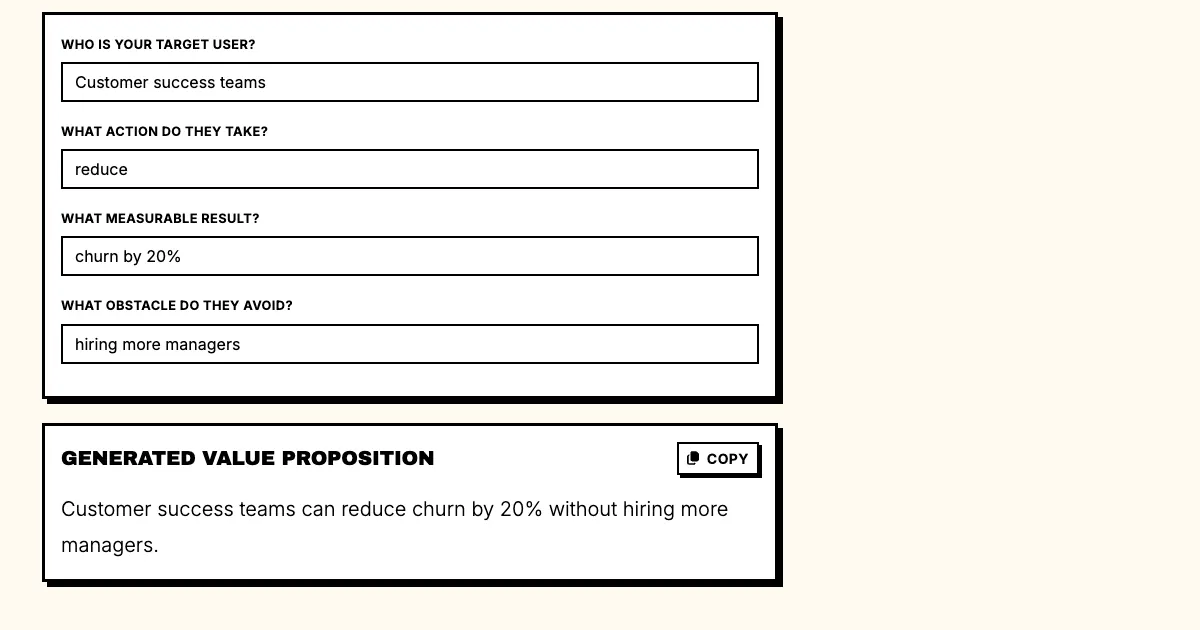
Generated Value Proposition
[AUDIENCE] can [VERB] [OUTCOME] without [CONSTRAINT].
Choose based on your product:
- Outcome-Focused: Measurable results
- Problem-Agitation: Pain-aware audiences
- Job-to-be-Done: Competitive positioning
- Unique Mechanism: Proprietary approach
- Finish-the-Sentence: Exclusivity angle
Fill in the fields to generate your value proposition.
What is a value proposition and how do you write one?
Within seconds of finding your brand, every prospect asks why they should care. The value proposition answers that: it states the specific outcome your product delivers, who it is for and how your approach differs from the alternatives. Whether visitors read on or leave right away depends on it.
The outcome-focused framework suits products with concrete, measurable results. If your product saves time, cuts costs or raises efficiency by an amount you can measure, lead with the number. A specific outcome beats a vague promise: "Reduce churn by 40%" does better than "improve retention" because it leaves nothing open to interpretation.
Problem-agitation copy names the reader's pain before it offers relief. It works on audiences who have the problem your product solves right now. Name the problem precisely and spell out what it costs them, and readers feel it before you introduce your solution. Done well, it makes readers feel understood before they feel sold to.
Job-to-be-done framing starts from the idea that customers hire a product to do a job. It moves the focus from your features to the customer's job, so the value proposition is about the customer instead of the product. When customers compare alternatives, they ask which one does their job best, not which has the most features.
Use the unique mechanism framework when your approach or technology really sets you apart. If your advantage comes from a particular algorithm, process, dataset or method, say so. Not every product suits this framing, but when it fits, it gives you a difference people remember and competitors find hard to copy.
Finish-the-sentence copy lets customers complete the thought in their own words. When readers finish the statement in their head, they take in your implied claim more deeply. "The only" positions you as exclusive, so use this framework only when you really offer something competitors don't.
Pick the framework that matches what your product is actually good at, since each one stresses a different kind of value. Products with strong numbers suit the outcome-focused or finish-the-sentence frameworks. Products that solve an acute pain suit problem-agitation, and products with a proprietary method suit unique mechanism.
Testing several frameworks shows which one works on your audience. Draft a value proposition with each of the five, then A/B test them on your real landing pages. The conversion rates of two framework variations often differ more than those of two entirely different marketing strategies.
Value propositions get better with revision. A first draft rarely finds the best positioning. Test it on real traffic, collect feedback, see which claims get the most engagement and revise. A value proposition is never finished; it changes as your product and market change.
Clear positioning matters more than clever positioning. The best value propositions are simple without being simplistic. Avoid jargon that needs explaining and wordplay that hides the meaning. Someone who knows nothing about your industry should find it clear.
Your value proposition and headlines should work together. When they use the same language and make the same claims, they reinforce each other across the page: visitors meet the same message several times, and the repetition builds conviction. When they don't match, visitors get confused and conversion suffers.
Different channels may call for different frameworks. A paid search landing page might use problem-agitation, because its visitors already know their problem. An organic content page might use job-to-be-done for visitors who are still researching. Choose the framework to fit what the audience on each channel already knows.
Don't claim your product is for everyone. "Best for everyone" positions you nowhere. Naming the audience ("for SaaS teams") makes the copy relevant to them and signals expertise. General claims sound like marketing; specific claims sound like experience. Your value proposition should read like something a satisfied customer would say.
Frequently asked questions
What is a value proposition?
A value proposition is a short statement of the outcome your product delivers, who it is for and why it beats the alternatives. It is the first thing a visitor should read on your landing page.
What is the difference between a value proposition and a tagline?
A tagline is a memorable phrase ("Just do it"). A value proposition is a concrete promise ("Close your books in two days instead of two weeks"). Taglines build brands; value propositions win sign-ups.
Which framework should I start with?
Start with the outcome-focused one. It forces you to name the result and the time it takes, which is what most SaaS buyers compare first.
Can I use the generated sentence as my headline?
Yes, as a first draft. Test it against two or three variations on your landing page before you settle.
Related reading
- Value proposition headlines
- Benefit vs feature headlines
- 20 SaaS landing page headline teardowns
- CTA Copy Generator
Sources
- Wikipedia: Value proposition
- Harvard Business School Online: how to create a value proposition
- Wikipedia: Unique selling proposition
Written by Punchd Team: Growth and content marketers who have run copy and conversion work at SaaS companies from seed stage to Series C. We built Punchd for that work. Last updated 2026-10-16.