Headline Analyzer and Grader
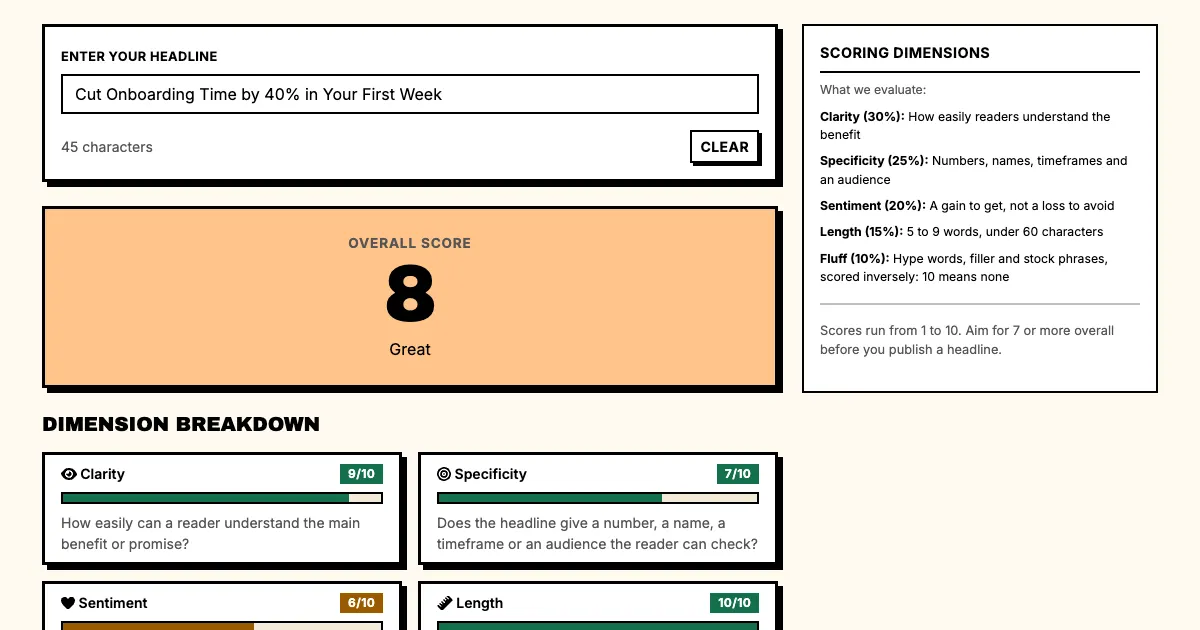
This headline analyzer scores a headline by the rules Punchd's generator writes by: clarity, specificity, sentiment, length and fluff. Numbers, names, timeframes and a named audience earn points; hype words, stock phrases, dashes and exclamation marks cost them. Paste a headline below and you get a score from 1 to 10 for each trait and one overall grade, free and without signing up.
Dimension Breakdown
What we evaluate:
- Clarity (30%): How easily readers understand the benefit
- Specificity (25%): Numbers, names, timeframes and an audience
- Sentiment (20%): A gain to get, not a loss to avoid
- Length (15%): 5 to 9 words, under 60 characters
- Fluff (10%): Hype words, filler and stock phrases, scored inversely: 10 means none
Scores run from 1 to 10. Aim for 7 or more overall before you publish a headline.
How does headline grading work?
The scores give you a benchmark, but they help most when you look at why a headline got them. Each dimension points to its own fix: a headline with good length and no specifics needs different work than one whose benefit is buried under hype words.
Clarity comes first. If readers can't see the benefit or promise right away, they move on, and the other dimensions never get a chance to work. Clear headlines use concrete words, specific numbers where they fit, and a direct statement of the benefit. Skip wordplay the reader has to decode. Each piece of fluff the grader finds also costs two clarity points, because it fills the space where a fact the reader could picture should be. A good headline gets its value across in under three seconds.
Specificity counts what a reader could check. The grader looks for four things: a number, a name such as a product or a tool the reader knows, a timeframe such as "in 10 minutes" or "before you leave the job site", and an audience such as "for plumbers". Each one adds two points. Compare "Grow Your Business Faster" with "Send the Invoice Before You Leave the Job Site". Any company could put its name on the first; the second shows one moment in one customer's day. Names are easiest to spot in sentence case. In a Title Case headline every word starts with a capital, so the grader only counts names with a capital inside them, such as HubSpot.
Use only numbers and names you can back up. The grader can't tell a real figure from an invented one, but your readers often can, and one invented claim makes them doubt the rest of the page.
Sentiment checks whether the headline promises something the reader gets or warns about something to avoid. Words like "save", "find" and "get" frame a gain; "stop", "don't" and "mistake" frame a loss. Fear of loss works for some audiences, but a headline that says what to do usually beats one that says what not to do.
Length counts words. Five to nine words usually works: enough for one benefit, short enough to take in at a glance. Under five words costs more than over nine, because a very short headline rarely has room for a benefit. A headline over 60 characters loses two more points, because Google cuts title links off around there and the part that is cut may be the message.
Fluff is scored the other way round: 10 means the grader found none, and each thing it finds costs three points. It looks for hype words such as "unlock", "ultimate", "game-changing", "secret" and "revolutionary"; filler words such as "really", "very" and "just"; stock phrases such as "take it to the next level" and "say goodbye to"; contrast reveals such as "It's not X, it's Y" or "Stop X. Start Y."; and em dashes, spaced hyphens and exclamation marks. Readers have seen these in so many ads that they skim past them. Replace each one with the fact it stands for. Punchd's generator follows the same list when it writes your headlines.
The weighted average matters more than any single dimension. Clarity carries 30% of the weight because the other dimensions depend on it, so a headline that does well elsewhere but is hard to understand still scores poorly overall. Work on all the dimensions, starting with clarity.
No real headline scores perfectly on every dimension. Find the one that holds your headline back most and work on that: a vague headline needs a number, a name or an audience, a hyped one needs its hype words swapped for facts, and one that gets cut off needs trimming.
Testing shows which dimensions your audience responds to. Software audiences react differently from healthcare audiences, and B2B buyers judge differently from consumers. Compare versions to find out which dimensions matter most for your conversion goals.
The overall score is a quick reference. Two headlines with the same overall score can need completely different fixes, so check the score for each dimension before you decide what to change.
Grading works best in rounds. Write a draft without worrying about the score, then grade it. Find the lowest-scoring dimension, revise for that one and grade again. Repeat until every dimension scores acceptably. Revising this way gets better results than changing things at random.
Read the scores in context. A 12-word headline scores lower on length but can work well on LinkedIn. A headline with neutral sentiment is fine for educational content. Treat the scores as a guide, and set your length target by the channel where the headline will mostly appear.
Some score patterns come up often. Low clarity together with a low fluff score usually means hype words have taken the place of the benefit. High clarity with low specificity means the headline is clear but could sit on any competitor's page. Knowing these patterns makes each round of revision faster.
The grader can't catch everything. Lines that sound wise but say nothing, such as "Speed Is a Feature", and clever pairings that hide the meaning, such as "Your Inbox, Minus the Noise", can still score well here. Read for those yourself.
No single score is the final word. A headline that scores 6/10 and connects with your audience will beat a 9/10 headline that feels forced. The scores tell you which way to revise, and your audience's actual response decides what works. Grade to guide your revisions, then confirm with real performance data.
Frequently asked questions
What is a headline grader?
A headline grader is a tool that scores a headline on the traits linked to clicks and conversions. This one scores clarity, specificity, sentiment, length and fluff from 1 to 10 and combines them into one weighted grade.
What is a good headline score?
Aim for 7 or higher overall. A score of 4 to 6 means one trait is holding the headline back; look at the dimension breakdown to see which one.
Why does clarity count for 30 percent?
A reader has to understand the promise in under three seconds. A headline that is punchy but unclear loses the reader before any other trait can work.
Why do power words lower my score?
Words like "unlock", "ultimate", "secret" and "game-changing" turn up in so many ads that readers skim past them, and each one takes the place of a fact they could check. The grader takes points off for them and gives points for numbers, names, timeframes and a named audience instead. Punchd's paid generator follows the same rules.
Is the headline grader free?
Yes. It runs in your browser, needs no account and keeps no copy of what you type.
Related reading
- How to write SaaS headlines
- 50 SaaS headline examples ranked by conversion potential
- Headline analyzer tools compared
- Power Word Checker
Sources
- Nielsen Norman Group: How Users Read on the Web
- Google Search Central: title links
- Wikipedia: Headline
Written by Punchd Team: Growth and content marketers who have run copy and conversion work at SaaS companies from seed stage to Series C. We built Punchd for that work. Last updated 2026-10-16.