Email Subject Line Tester
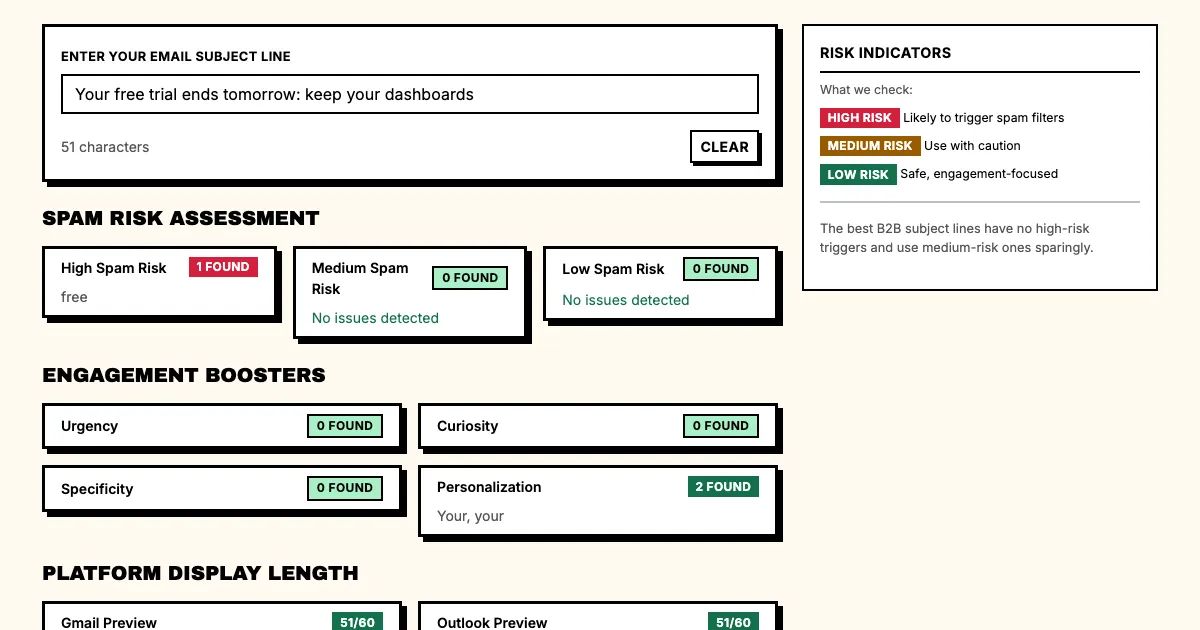
This email subject line tester flags spam risks, finds the words that lift opens and shows how a subject line fits the inbox of each email client. A good subject line is short, specific and free of spam triggers, so paste yours below and check it before you send.
What we check:
- High Risk Likely to trigger spam filters
- Medium Risk Use with caution
- Low Risk Safe, engagement-focused
The best B2B subject lines have no high-risk triggers and use medium-risk ones sparingly.
What makes an email subject line get opened?
The subject line decides whether your email gets opened or ignored. In the inbox it competes with dozens of others for a moment of attention. Email marketers who get results know what drives opens, what trips spam filters and what affects deliverability; the rest wonder why their campaigns underperform.
Spam filters check subject lines with pattern matching and machine learning. They learn from huge sets of reported spam and pick out the patterns that go with unwanted mail. Words like "free," "act now" and "guaranteed" show up in that training data next to real spam, so they hurt deliverability even in a legitimate email. Knowing which patterns are risky lets you convey urgency without setting off the filters.
How you treat a pattern depends on whether it is high, medium or low risk. High-risk triggers almost never appear in legitimate B2B email; if you are reaching for one, rethink the subject line. Medium-risk triggers are fine when they really fit and the rest of the line gives them context. Low-risk triggers point to a useful action and carry no spam association.
Engagement boosters raise open rates when they are honest. Urgency words work best when there is a real deadline or time limit, and false urgency damages trust faster than no urgency at all. Curiosity triggers open a gap in what the reader knows, and the reader wants to close it. Specific details add credibility: numbers and concrete facts suggest real content instead of generic promotion.
Personalization helps only when it is relevant. Using "your" or "you" in a way that feels mass-produced often backfires, and generic tokens like "First Name" read as fake to most recipients today. Personalization based on what the reader actually did or who they are ("Your Q4 report is ready") does better than a name token.
Length limits differ by email client and device. Gmail shows about 60 characters in the desktop preview and fewer on mobile. Outlook cuts off at around 55 to 60 characters, Apple Mail shows a little more at 65, and Yahoo shows the least, around 50. Aim for the strictest limit, and make sure a cut-off version still gets the main message across.
Going through the line word by word shows where the risks and openings are. Each word either adds to your message, adds noise or raises spam risk. The best subject lines state one clear value proposition in plain language within the character limit. Wordplay the reader has to decode slows them down, and in a fast-scrolling inbox that costs opens.
A/B tests of subject line variations show what works on your audience. B2B SaaS audiences respond differently from consumers, and each industry has its own conventions and expectations. Wait for statistically significant results before you draw conclusions; small samples give misleading results and lead to bad decisions.
Preview text works together with the subject line. Most email clients show both, which gives you more room to show the value. A strong subject line with preview text that adds to it does far better than either one alone, so write them together and judge the whole inbox preview the reader sees.
Deliverability depends on more than the subject line. Sender reputation, list hygiene, engagement history and content quality all affect whether your email reaches the inbox or lands in spam, and a perfect subject line still fails when your sender score is damaged. Keep your lists clean, send honestly and keep engagement steady to protect deliverability over time.
Rendering varies a lot between email clients. A subject line that looks clean in Gmail may be cut off badly in Outlook or display oddly in Apple Mail. Preview the final subject line in each client before sending, using one of the tools built for email preview testing.
Over the long run, the email has to live up to its subject line. Clickbait that overpromises gets opens but damages trust when the content doesn't match. Email marketing that lasts builds a reputation by keeping the subject line's promise every time. Chasing short-term open rates at the cost of trust damages deliverability in the long term.
Watch deliverability metrics as well as engagement metrics. Open, click and conversion rates all matter, but also track where your emails land. Spam folder, bulk folder and inbox placement rates show whether technical deliverability problems are undoing the work you put into your subject lines.
Frequently asked questions
What makes an email subject line get flagged as spam?
Words and patterns that spam filters and readers associate with junk: "free money", "act now", all capitals, many exclamation marks and dollar signs. The analyzer lists each trigger it finds.
How long should a subject line be?
40 to 60 characters. Gmail and Outlook show about 60 in the inbox and Yahoo Mail about 50, so a longer line is cut off on phones.
Do questions in subject lines get more opens?
Often, yes. A specific question makes the reader want the answer. A vague question ("Ready?") does not.
Is the analyzer a deliverability test?
No. It checks the words of the subject line only. Deliverability also depends on your sender reputation, authentication and list quality.
Related reading
- How to write email subject lines
- Onboarding email headlines that drive activation
- When to use question headlines
- Headline Length Checker
Sources
- Google: email sender guidelines for reaching Gmail inboxes
- Wikipedia: Email marketing
- Nielsen Norman Group: writing headlines, page titles and subject lines
Written by Punchd Team: Growth and content marketers who have run copy and conversion work at SaaS companies from seed stage to Series C. We built Punchd for that work. Last updated 2026-10-16.