A headline formula is a template with blanks, such as "Get [outcome] in [timeframe] without [pain]", that produces a working headline in minutes. The 30 formulas below are sorted by funnel stage.
Why do headline formulas matter?
Headline writing is a skill that improves with structure. Most writers treat every headline as a blank page: they stare at the cursor, write something vague and move on.
Experienced copywriters use formulas. A formula gives you a starting point, forces you to be specific, and saves you from the paralysis of infinite choice. Most are filled-in versions of broader copywriting frameworks, such as problem-awareness or transformation.
The 30 formulas in this guide are organized by marketing funnel stage. Awareness-stage headlines attract attention, consideration-stage headlines build trust, and decision-stage headlines drive action. Each formula comes with its structure, an example and a note on when it works best.
Which headline formulas work at the awareness stage?
Awareness headlines interrupt scrolling. The reader recognizes their own situation and feels seen.
Formula 1: Problem interruption
Structure: "[Problem] is killing your [outcome]"
Example: "Poor onboarding is killing your retention"
When it works: When your target audience already knows they have the problem. The headline validates their frustration.
Formula 2: Curiosity gap
Structure: "The real reason [common phenomenon] isn't working"
Example: "The real reason your A/B tests aren't conclusive"
When it works: Only when you actually have the answer the headline promises.
Formula 3: Numbered list
Structure: "[Number] ways to [desired outcome]"
Example: "7 ways to reduce churn in the first 30 days"
When it works: When the number is specific and the outcome is clear. Vague numbers ("5 things") don't create urgency.
Formula 4: Comparison hook
Structure: "[Conventional approach] is broken. Here's what works."
Example: "OKRs are broken. Here's what actually drives alignment."
When it works: When you're challenging a widely held assumption in your category. The stronger the conventional wisdom you're challenging, the better it works.
Formula 5: Question recognition
Structure: "Are you making these [category] mistakes?"
Example: "Are you making these onboarding mistakes?"
When it works: When the mistakes are specific and recognizable. Generic mistakes don't produce the "that's me" moment.
Formula 6: Specific outcome
Structure: "How to get [specific result] in [timeframe]"
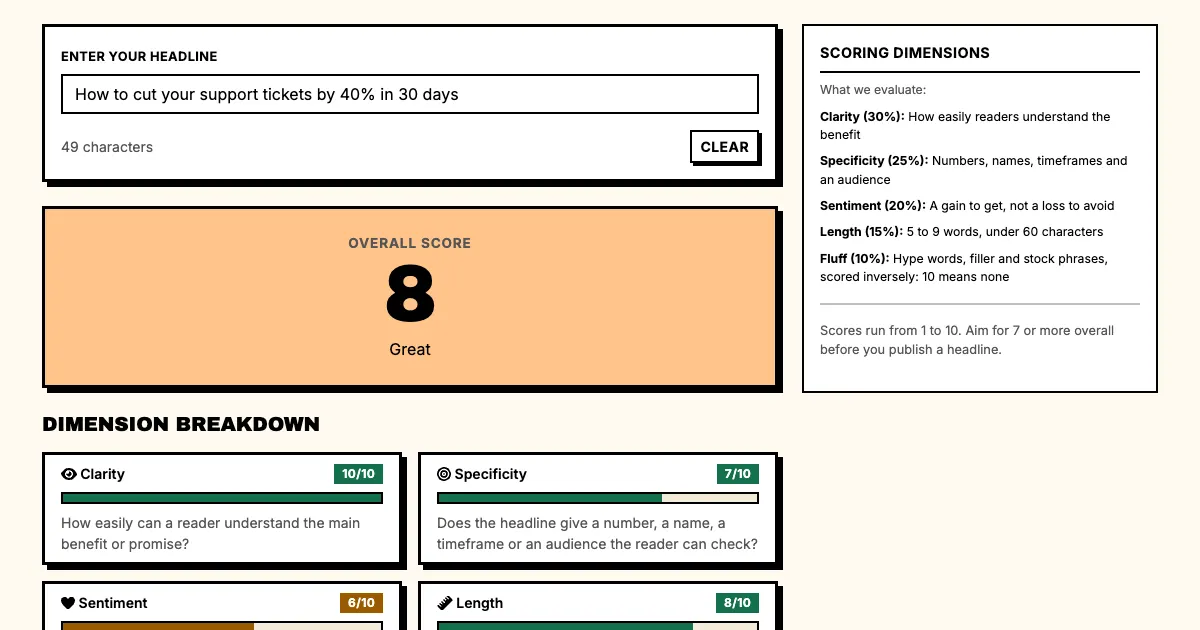
Example: "How to cut your support tickets by 40% in 30 days"
When it works: When the result and the timeframe are both specific and believable, since specificity is what builds credibility.
Formula 7: Contrast framing
Structure: "Why your [current state] isn't working (and what to do instead)"
Example: "Why your content calendar isn't working (and what to do instead)"
When it works: When the "instead" part offers a really different approach. Vague alternatives don't get clicks.
Formula 8: Identity hook
Structure: "For [specific role] who [specific challenge]"
Example: "For product managers who can't get engineers to prioritize"
When it works: When the challenge is specific enough that only your target audience recognizes it. "For product managers who struggle" is too vague. "For product managers who can't get engineers to prioritize" is precise.
Formula 9: Warning signal
Structure: "The [metric] mistake that's costing you [specific outcome]"
Example: "The pricing page mistake that's costing you 30% of signups"
When it works: When you can name the specific mistake and the specific cost. Vague warnings make readers skeptical.
Formula 10: Trend acknowledgment
Structure: "How [trend] is changing [industry] (and what to do about it)"
Example: "How AI is changing SaaS support (and what to do about it)"
When it works: When the trend is current and the advice is actionable. Expect trend-driven headlines to date quickly.
Which headline formulas work at the consideration stage?
Consideration headlines build trust: they show expertise and make the reader believe you're the solution.
Formula 11: Framework introduction
Structure: "The [number]-step [framework name] for [desired outcome]"
Example: "The 4-step retention framework for SaaS startups"
When it works: When the framework is named and memorable, which gives the reader something to share and remember.
Formula 12: Case study preview
Structure: "How [company type] achieved [specific result] using [approach]"
Example: "How a 10-person startup achieved 200% ARR growth using content"
When it works: When the company type is recognizable and the result is specific. "A startup grew" is forgettable. "A 10-person startup grew 200%" is notable.
Formula 13: Expert insight
Structure: "[Expert name]: The biggest [category] mistake I see"
Example: "Intercom's head of support: The biggest onboarding mistake I see"
When it works: When the expert is credible and the insight is specific. Generic expert quotes ("I see companies struggle with...") don't build trust.
Formula 14: Myth busting
Structure: "The [category] myth that costs you [specific metric]"
Example: "The personalization myth that costs you conversions"
When it works: When the myth is widely believed and the cost is specific. It gives the reader a moment of revelation.
Formula 15: Process transparency
Structure: "How we [achieved outcome], and what it cost us"
Example: "How we reduced churn by 25%, and what it cost us"
When it works: When you're willing to share the tradeoffs. Buyers who see the real cost appreciate the honesty, and that transparency builds trust.
Formula 16: Mechanism explanation
Structure: "The [specific mechanism] behind [common outcome]"
Example: "The recency effect behind customer churn"
When it works: When the mechanism is surprising or counterintuitive. It suits buyers who want to understand the "why" behind best practices.
Formula 17: Outcome stacking
Structure: "Not just [benefit 1]: [benefit 2] and [benefit 3]"
Example: "Not just analytics: insights, alerts, and automated actions"
When it works: When your product delivers several benefits that aren't commonly combined. It expands the perceived value.
Formula 18: Constraint reframe
Structure: "Why [common constraint] isn't actually a problem"
Example: "Why your team size isn't actually a scaling problem"
When it works: When you can reframe a widely held belief that's holding your audience back, and you have evidence for the reframe.
Formula 19: Pattern recognition
Structure: "The [category] pattern I see in [specific group]"
Example: "The pricing pattern I see in failing SaaS companies"
When it works: When the pattern is specific and the group is recognizable. These headlines appeal to buyers who want to learn from other people's mistakes.
Formula 20: Resource catalog
Structure: "[Number] [category] templates to [desired outcome]"
Example: "12 onboarding email templates to reduce churn"
When it works: When the resources are tangible and the outcome is clear. The headline promises immediate value.
Which headline formulas work at the decision stage?
Decision headlines drive action by creating urgency and reducing friction.
Formula 21: Direct solution
Structure: "[Problem] ends here"
Example: "Your onboarding problems end here"
When it works: When your solution actually solves a specific problem. The headline is a commitment, so use it only when you can defend the claim.
Formula 22: Transformation promise
Structure: "Turn [problem state] into [outcome state]"
Example: "Turn support chaos into customer loyalty"
When it works: When the transformation is dramatic and specific. Vague transformations ("turn problems into success") don't get clicks.
Formula 23: Constraint removal
Structure: "Get [desired outcome] without [common obstacle]"
Example: "Get real-time analytics without a data team"
When it works: When the obstacle is real and the alternative is painful. It answers the biggest objections to adoption.
Formula 24: Social proof anchor
Structure: "Used by [specific companies] to [specific outcome]"
Example: "Used by Stripe, Notion, and Figma to onboard thousands of users"
When it works: When the companies are recognizable and the outcome is specific. Named companies are social proof, and named companies with specific outcomes are stronger still.
Formula 25: Time-bound offer
Structure: "[Outcome] before [specific deadline]"
Example: "Cut churn by 20% before your next renewal"
When it works: When the deadline is real and the outcome is specific. False urgency destroys trust.
Formula 26: Guarantee statement
Structure: "[Desired outcome], or your money back"
Example: "Reduce support tickets by 30%, or your money back"
When it works: When you're confident enough in your product to offer a guarantee. It has to be credible and easy to claim.
Formula 27: Comparison winner
Structure: "Stop [alternative] and start [better approach]"
Example: "Stop guessing and start testing"
When it works: When the alternative is clearly inferior and the better approach is specific. It sets up a clear before/after.
Formula 28: Qualification signal
Structure: "The [tool] for [specific audience] who [specific goal]"
Example: "The analytics tool for product teams who can't wait for engineering"
When it works: When the audience and goal are specific enough that the right buyers recognize themselves, which is what makes the headline relevant to them.
Formula 29: Feature-benefit link
Structure: "[Feature] means [specific benefit]"
Example: "Automated workflows mean your team spends time on hard problems"
When it works: When the benefit is specific and meaningful. "Saves time" is vague. "Your team spends time on hard problems" is specific.
Formula 30: Next step clarity
Structure: "Try [product] free for [timeframe]. No credit card required."
Example: "Try our onboarding tool free for 14 days. No credit card required."
When it works: When the trial is real and the friction is gone. It removes the two biggest objections to trying your product.
FAQ: Headline formulas
Q: How do I know which formula to use?
A: Match the formula to the funnel stage: awareness-stage buyers need recognition, consideration-stage buyers need trust, and decision-stage buyers need urgency and less friction.
Q: Can I combine formulas?
A: Yes. The best headlines often combine two or three formula elements, as long as each element supports the same core promise. Formulas that send mixed signals don't belong in one headline.
Q: How do I test which formula works best?
A: Write headlines with three different formulas for the same page, then run an A/B test or show them to five people in your target audience. Watch which headline creates the most recognition and urgency.
Q: What if none of these formulas fit my product?
A: Study your buyers: what problem they're trying to solve and what language they use for it. Build your own formula from their words; the best formulas are often reverse-engineered from buyer language.
What should you do now?
- Pick one of your key landing pages.
- Write headlines using three different formulas from this guide.
- Show each headline to five people in your target audience.
- Ask: "Does this make you want to learn more?"
- Keep the headline that creates the most recognition and urgency.
A formula only gets you a starting point, so keep refining until the headline feels inevitable. For more templates and free tools, see our collection of copywriting resources.
Sources
Generate headline variations from these formulas. Punchd's AI headline generator writes 20 headlines per punch.