Power Word Checker
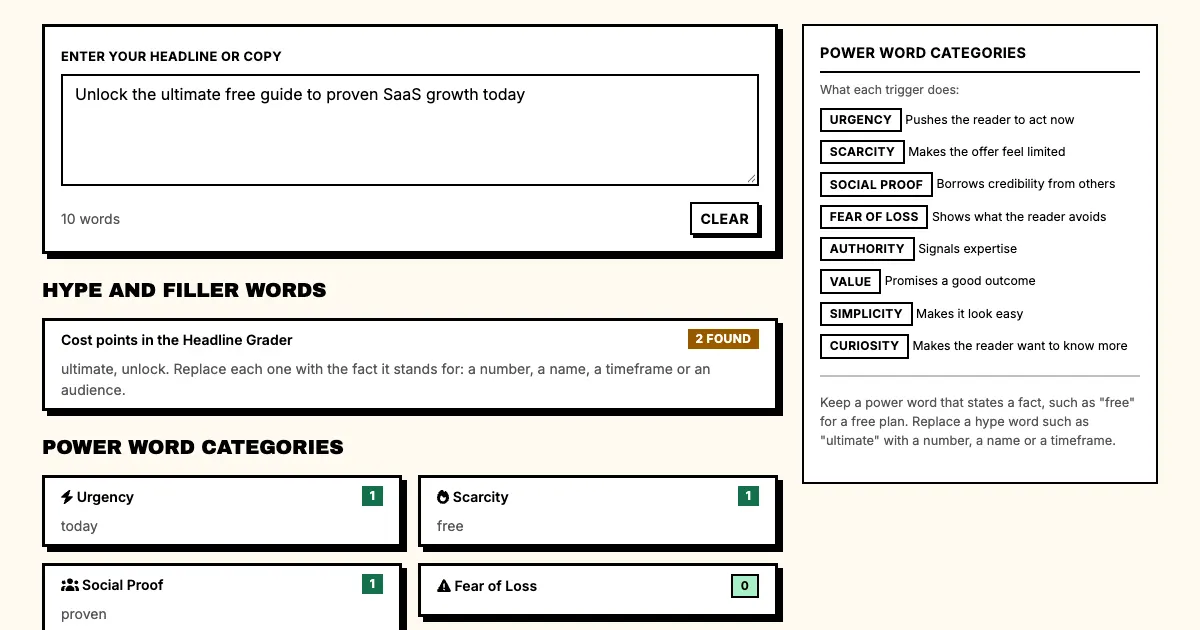
This power word checker lists every word in your copy that triggers an emotion or a decision, such as "free", "proven" or "now", grouped by the trigger it pulls. Paste a headline or a paragraph below to see them. It also flags the hype and filler words, such as "unlock" and "ultimate", that the Headline Grader takes points off for.
Power Word Categories
What each trigger does:
- Urgency Pushes the reader to act now
- Scarcity Makes the offer feel limited
- Social Proof Borrows credibility from others
- Fear of Loss Shows what the reader avoids
- Authority Signals expertise
- Value Promises a good outcome
- Simplicity Makes it look easy
- Curiosity Makes the reader want to know more
Keep a power word that states a fact, such as "free" for a free plan. Replace a hype word such as "ultimate" with a number, a name or a timeframe.
What are power words, and when do they help?
Power words are words that pull a psychological trigger: urgency, scarcity, social proof, fear of loss, authority, value, simplicity or curiosity. Copywriters have leaned on them for decades, and readers have now seen the common ones in so many ads that they skim past them. A word like "ultimate" or "secret" marks the line as an ad and fills the space where a fact could have gone.
This checker sorts the power words in your copy by the trigger they pull and flags the hype and filler words separately. That second list is the one Punchd's Headline Grader takes points off for, and Punchd's paid generator is told to avoid the same kind of words when it writes your headlines.
A power word that states a fact can stay. "Free" is fine when the plan is free, "today" when the offer ends today, and "proven" when the proof sits next to it. Each of these gives the reader something to check. Hype words such as "unlock", "ultimate", "revolutionary" and "game-changing" could describe any product, so readers discount them.
Urgency words such as "now", "today" and "deadline" work when the deadline is real. A countdown that resets or a "limited time" offer that never ends costs more trust than it earns. If there is a date, give the date.
Scarcity is about access: "members only", "invite only", "limited". Say what is limited and by how much: "50 seats" tells the reader more than "exclusive", which the grader counts as hype.
"Proven", "trusted" and "verified" are social proof: they claim that other people have checked your product. Skeptical B2B buyers believe them only with the evidence beside them, such as a customer count, a named customer or a review score.
Fear of loss words such as "stop", "avoid" and "no more" name a problem the reader already has. They land with people who feel that problem, but a headline that says what to do usually beats one that says what not to do, and the grader's sentiment score reflects that.
For authority, "expert", "certified" and "official" signal competence when they are true. "Industry-leading" and "world-class" are the hollow versions: every company claims them, so the grader counts them as hype. Name the certification or the customers instead.
Value words such as "free", "save" and "included" promise a gain the reader can check. "Unlock", "ultimate" and "powerful" promise a gain without saying what it is, and the grader takes points off for them.
Simplicity words such as "easy", "one-click" and "no code" make trying the product look like less work. They hold up when the product does remove the work. "Effortless" and "seamless" make the same promise with nothing behind it, while "set up in 10 minutes" gives the reader a number to check.
Curiosity words such as "secret", "hidden" and "what nobody tells you" hold back part of the message so the reader clicks for the rest. On a landing page the gap usually works against you, because a reader who leaves never learns the benefit. The grader counts "secret" and "revealed" as hype.
Compare "Stop Wasting Time: The Secret Way Experts Get Results in One Click" with "Send Invoices From the Job Site in 2 Minutes". The first stacks five triggers and says nothing a reader could check. The second names one task and how long it takes.
Paste your headline and read the hype and filler list first. Replace each word on it with the fact it stands for: a number, a name, a timeframe or an audience. Then read the categories. Keep a power word that states something true and checkable, cut one you can't explain for this product, and run the result through the Headline Grader.
Frequently asked questions
What is a power word?
A power word is a word that pulls a psychological trigger, such as urgency ("now"), scarcity ("limited"), social proof ("trusted") or fear of loss ("mistake"). Readers have seen the common ones in so many ads that many now skim past them.
How many power words should a headline have?
Only the ones that state a fact the reader can check, which is rarely more than one or two. "Free" on a free plan is a fact. "Ultimate", "unlock" and "game-changing" are hype, and the Headline Grader takes points off for each one.
Which power words count as hype?
The ones that could describe any product, such as "unlock", "ultimate", "secret", "seamless" and "game-changing". The checker flags every hype and filler word on the Headline Grader's list, about 50 in all, so you can replace them before you grade the headline.
Do power words work in B2B copy?
The ones that state a fact do. B2B buyers check claims, so "proven" needs the proof beside it and "in minutes" has to be true. Hype words such as "amazing" or "revolutionary" give them nothing to check.
Which power word categories does the checker know?
Eight: urgency, scarcity, social proof, fear of loss, authority, value, simplicity and curiosity. It also lists the hype and filler words the Headline Grader takes points off for.
Related reading
- Power words: the triggers that drive conversions
- Emotional headlines in B2B copy
- Copy psychology fundamentals
- Headline Grader
Sources
Written by Punchd Team: Growth and content marketers who have run copy and conversion work at SaaS companies from seed stage to Series C. We built Punchd for that work. Last updated 2026-10-16.