A power word is a word that pulls a psychological trigger, such as "free", "today" or "proven". Keep it when it states something the reader can check. When it only adds excitement, as "exclusive", "unlock" and "ultimate" do, replace it with a number, a name, a timeframe or an audience.
What makes a word powerful?
A power word makes the reader feel something, often urgency, where a plain word only describes. "Download this guide" describes; "grab this before it's gone" adds pressure. The same pull drives emotional headlines, where the whole line is built around one feeling.
That pressure works only when it is true. Readers have seen "exclusive", "secret" and "game-changing" in so many ads that they skim past them, and each one fills the space where a fact could have gone. Punchd's Headline Grader takes points off for these hype words, and Punchd's generator is told to avoid the same kind of words.
A power word earns its place when the reader could check it: "free" on a free plan, "today" on an offer that ends today, "proven" with the proof beside it. If you can't say which fact a word stands for, cut it and write the fact.
Below are 35 power words grouped by psychological trigger, each with where it works and where it backfires. Three of them, "exclusive", "unlock" and "effortless", are on the grader's hype list, and their entries say what to write instead.
Which words trigger urgency?
Urgency words make the reader feel that waiting has a cost. They hold up only when the cost is real, so give the date when there is one.
Now: Signals immediacy. Use it when you want the reader to act today.
Example: "Get your headlines analyzed now"
Works best for: Time-sensitive offers, limited availability, breaking changes.
Backfires when: There's no real time constraint. False urgency destroys trust.
Today: Like "now", but tied to the day.
Example: "Start writing better headlines today"
Works best for: Onboarding sequences, welcome campaigns, first-week engagement.
Backfires when: The offer doesn't have a real deadline.
Instant: Promises speed without friction.
Example: "Get instant feedback on your headlines"
Works best for: Tools, automation, real-time features.
Backfires when: Your product takes time. If delivery is slow, "instant" works against you.
Immediately: Creates urgency through time pressure.
Example: "Your account was upgraded immediately"
Works best for: Confirmation emails, support responses, service updates.
Backfires when: It's used in marketing copy and delivery isn't immediate.
Fast: Plain speed language.
Example: "Fast payroll for teams under 50"
Works best for: Speed claims you can put a number on.
Backfires when: Speed doesn't set you apart in your category, or you can't say how fast. "Set up in 10 minutes" tells the reader more than "fast".
Quick: Casual urgency.
Example: "Get a quick win with your next campaign"
Works best for: Starter guides, first-action sequences.
Backfires when: The task isn't quick.
Which words trigger scarcity?
Scarcity words tell the reader that supply is limited, which creates FOMO. Say what is limited and by how much: "50 seats" tells the reader more than any scarcity word.
Exclusive: Signals that something is reserved for a specific group. The Headline Grader counts it as hype, because nearly every newsletter and webinar calls itself exclusive.
Example: "Exclusive insights for SaaS founders"
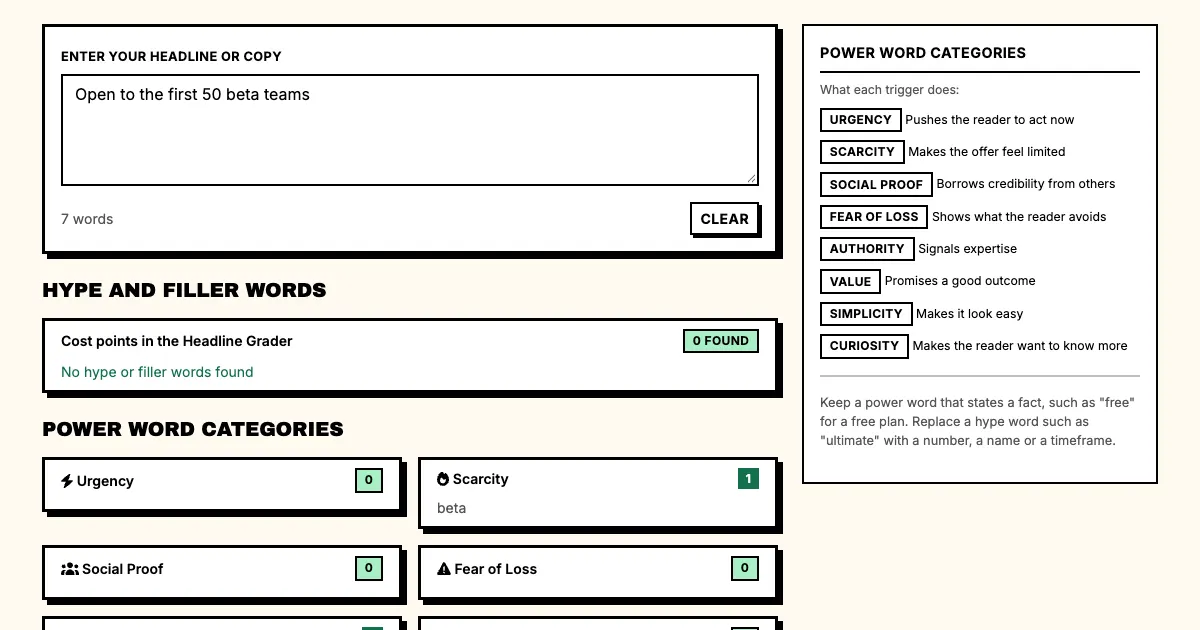
Write instead: Who gets access and how many. "Open to the first 50 beta teams" says what "exclusive" only hints at.
Limited: A clear limit on availability.
Example: "Limited to 20 seats per workshop"
Works best for: Events, cohort-based programs, beta access.
Backfires when: The "limited" offer never runs out.
Only: Creates singular focus.
Example: "The only headline tool with built-in A/B testing"
Works best for: Competitive positioning, feature differentiation.
Backfires when: Other products have the same feature. "Only" is a superlative, so check your competitors before you write it.
Free: Zero-cost language.
Example: "Start your free trial today"
Works best for: Freemium products, trial offers.
Backfires when: "Free" hides a costly upgrade path. Say on your SaaS pricing page exactly what "free" includes.
Rare: Implies uniqueness.
Example: "A rare look at our conversion data"
Works best for: Research reports, behind-the-scenes content.
Backfires when: The "rare" access is easy to get.
Which words trigger social proof?
Social proof words borrow credibility from what other people do. In landing page headlines, keep the number or customer name that backs them up in the same view.
Proven: Signals that something works.
Example: "Proven headline formulas for SaaS"
Works best for: Frameworks, methodologies, results-based claims.
Backfires when: The proof isn't visible. Without evidence, "proven" is only a claim.
Tested: Like "proven", but it points to a process.
Example: "Headline formulas tested on 200 landing pages"
Works best for: Enterprise positioning, security-conscious buyers.
Backfires when: You can't say what was tested or how. "Battle-tested" with nothing behind it reads as hype.
Trusted: Implies peer validation.
Example: "Trusted by 10,000+ marketing teams"
Works best for: Scale-focused positioning, social proof moments.
Backfires when: The number or named companies don't support the claim.
Results: Outcome-focused language.
Example: "Results from 300 headline A/B tests"
Works best for: Performance positioning, outcome-focused buyers.
Backfires when: You don't put numbers on the results. "Headlines that deliver results" could describe any tool.
Verified: Signals authenticity.
Example: "Verified conversion rates"
Works best for: Data-driven claims, audit trails.
Backfires when: You don't explain the verification.
Which words trigger fear of loss?
Fear-of-loss copy flips the usual benefit pitch and tells readers what they will avoid or escape. It lands with readers who already feel the problem. A headline that says what to do usually beats one that says what not to do, and the Headline Grader's sentiment score takes points off for "stop" and "avoid".
Stop: Creates a moment of recognition.
Example: "Stop writing boring headlines"
Works best for: Readers who already know they have the problem.
Backfires when: Vague advice follows it, or it sets up a "Stop X. Start Y." line, which the grader flags as a stock contrast.
Avoid: Promises prevention.
Example: "Avoid the headline mistakes that kill clicks"
Works best for: Educational content, warning-oriented copy.
Backfires when: The mistakes aren't specific enough to feel real.
Prevent: Like "avoid", with more agency.
Example: "Prevent churn before it happens"
Works best for: Proactive positioning, risk-averse buyers.
Backfires when: The prevention mechanism isn't clear.
Escape: Implies breaking free from something.
Example: "Escape the endless cycle of bad headlines"
Works best for: Frustrated audience positioning.
Backfires when: The escape route isn't clear.
Eliminate: Signals complete removal.
Example: "Eliminate your copywriting bottlenecks"
Works best for: Efficiency positioning, pain-point-driven buyers.
Backfires when: The bottlenecks don't go away.
Which words trigger authority?
Authority words build credibility by signaling expertise. Name the certification, the customer or the credential behind them. "Industry-leading" and "world-class" are the hollow versions: every company claims them, so the grader counts them as hype.
Expert: Signals deep knowledge.
Example: "Expert-level headline analysis"
Works best for: Premium positioning, advanced content.
Backfires when: The rest of the copy doesn't demonstrate the expertise.
Professional: Signals quality and reliability.
Example: "Professional-grade headline templates"
Works best for: Enterprise positioning, B2B buyers.
Backfires when: The "professional" quality isn't visible.
Certified: Signals formal validation.
Example: "Certified conversion specialists"
Works best for: Service positioning, training programs.
Backfires when: Nobody recognizes the certification.
Official: Signals authority and authenticity.
Example: "The official guide to headline writing"
Works best for: Definitive content, educational resources.
Backfires when: The "official" status isn't credible.
First: Signals leadership.
Example: "The first AI-powered headline grader"
Works best for: Innovation positioning.
Backfires when: You can't defend the claim.
Which words trigger value?
Value words name the outcome the reader gets instead of the feature.
Free: Zero-cost language.
Example: "Get your free headline audit"
Works best for: Lead magnets, trial offers.
Backfires when: "Free" hides costs elsewhere.
Unlock: Suggests hidden potential. The Headline Grader counts it as hype, because it promises a gain without saying what the gain is.
Example: "Unlock the science of viral headlines"
Write instead: The thing the reader gets. "See which words cost your headline points" names it.
Discover: Implies revelation.
Example: "Discover which headline your readers click"
Works best for: Analysis tools, insight-driven content.
Backfires when: The discovery isn't surprising.
Gain: Signals positive addition.
Example: "Gain clarity on your headline strategy"
Works best for: Strategic positioning, planning content.
Backfires when: The gain isn't specific.
Save: Signals efficiency.
Example: "Save hours on your next headline session"
Works best for: Time-focused buyers, productivity positioning.
Backfires when: You don't say how much time it saves.
Which words trigger simplicity?
Simplicity words reduce perceived effort.
Easy: Signals low friction.
Example: "Easy headline optimization"
Works best for: Beginner content, accessibility positioning.
Backfires when: The task isn't easy.
Simple: Like "easy", but more concrete.
Example: "Simple formulas for complex headlines"
Works best for: Framework positioning, beginner-friendly content.
Backfires when: The formulas turn out to be complex.
One-click: Signals extreme simplicity.
Example: "One-click headline analysis"
Works best for: Tool positioning, efficiency buyers.
Backfires when: It takes more than one click.
Automatic: Signals hands-off execution.
Example: "Automatic headline optimization"
Works best for: Automation positioning, set-it-and-forget-it buyers.
Backfires when: Someone still has to step in manually.
Effortless: Implies zero friction. The Headline Grader counts it as hype: every tool claims it, and the reader can't check it.
Example: "Effortless headline generation"
Write instead: How long it takes or how many steps. "20 headlines from one product description" gives the reader a number to check.
FAQ: Using power words
Q: Can I use multiple power words in one headline?
A: Keep each one that states a fact and cut the rest, which usually leaves one or two. A headline that stacks three or four reads as an ad, and each hype word among them costs points in the Headline Grader.
Q: Which power words does the Headline Grader penalize?
A: The hype words on its list, such as "exclusive", "secret", "unlock", "ultimate", "effortless" and "game-changing", and filler words such as "really", "very" and "just". The Power Word Checker flags each one it finds in your headline.
Q: Do power words work differently for B2B vs. consumer audiences?
A: Yes: B2B buyers check claims, so authority and outcome words ("proven," "results," "expert") work when the evidence sits beside them. Consumer audiences respond more to price and availability words ("free," "limited," "today"). In both cases the word has to be true.
Q: What happens when everyone in my category uses the same power words?
A: They lose impact: "exclusive" used to mean something, and now it appears in every email subject line. A rarer power word helps only until competitors copy it, while a number, a customer name or a timeframe that only your product can claim lasts longer. Our guide to SaaS headlines shows how to build a line around those specifics.
Q: Can power words backfire?
A: Yes, when they're false: a "limited time" offer that never ends, a "free" trial that costs money, "exclusive" content anyone can get. Power words create urgency, and false urgency creates distrust.
What should you do now?
- Pick one of your current headlines.
- Run it through the Power Word Checker and note every hype or filler word it flags.
- Replace each flagged word with the fact it stands for: a number, a name, a timeframe or an audience.
- For each power word left, ask which fact it states. Keep it if the reader could check that fact, and cut it if not.
- Test the revised headline against your original.
Sources
Want to see which power words your headline uses, and which of them the grader counts as hype? Try the Power Word Checker.