SaaS headlines convert when they name who the product is for, the outcome it delivers and what makes it different. Drop any one of the three and the headline turns into a category label that buyers scroll past.
What makes a SaaS headline work?
A SaaS headline lives or dies by one test: does it make the right person stop scrolling and take action?
That person is usually a product manager, founder or marketing leader with a real problem. They've tried other solutions, they've been burned by bad software, and they're skeptical. Your headline has about two seconds to get past that.
Most SaaS headlines fail because they talk about the product instead of the person. They lead with features, use jargon and sound like everyone else.
The best ones make a specific promise to a specific person about a specific outcome. That rule holds for writing headlines that get clicks anywhere, and the rest of this guide applies it to SaaS.
What is the psychology behind SaaS headlines?
Readers scan a page and decide within seconds whether a headline is worth their attention. Three psychological triggers drive that decision.
Specificity beats vagueness. "Increase revenue" triggers less response than "increase revenue by 40%," because numbers, names and concrete details signal credibility.
Problem awareness comes before solution awareness. If your headline doesn't acknowledge the problem your reader is living with, it won't resonate. The problem is the hook.
Urgency and curiosity create action. Headlines that imply something will be gained or lost generate clicks, but the urgency has to be earned, because false urgency destroys trust.
What is the three-element formula for SaaS headlines?
Every high-converting SaaS headline contains three elements:
- Who it's for: a specific audience identifier
- What it does: a clear outcome or benefit
- Why it's different: a differentiator or constraint
Here is how that looks in practice.
Weak: "Project Management Software"
Strong: "For growing teams who need project management without the chaos"
The weak version describes a category. The strong one names a person and a pain point.
Weak: "Analytics Dashboard"
Strong: "See why your best customers are about to churn, before it happens"
This weak version describes a feature, while the strong one builds urgency around a specific problem.
Weak: "CRM for Small Business"
Strong: "The CRM that grows with you, without the enterprise complexity"
The last weak version is simply generic. The strong one addresses a specific objection (complexity) and implies a benefit (grows with you).
Every headline you write should pass this three-element test.
10 SaaS headline examples: before and after
Here are 10 typical SaaS headlines, rebuilt with the formula.
Teardown 1: Generic feature description
Before: "Cloud-Based Marketing Automation Platform"
This could describe any of a hundred tools, because it uses the category's vocabulary instead of the buyer's.
After: "Marketing automation that actually sends the emails your team designed"
The rewrite tells a specific story. "The emails your team designed" names a failure mode, automation that falls down at execution, and the headline promises that this one delivers.
Teardown 2: Feature-first positioning
Before: "Real-Time Analytics and Reporting"
Every SaaS tool claims real-time analytics, so buyers expect it and there's no hook.
After: "Know exactly when your pipeline is lying to you"
The rewrite recasts analytics as a way to catch problems early, and it's provocative: it implies that pipeline data is often misleading without this tool. Anyone who has worked a pipeline knows the frustration of data that looked solid and wasn't, so the reader recognizes the problem at once.
Teardown 3: Bland benefit statement
Before: "Improve Team Collaboration"
Collaboration is a vague promise, and every SaaS tool claims to improve it.
After: "Where remote teams stop missing each other"
"Missing each other" is something remote teams really experience, and the headline promises to fix it. The phrase is also visual: it turns an abstract idea (collaboration) into a picture.
Teardown 4: Competitive filler
Before: "The Best Project Management Tool for Agile Teams"
This headline tries to own a category and an audience at the same time, and commits to neither.
After: "For Scrum teams who need standups that actually matter"
The rewrite names a specific methodology (Scrum), a specific meeting (standups) and a specific frustration (standups that don't matter). It speaks directly to any team that has sat through useless standups, and that recognition is what pulls them in.
Teardown 5: Feature list headline
Before: "Email, Chat, Video, and File Sharing in One App"
This is a feature list, and it never tells the buyer why any of it matters.
After: "Stop switching between Slack, Zoom, and email. Your team will thank you"
The rewrite turns the feature list (email, chat, video) into a user benefit (stop switching), and "your team will thank you" implies social proof. Every knowledge worker has felt context-switching fatigue, and this headline names that pain directly.
Teardown 6: Technical jargon
Before: "AI-Powered Workflow Automation for Enterprise"
"AI-powered" has become meaningless, and "enterprise" names a category without offering a benefit.
After: "Let AI handle the busywork your team hates"
The rewrite puts the technical claim in emotional terms. Everyone recognizes "busywork your team hates," and tying AI to that feeling makes it tangible without over-promising.
Teardown 7: Benefit vagueness
Before: "Close Deals Faster"
"Faster" compared to what? The claim has no number behind it.
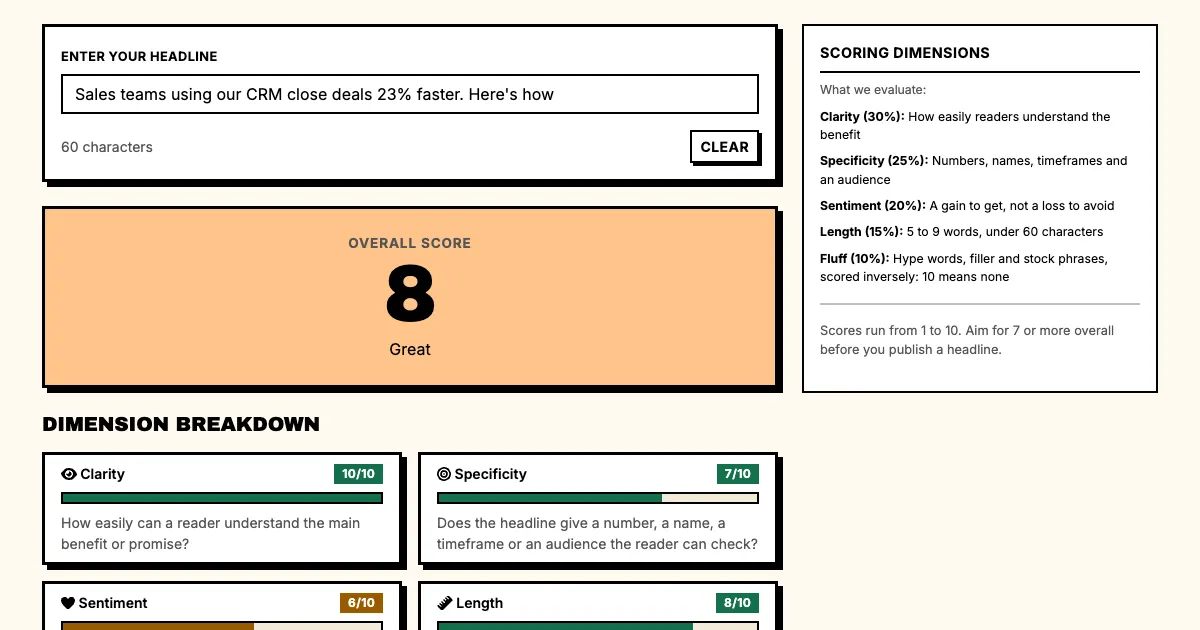
After: "Sales teams using our CRM close deals 23% faster. Here's how"
The number ("23%") adds credibility, and "here's how" promises to teach something. A specific number reads like it came from real data.
Teardown 8: Category claim
Before: "The #1 Rated Help Desk Software"
Ratings are easy to manipulate, and the headline tells the buyer nothing about the product.
After: "Support teams love us because tickets actually get resolved"
The rewrite swaps external validation (ratings) for internal evidence (tickets get resolved), which is a more tangible promise. "Actually get resolved" implies that most help desk software doesn't resolve tickets, and that's a real frustration.
Teardown 9: Audience mismatch
Before: "The All-in-One Business Platform"
"All-in-one" is a red flag for buyers who've been burned by jack-of-all-trades software. It's also completely generic.
After: "For growing businesses who need accounting, invoicing, and payroll without the accountant"
The rewrite is specific about what it includes (accounting, invoicing, payroll) and what it avoids (the accountant), which is a real alternative for the buyer. "Without the accountant" is provocative, and it suggests cost savings and simplicity.
Teardown 10: Passive voice
Before: "Analytics That Help You Understand Your Customers"
"Help you understand" is passive and promises no specific outcome.
After: "See exactly what your best customers do before they churn"
The rewrite is specific about the outcome (before they churn) and the action (see exactly what your best customers do). "Exactly" and "before they churn" add urgency, and the buyer can picture what they're getting.
How do you write SaaS headlines for SEO and conversion?
The best SaaS headlines work for both SEO and conversion, even though the two pull in different directions. SEO keywords often don't sound like human copy. "Project management software" ranks, but "project management software that doesn't make you hate Mondays" converts better.
Handle it in two layers. First, put your primary keyword in the page title and at least one major heading (the H1 or a subheading), which covers the SEO requirements.
Then use conversion language in the subheadings and body. Subheadings can be more creative and specific, with emotional language, questions and contrast framing. The same split shapes landing page headlines, where the H1 has to do both jobs at once.
For example:
- H1: "How to Write SaaS Headlines That Convert"
- H2: "Three Things Every SaaS Headline Needs"
- H3: "Stop Writing Feature Descriptions. Start Writing Problem Solutions"
The H1 targets the keyword, and the H2 and H3 sound like a person wrote them.
Which SaaS headline mistakes kill conversion?
These five patterns kill conversion. If one of your headlines matches any of them, rewrite it.
- Leading with your product name. "Acme helps teams collaborate" makes Acme the hero, when the buyer is the hero of their own story. "Collaborate with your team in real time" puts the buyer first.
- Using words that have lost meaning. "Powerful," "Seamless," "Intuitive" and "Game-changing" appear in every SaaS headline. They signal that the marketing team ran out of real differentiators, so pick power words that name a concrete result instead.
- Comparing yourself to competitors. "Better than Asana" might be true, but it's an argument, and headlines make promises.
- Promising results you can't deliver. "10x your conversion rate" sounds great, and it sets up disappointment when buyers don't see 10x results. Be honest about what's possible.
- Writing for everyone. "The best project management tool for any team" speaks to no one. Specificity creates relevance, and generalities create indifference.
FAQ: SaaS headline writing
Q: How long should a SaaS headline be?
A: Aim for 50-60 characters in Google titles and 40-50 characters in email subject lines. Landing page H1s have more room: 8-12 words works well. At any length, every word should earn its place.
Q: Should I use questions in SaaS headlines?
A: Use them when they make the reader recognize a problem. "Are you making these common headline mistakes?" works because it implies the reader might be making them, while a question without that recognition feels gimmicky.
Q: How do I test headlines before publishing?
A: Run them through a grader that scores clarity, specificity, sentiment, length and fluff. A/B test email subject lines if you have a list, preview how headlines truncate on mobile devices, and ask five people in your target audience which headline they'd click.
Q: Can I use the same headline for SEO and conversion?
A: Sometimes, but the headline that ranks best is often different from the one that converts best. Use the SEO-optimized version for page titles and H1s, and the conversion-optimized version for ads, calls to action and email subject lines.
Q: How often should I update my headlines?
A: Review headline performance quarterly. Update SEO headlines when search intent changes and conversion headlines based on A/B test results, and retire and replace any headline that stops performing.
What should you do now?
- Pick one page on your site with underperforming headlines.
- Apply the three-element formula (who, what, why) to your current headline.
- Write three alternative versions using different angles.
- Test one alternative against your current headline for two weeks.
- Measure click-through rate and conversion rate changes.
Keep testing until you find the headline that gets your specific audience to act.
Sources
- Nielsen Norman Group: headings as pickup lines
- Google Search Central: title links
- Wikipedia: Value proposition
Want headline variations fast? Our AI headline generator writes 20 headlines in one punch.