Headline testing works as a fixed loop: pick one variable, run two versions to enough traffic, keep the winner and repeat. The setup, test types and mistakes below make the loop reliable.
Why does headline testing beat guessing?
Your current headline is probably not your best one, and testing is the only way to find out.
Headline testing is one of the highest-return activities in conversion optimization: a 10% improvement in click-through rate compounds over time. Done wrong, though, testing wastes traffic and produces misleading results.
Which headlines should you test first?
High-traffic pages first
Not every page needs testing. Focus on pages with significant traffic, because a page with 100 visitors per month won't produce useful results. Start with your homepage, main landing pages, high-traffic blog posts, and email campaigns.
Test one thing at a time
If you change both the format and the promise, you won't know which change caused the result. Change one variable per test: the format, the promise, or the call-to-action, never two at once.
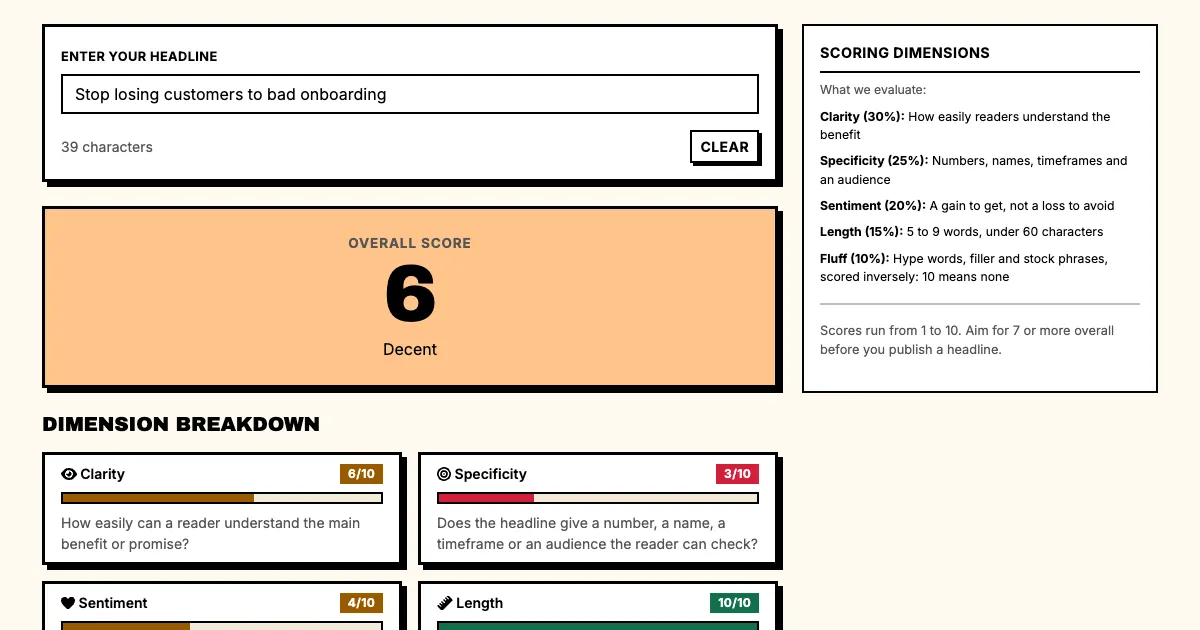
For example, "Stop losing customers to bad onboarding" against "Onboarding that retains customers" changes only the framing.
Test the right elements
Some elements are more worth testing than others. The core promise, emotional framing, headline format, and CTA wording have a high impact. Punctuation, capitalization, and minor word changes have a low one.
Fix those small things with headline optimization tips instead of spending traffic on them.
How do you set up a headline test?
Step 1: Define your metric
Decide what success looks like before you start. Typical metrics:
- Click-through rate
- Email open rate
- Time on page
- Conversion rate
Step 2: Set a minimum sample size
Small samples produce noise. A 10% difference with 100 visitors is meaningless; the same difference with 10,000 visitors is significant. For reliable results, get at least 1,000 visitors per variation.
Step 3: Run long enough
Traffic patterns vary by day and week, so short tests produce skewed results. Run each test for at least two full business cycles, with a minimum runtime of two weeks.
Step 4: Track secondary metrics
Primary metrics can miss unintended consequences. Say headline A gets more clicks but a higher bounce rate, and headline B gets fewer clicks but more conversions.
The primary metric (clicks) favors A, and the secondary metric (bounce rate) reveals the problem.
What types of headline tests are there?
A/B tests
Divide traffic evenly between two variations and track which one drives more of your target metric. A/B tests work best for landing page headlines and email subject lines.
Our guide to A/B testing headlines walks through one of these tests from setup to result.
Multivariate tests
Test several variations at the same time. It's more complex, but it reveals interaction effects between variations. Multivariate tests work best on high-traffic pages where you want to test many variations.
Bandit tests
A bandit test automatically routes traffic to the best-performing variation over time. It works best for long-running campaigns where you want to optimize continuously.
What are the common headline testing mistakes?
Mistake 1: Calling tests too early
Early results often flip: a headline that's winning on day 3 might be losing on day 14. Run each test to statistical significance or to the minimum sample size.
Mistake 2: Ignoring statistical significance
Results that aren't statistically significant are noise. Use a significance calculator, and don't call a test until you have 95% confidence.
Mistake 3: Not documenting results
Document every test: what you tested, what the results were, and what you learned. A test log with your hypotheses, results, and learnings covers it.
Mistake 4: Testing without traffic
Without traffic, testing is an academic exercise, and tests on small samples waste resources. Focus on increasing traffic before you test, and judge headlines with headline analysis until then.
What is the testing workflow?
- Write your hypothesis, for example "Negative framing will outperform positive framing."
- Create two variations that test one thing.
- Run the test to the minimum sample size.
- Check the primary and secondary metrics.
- Record the results and learnings.
- Use the winner as the baseline for the next test.
Each round needs fresh variations, and a bank of headline ideas keeps the loop going.
FAQ: Headline testing
Q: How long should I run a test?
A: At least two weeks or until you reach the minimum sample size, whichever comes first. Don't stop early because one variation is winning.
Q: Can I test more than two variations?
A: Yes, but each variation needs the minimum sample size, so more variations require more traffic.
Q: What if I don't have enough traffic for testing?
A: Generate more variations with Punchd and pick the best one by its Headline Grader score instead of a test. Save testing for when you have the traffic.
What should you do now?
- Identify your highest-traffic page.
- Write a hypothesis about what might improve it.
- Create two variations that test one thing, for example with the AI headline generator.
- Set up an A/B test with equal traffic split.
- Run the test for at least two weeks.
- Document the results.
Sources
Score your variations before you test them. Use the Headline Grader: rate each one on clarity, specificity, sentiment, length and fluff.