Getting hundreds of good headline ideas takes a system: a brief, a bank of frameworks, a generator and a scoring step. The 20/10/5 rule below turns that system into a daily routine.
Why do teams run out of good headline ideas?
Content teams need headlines at scale. Blog posts, ad variations and landing pages all need headlines, and every email campaign needs subject lines.
The demand is constant, the quality standard is high and the time is limited. Most teams cope by writing headlines fast and accepting mediocre ones like "Improve your onboarding process".
A better approach is to build a system that produces volume without sacrificing quality.
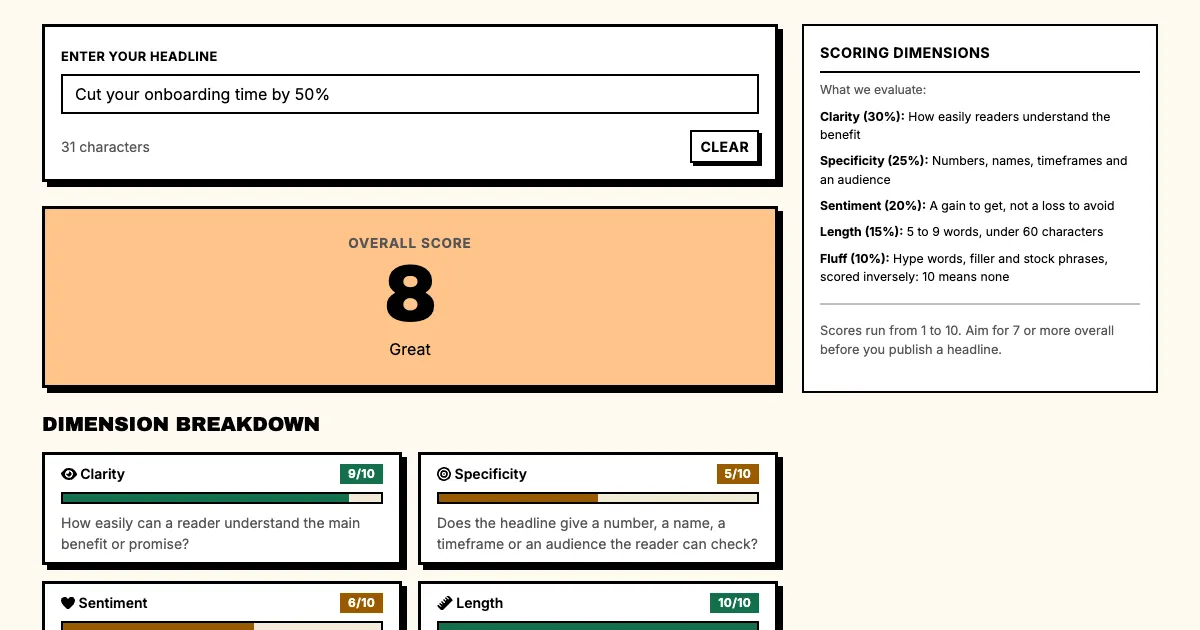
What is a headline generation system?
Step 1: Build templates
Instead of writing headlines one at a time, build templates that generate them.
A template is a structure with placeholders, such as "Cut your [metric] by [number]%". Fill in different metrics and numbers and you get dozens of headline ideas, from "Cut your onboarding time by 50%" to "Cut your churn by 20%".
Example templates:
- "Cut your [metric] by [number]%"
- "Stop [problem] with [solution]"
- "[Number] ways to [outcome]"
- "The real reason [issue] is [reason]"
Step 2: Generate first, evaluate second
Volume depends on keeping generation and evaluation apart. Generating creates options; evaluating picks the best of them.
While you generate, write fast and don't judge. Quantity matters more than quality at this stage, because the goal is options.
While you evaluate, slow down and judge critically. Now quality matters more than quantity, because the goal is the single best headline.
Step 3: Use constraints to drive creativity
Constraints make you more creative, odd as that sounds. With unlimited options you freeze; with specific constraints you focus.
Example constraints:
- Must include a number
- Must use negative framing
- Must be under 50 characters
- Must trigger loss aversion
Negative framing makes a good constraint: our SaaS headline data found it underused.
Step 4: Systematize evaluation
Score every headline with a rubric that uses the same criteria every time, so your evaluation stays consistent.
Example rubric:
- Clarity: Can the reader understand the promise immediately?
- Specificity: Is the outcome quantified or specific?
- Length: Is it 5 to 9 words?
- Fluff: Is it free of hype words such as "ultimate" and "game-changing"?
A 5-second test checks the clarity line with someone outside your team.
What is the 20/10/5 rule?
For every headline you need, generate 20 options. Pick the 10 best, test the 5 strongest and ship the winner.
The ratio sounds excessive, but the difference between the first headline you write and the 20th is significant. Most headline writers stop after option one, and the 20/10/5 rule makes you see what else is possible.
Our guide to headline testing covers how to run the test on the final five.
How do you automate headline generation?
An AI headline generator like Punchd can generate dozens of headline variations in seconds. The best workflow is human generation plus AI amplification.
You generate the first 5-10 headlines, define the templates and constraints, and do the evaluating and choosing. The AI generates the next 20-50 variations, suggests alternatives you hadn't considered and fills in the template variations.
FAQ: Headline ideas at volume
Q: How do I maintain quality at high volume?
A: Separate generation from evaluation. Generate at volume, then evaluate with a consistent rubric, and don't let the generation phase contaminate the evaluation phase.
Q: How many headlines should I generate per piece of content?
A: At least 10, ideally 20. For high-stakes content such as a homepage H1 or a major campaign, 50+.
Q: Should I use AI for headline generation?
A: Yes. AI can generate more options faster, so use it for generation and keep human judgment for evaluation and selection.
What should you do now?
- Build three headline templates for your most common content types.
- Use Punchd to generate 20 variations for your next headline.
- Evaluate each against a consistent rubric.
- Test the top three variations.
- Track which templates and styles perform best.
Sources
- Wikipedia: Brainstorming
- Nielsen Norman Group: writing headlines, page titles and subject lines
- Wikipedia: Content marketing
Generate 20 headline variations in one punch, then score them. Use the free Headline Grader: rate each one on clarity, specificity, sentiment, length and fluff.