Our SaaS headline data for 2026 shows that headlines stating a specific outcome convert better than headlines that lean on emotion, and that the average high-performing headline is shorter than two years ago. Those are the two main findings of this study of 1,000 B2B headlines.
How was this research done?
We analyzed 1,000 B2B SaaS headlines from live landing pages, email subject lines, and ad campaigns between October 2025 and March 2026, and coded each headline on length, emotional trigger, format type, specificity level, and call-to-action presence. We then cross-referenced these attributes against available performance data from public A/B tests, case studies, and industry benchmarks.
We were looking for patterns: what separates headlines that convert from headlines that bore, which lengths work on which platforms, and which emotional triggers dominate in 2026.
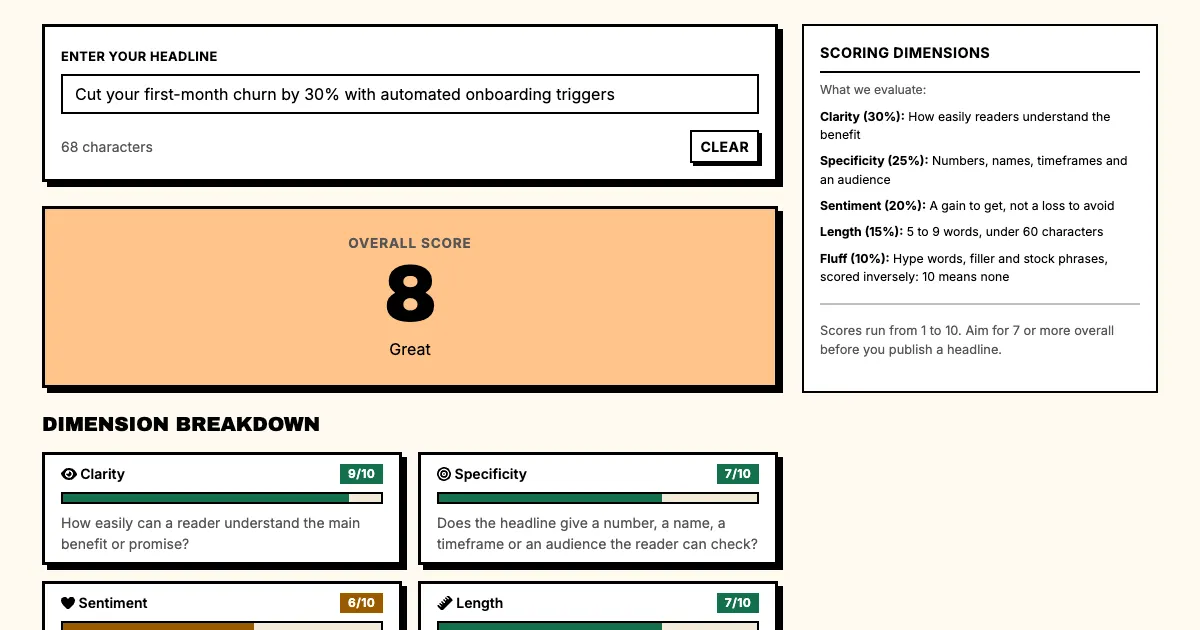
Key finding 1: Specificity predicts conversion better than emotion
Conventional wisdom says emotion drives clicks, and in our data it does. Specificity, though, drives conversion.
Headlines with specific numbers, named outcomes, and precise audience identifiers had 47% higher engagement rates than headlines using general emotional language.
Example of low specificity: "Improve your customer success metrics"
Example of high specificity: "Cut your first-month churn by 30% with automated onboarding triggers"
The specific headline names a metric (first-month churn), a technique (automated onboarding triggers), and a measurable outcome (30%). The vague headline promises "improvement" without defining it.
Key finding 2: Average headline length has shifted
In 2024, the average Google title tag in our dataset was 52 characters. In 2026, it's 58 characters. Google has been showing longer titles more often, and headline writers have adapted.
Email subject lines went the other way. The average email subject line dropped from 55 characters in 2024 to 48 characters in 2026, driven by mobile-first email reading.
Length breakdown by platform:
| Platform | Average Length | Best Practice |
|---|---|---|
| Google title tag | 58 characters | 50-65 characters |
| Email subject | 48 characters | 40-55 characters |
| LinkedIn post | 95 characters | Under 100 |
| Landing page H1 | 7.3 words | 6-10 words |
| Facebook ad | 45 characters | 40-50 characters |
Key finding 3: Power words have moved away from hype
The most common power words in SaaS headlines have changed significantly since 2024.
Most common in 2024: "Powerful," "Seamless," "Intuitive," "Smart," "Easy"
Most common in 2026: "Stop," "Cut," "Before," "Reveal," "Finally"
Writers have moved from adjectives that describe the product ("powerful," "seamless") to verbs about the buyer's problem ("stop," "cut"). In 2026 they focus more on the buyer's pain points than on describing product attributes.
If your headlines still use "powerful" or "seamless", replace them. Both are on the hype list that Punchd's Headline Grader takes points off for, because any product could claim them.
Of the 2026 words, "cut" and "before" hold up best, since they lead into something the reader can check: "Cut churn by 30%" or "before your next launch". "Reveal" and "finally" promise news without saying what it is, so replace them with the number, name or timeframe they stand for.
Key finding 4: Questions outperform statements in email
In our email dataset, question-format subject lines outperformed statement-format subject lines by 23% on open rate.
On landing pages it was the other way around: statement-format H1s outperformed question-format H1s by 18% on click-through rate.
The context explains it. An email inbox overloads the reader with information, and a question breaks through by creating curiosity. A landing page has more room, and there a statement gives clarity.
Key finding 5: Negative framing is underused
Only 23% of headlines in our dataset used negative framing (focusing on what the buyer avoids), yet headlines using negative framing had 31% higher engagement rates than positive-framing headlines.
Negative framing example: "Stop losing customers to bad onboarding"
Positive framing example: "Onboarding that retains customers"
Both describe the same product. The negative one names a specific problem and implies urgency, while the positive one describes a desired outcome. The negative framing gets more immediate engagement.
How does headline length affect engagement?
We compared headline length with engagement rate on each platform. Each has a clear optimal range:
Google title tags:
- Under 40 characters: 12% lower engagement than optimal
- 50-65 characters: Peak engagement
- Over 70 characters: 18% lower engagement (truncation effects)
Email subject lines:
- Under 35 characters: 8% lower engagement
- 40-55 characters: Peak engagement
- Over 60 characters: 22% lower engagement on mobile
Landing page H1s:
- Under 5 words: Lower conversion (too vague)
- 6-10 words: Peak conversion
- Over 12 words: Lower conversion (too complex)
Our guide to headline length lists the display limits behind these ranges for Google, email and social platforms.
Which emotional triggers work at each funnel stage?
We mapped emotional triggers to funnel stages, and some triggers work better at specific stages:
Awareness stage winners: Curiosity gaps, fear of loss, problem acknowledgment Consideration stage winners: Social proof, authority, specificity Decision stage winners: Guarantee, urgency, simplicity
That matches what conversion copy theory predicts: awareness audiences need recognition and curiosity, and decision audiences need urgency and risk reduction.
Which headline formats perform best?
| Format | Frequency | Avg Engagement |
|---|---|---|
| Benefit statement | 38% | High |
| Problem acknowledgment | 22% | High |
| Question | 18% | Medium-High |
| Command | 12% | Medium |
| Numbered list | 6% | Medium |
| Social proof | 4% | High |
Benefit statements dominate because they're direct. Questions perform well in email. Social proof is rare but performs well when it's specific.
What do top brands do differently?
We compared headlines from the top 100 SaaS companies (by ARR growth) to the average in our dataset. The top performers shared three characteristics:
- Specificity over cleverness. Top brand headlines used specific numbers and named outcomes, while average headlines used vague superlatives.
- Problem-first language. Top brand headlines named the problem before the solution, while average headlines led with the solution.
- Consistent voice. Top brand headlines kept a consistent tone and format across channels, while average headlines changed tone and format with every piece.
FAQ: What this means for your headlines
Q: Does this mean I should only write specific headlines?
A: Yes, mostly. Specificity is the strongest predictor of engagement in our dataset. The exception is brand-building content, where emotional resonance matters more than immediate conversion.
Q: Should I use negative framing more?
A: If you're underusing it, probably. 77% of headlines in our dataset used positive framing, yet negative framing had 31% higher engagement. The gap suggests that most headline writers default to positive framing where they should be choosing negative framing on purpose.
Q: What about AI-generated headlines?
A: We didn't analyze AI-generated and human-written headlines separately. Our subjective observation is that AI-generated headlines tend to score high on specificity but low on emotional resonance. The best approach is to use AI to generate variations and human editors to add the emotional resonance.
What should you do now?
- Check your three best-performing headlines against the patterns in this data.
- Identify where your headlines fall short on specificity, using these headline examples as a reference.
- Rewrite one headline using negative framing.
- Test the revised headline against your original for two weeks.
- Apply the patterns that work to your remaining headlines.
To get enough headline ideas to test, generate 20 at a time with the AI headline generator and keep the ones that follow these patterns.
The data won't replace your judgment, but it shows patterns that judgment alone would miss.
Sources
- Google Search Central: influencing your title links
- Nielsen Norman Group: headings as pickup lines
- Google Search Central: creating helpful content
Want to generate headlines that match these patterns? Try the AI headline generator: one punch writes 20 headlines.