Headline rewrites turn a weak headline into a specific one in a single pass: vague to specific, passive to active, feature to outcome, long to short. The five rewrites below show each move with the before and after, followed by a 4-step process for your own headlines.
What makes a headline rewrite work?
The first draft is never the best draft. Even the best copywriters rewrite headlines dozens of times.
Most of the improvement comes in revision, where you cut words, add specifics and test your assumptions. Each rewrite below starts from a weak headline and shows what changed.
For the wider checklist behind these moves, see our headline optimization tips.
Rewrite 1: Vague to specific
Original: "Improve Your Sales Process"
This headline tells me nothing: improve how, which process, and why should I care?
Rewrite: "Close Deals 30% Faster Without Hiring Another Rep"
Now there's a number and a specific outcome. "30% faster" answers "improve how?", and "without hiring" answers "why should I care?"
Rewrite 2: Passive to active
Original: "Your Data Can Be Analyzed Automatically"
The passive voice makes this sentence soft, with no energy.
Rewrite: "Stop Guessing. Start Knowing."
Two imperatives, no passive voice, and a clear contrast between the problem and the solution. The rewrite drops the filler and turns the statement into an action.
Rewrite 3: Feature to outcome
Original: "Our AI Learns Your Style"
This is about the feature: it says what the product does, not what I get.
Rewrite: "Headlines That Sound Like You Wrote Them"
The rewrite is about the reader and the result they get, and leaves out the mechanism.
Rewrite 4: Long to short
Original: "The Complete Solution for Managing All Aspects of Your Customer Relationship Management Needs"
Thirteen words, and most of them are filler.
Rewrite: "CRM Without the Complexity"
Four words with the same meaning and a better rhythm. The rewrite keeps the core and cuts the rest.
Rewrite 5: Generic to specific
Original: "Trusted by Leading Companies"
Generic social proof like this feels hollow.
Rewrite: "Used by 500+ Sales Teams at Tech Startups"
It names a number, a type of user and a context, which makes the claim believable.
What is the headline rewrite process?
When you're rewriting headlines, follow this sequence:
Step 1: State the problem
What's the pain point you're addressing?
Example: "My team wastes time on manual follow-ups"
Step 2: Add a number
Quantify the problem or solution.
Example: "My team wastes 8 hours a week on manual follow-ups"
Step 3: Contrast states
Show before and after.
Example: "My team wastes 8 hours a week on manual follow-ups. Automate them and reclaim your time."
Step 4: Cut everything else
Remove filler words and shorten the sentences until the headline is punchy.
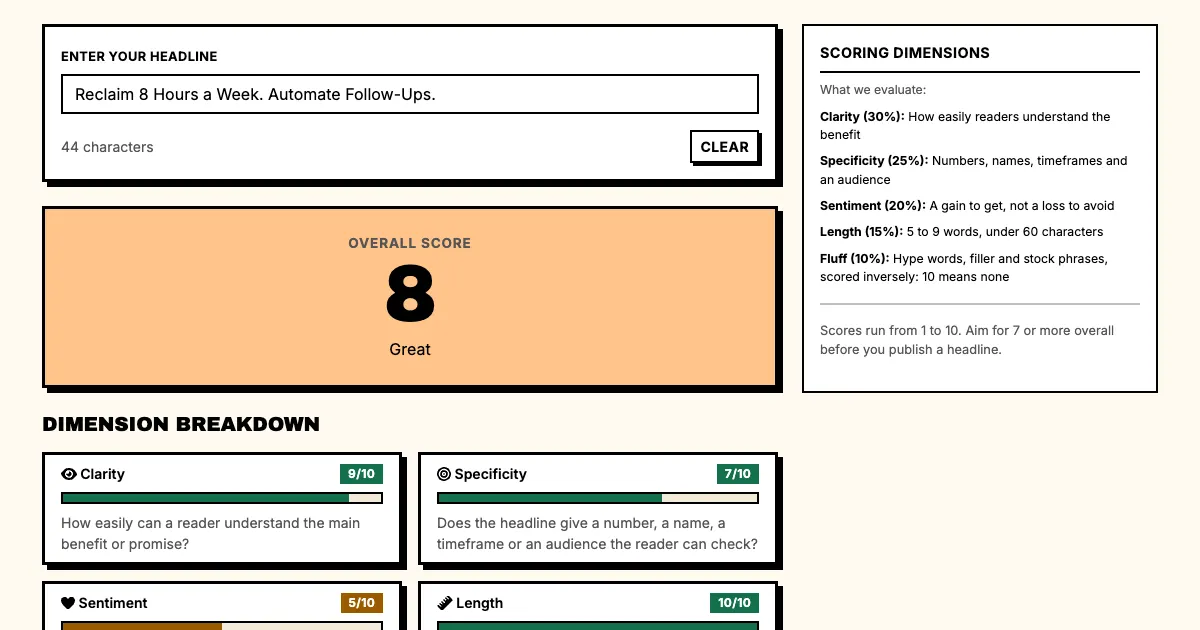
Example: "Reclaim 8 Hours a Week. Automate Follow-Ups."
How do you rewrite your own headlines?
Take your top 3 headlines. For each one:
- Add a number (even if you estimate)
- Cut 50% of the words
- Make it about the outcome, not the feature
- Test it with the 5-second rule
Compare each version with the one before it, for example in our free headline analyzer.
If a rewrite still falls flat, change the format. Turn the statement into the question your reader already asks, as in these question headlines.
When does a headline need a rewrite?
Watch for these patterns in weak headlines:
"Your" as a subject
"Your data" is weak. "Stop losing data" is strong.
Passive voice
"The reports are generated" vs. "Get reports in seconds."
Vague verbs
"Improve," "enhance" and "optimize" say nothing on their own.
Replace them with specific actions: "Cut," "stop," "save," "double."
Abstract nouns
"Growth," "success," "efficiency" are too vague.
Replace them with concrete things: "leads," "deals," "hours."
Sources
- Wikipedia: Readability
- Nielsen Norman Group: How Users Read on the Web
- Nielsen Norman Group: writing headlines, page titles and subject lines
FAQ: Headline rewrites
Q: How many times should I rewrite a headline?
A: Until the rewrite stops improving the score. Three to five passes is typical; after that, generate new options instead.
Q: What is the most common rewrite?
A: Vague to specific. Replacing "improve your results" with a number and a timeframe lifts almost every headline.
Q: Can I rewrite with a tool?
A: Yes. Grade the headline first, rewrite the weakest trait, then regrade. The Headline Grader shows which trait to work on.
When should you generate instead of rewrite?
When rewriting one headline stops helping, you need more options to choose from. Punchd generates 20 headlines at once. Pick the best few and apply the rewrite steps above to them: generate, select, then refine.