Message match means the landing page delivers exactly what the ad or link promised, in the same words. When the promise and the page match, bounce rates fall and conversions rise; when they differ, visitors leave.
What is message match?
When I click an ad, I expect something specific, and when I land on your page, I expect to see what was promised. If the page doesn't match the ad, I leave. If it doesn't match the product, I churn.
The gap between what the ad promised and what the page shows is a message mismatch, and it costs you conversions. Some marketers call the goal expectation congruence: the ad, the page and the product all set the same expectation.
Why do landing pages break message match?
It usually goes like this:
- Ad promises "10x Your Pipeline"
- Landing page talks about features
- Onboarding takes three days to understand
- User realizes the product does something different
- User churns and leaves a bad review
The ad set one expectation, the product delivered something else, and the user felt deceived. A mismatch also happens when the ad and the page speak to different marketing funnel stages: an awareness ad that names a problem sends visitors to a decision page that pushes a trial.
Message match examples: before and after
Before: Ad: "Generate unlimited headlines" Landing page: Lists all features of the headline tool Reality: Free users get 5 headlines per day
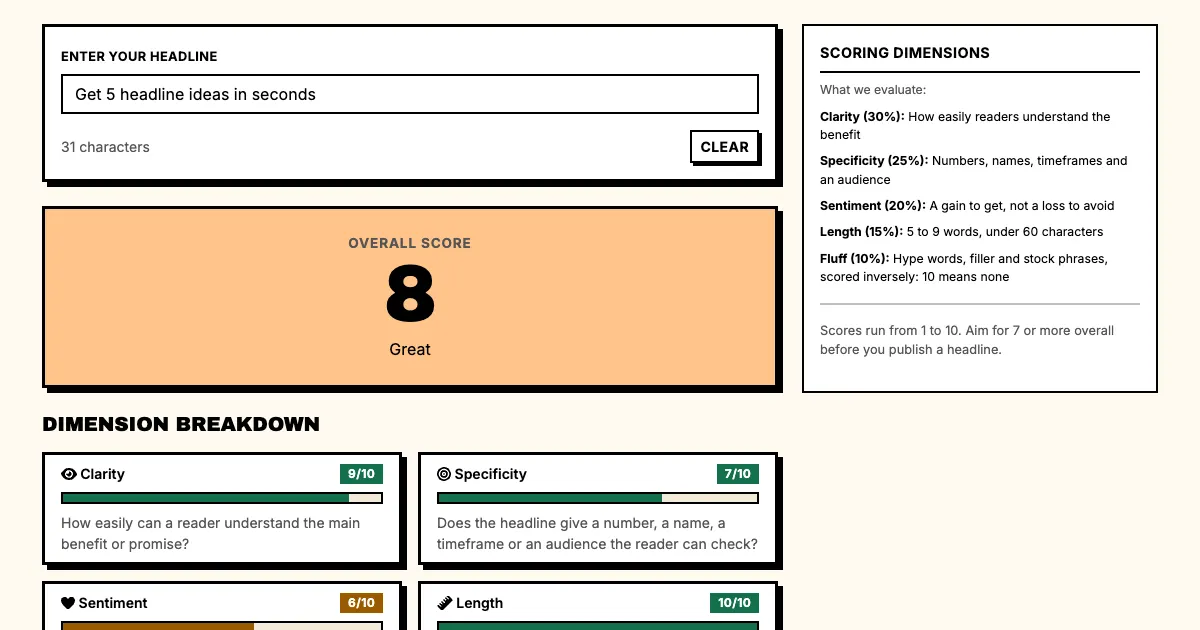
After: Ad: "Get 5 headline ideas in seconds" Landing page: Shows exactly 5 headlines being generated Reality: User gets 5 headlines in under 60 seconds
The second version sets an accurate expectation, so the user knows exactly what they'll get.
Before: Landing page headline: "The AI That Writes Your Headlines" Product reality: AI generates suggestions, user picks and refines
After: Landing page headline: "AI-Powered Headline Suggestions. You Pick. We Generate." Product reality: User inputs topic, AI suggests 20 headlines, user selects favorites
The second version describes the real workflow, so nothing surprises the user later.
Before: CTA: "Start Your Free Trial" Reality: 14-step onboarding process before accessing core features
After: CTA: "Get Started in 60 Seconds" Reality: Email signup, immediate access to all features
The second version matches what actually happens after the click.
How do you test message match?
A quick first check is the 5-second test: if a visitor can't name the ad's promise after five seconds on the page, the match is off. Then answer three questions.
1. Does your headline match what the product does?
If your headline promises X, your product has to deliver X. If it doesn't, change the headline or change the product. Our teardown of 20 SaaS landing page headlines shows how specific promises read.
2. Does your CTA match the next step?
If your CTA says "Get Started," clicking it should actually get the user started. If the next step is a 20-question quiz, the CTA lies.
3. Does your social proof match real users?
If you claim "Used by enterprise teams," check that enterprise teams actually use you. Fake social proof creates false expectations.
How do you run a message match audit?
- Write down your landing page headline
- Write down your main CTA
- Write down your top 3 feature claims
- For each one, ask: "Does the product actually deliver this?"
- If any answer is no, mark it for fixing
The audit takes 10 minutes and shows you where the promise and the delivery come apart. Once the promises hold, check the page for the other landing page mistakes that cost conversions.
How do you build message match?
Set accurate expectations
Don't overpromise. Under-promise and over-deliver.
Instead of: "Revolutionize your marketing overnight"
Try: "Get marketing copy in under 2 minutes"
Show the real workflow
Use screenshots of the actual interface and walk through the actual process. Buyers who know what they're getting buy with more confidence.
Match your CTA to the next step
Your button should tell me what happens when I click it. "Get My Headlines" should show me headlines right away, and "Start Free" should start my free access right away.
What does a message mismatch cost?
Expectation - Reality = Churn
The bigger the gap, the bigger the churn. Keep the gap at zero or negative, which means your product delivers more than your page promises.
What does a message match test look like in practice?
At Punchd, we test every headline against the product experience. If our headline says "Generate 20 headlines," the user generates 20 headlines in under 60 seconds. A headline like "Get perfect headlines" would fail that test every time, so we don't use it.
Sources
- Nielsen Norman Group: How Long Do Users Stay on Web Pages?
- Wikipedia: Landing page
- Google Search Central: creating helpful content
FAQ: Message match
Q: What is message match?
A: The match between what an ad or link promises and what the landing page shows. Strong message match means the visitor sees the promised thing within seconds.
Q: How do I measure it?
A: Compare bounce rate and conversion rate per traffic source. A source with a high bounce rate and a low conversion rate usually promises something the page does not show.
Q: Should the ad headline and the page headline be identical?
A: Close, but not word for word. Keep the promise and the key phrase; adapt the length to the page.
What should you do now?
The expectation gap costs you first-time buyers, and later it shows up in reviews, referrals, and retention.
Run your message match audit today, fix the gaps it finds, and match your promises to what the product does. Your conversion rate will improve and your churn will drop.
Write headlines that match your product with Punchd's AI headline generator.