Each of the three marketing funnel stages needs its own headline: awareness headlines earn recognition, consideration headlines build trust and decision headlines drive action. The same message fails when it is shown at the wrong stage.
Why do marketing funnel stages need different headlines?
A headline that works for an awareness-stage audience fails for a decision-stage audience, and the reverse is true too. The three stages are a simplified version of the classic purchase funnel, which runs from first awareness to the purchase.
Awareness audiences are learning about a problem and don't know your product. They need recognition, so your headline has to make them feel seen.
Consideration audiences have identified the problem and are evaluating solutions. They need to trust that your product can help, which means the headline has to build credibility.
Decision audiences are ready to choose and need to believe your specific solution is the right one. Here the headline needs urgency, and its job is to drive action.
How do you write awareness-stage headlines?
Awareness audiences are just finding out about their problem. They don't know your product and don't care about your features; they care about their problem.
The goal is to make them feel seen and create the "that's me" moment. The formats that work best:
- Problem acknowledgment
- Curiosity gaps
- Fear of loss
- Question recognition
Example: "Is your onboarding killing your retention?"
This headline names a problem. A reader who suspects their onboarding is causing churn feels recognized and is primed to learn more.
Avoid solution-forward headlines. "Our onboarding tool cuts churn" doesn't resonate with someone who doesn't know they have an onboarding problem.
How do you write consideration-stage headlines?
Consideration audiences know they have a problem and are evaluating solutions. They need to believe your product can help.
The goal is trust: show them you understand their situation and have a real solution. The formats that work best:
- Benefit statements
- Specificity
- Authority signals
- Comparison hooks
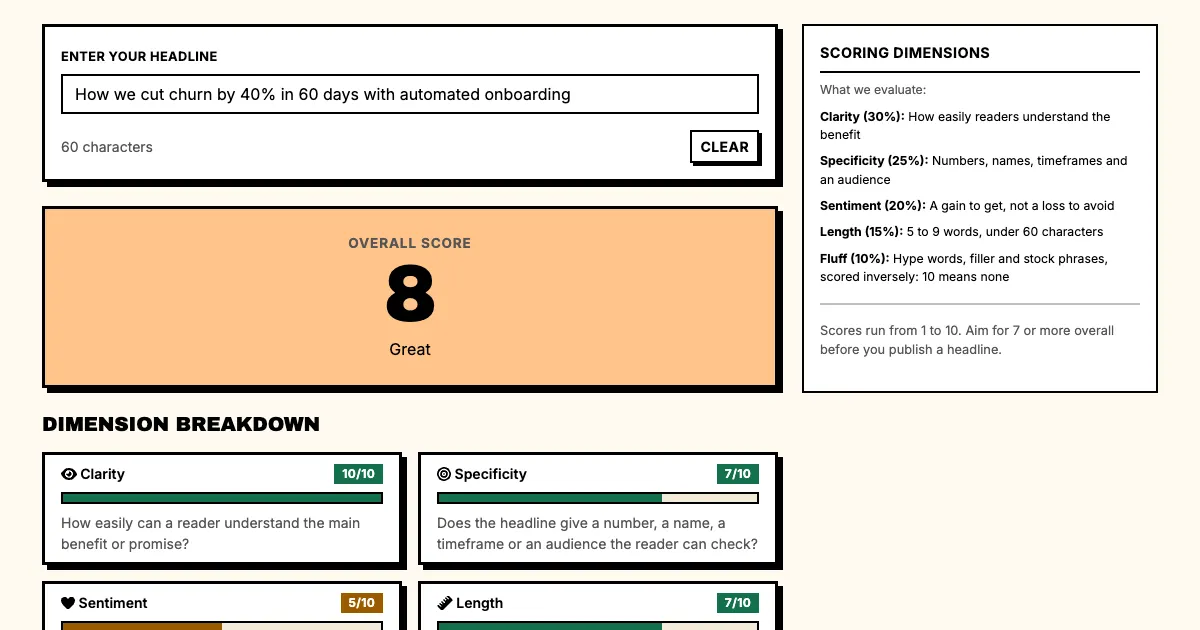
Example: "How we cut churn by 40% in 60 days with automated onboarding"
This headline shows a specific result with data ("40%", "60 days") and names a mechanism ("automated onboarding"). The specificity is what builds credibility.
Avoid vague benefit statements. "Better onboarding" doesn't build trust; specific data does.
How do you write decision-stage headlines?
Decision audiences are ready to choose. They need urgency, and the confidence that your solution is the right choice.
The goal is action: remove friction and create urgency. The formats that work best:
- Commands
- Social proof
- Guarantee statements
- Constraint removal
Example: "Try our headline tool free for 14 days. No credit card required."
This headline removes the biggest objection to trying a new product. The trial is real ("14 days") and the friction is gone ("no credit card").
Avoid passive language. "Our tool might help you" doesn't drive action, while command language ("Try now") does.
How do you audit headlines by funnel stage?
- Map each headline to a funnel stage.
- Check if the format matches the stage.
- Identify any stages with no headlines.
- Identify any stages with misaligned headlines.
Most teams have too many consideration-stage headlines and too few awareness-stage ones, and the awareness stage is where most traffic arrives. Our 30 headline formulas are sorted by funnel stage, so you can fill the gaps the audit finds.
Search traffic is the easiest to map, because the query shows the stage; our guide to search marketing headlines matches ad and page headlines to the query. Email works the same way: a nurture sequence moves readers from stage to stage, so write email subject lines for the stage each send targets.
Can one headline serve the whole funnel?
Some headlines work across several stages, and they are usually the most specific ones.
Example: "Cut your churn by 30% in 60 days with automated triggers"
This headline works for awareness (it names a problem and solution), consideration (it provides specific data), and decision (it creates urgency through the timeframe). The more specific the headline, the more stages it can serve.
FAQ: Funnel headlines
Q: Should I write different headlines for each funnel stage?
A: Ideally, yes, because different stages require different approaches. The most specific headlines can still serve several stages.
Q: How do I know which funnel stage a page targets?
A: Look at where the traffic comes from. Organic search is usually awareness or consideration; paid search on a solution keyword is consideration or decision.
Q: What if I only have resources for one headline?
A: Write for consideration. Those visitors are actively evaluating and most likely to convert, and you can reach awareness and decision audiences through other channels.
What should you do now?
- Map your top 10 pages by funnel stage.
- Check if each headline matches the stage.
- Rewrite any misaligned headlines.
- Add awareness-stage headlines for your top traffic pages.
- Track funnel progression to see where headlines create friction.
Sources
Write headlines for every stage with Punchd's AI headline generator, then score each one in the free headline grader.