Search marketing headlines rank and convert when they answer the query in the first words and carry its keyword through the title, the ad and the landing page. The 15 formulas below cover SEO titles, search ads and landing pages, each with a before-and-after rewrite.
Every search query is a question someone needs answered, and your headline has to show that you have the answer.
Most search marketing headlines try to be clever when they should be specific. They make vague claims where a precise promise would work, and they chase brand awareness when the clicks that matter come from buyers who are ready.
How are search marketing headlines different from social ones?
Search traffic behaves differently from social traffic. Social visitors are browsing, while search visitors are trying to solve a problem.
That shapes every headline you write for search. A social headline can be creative. A search headline has to be relevant: it matches the query intent and promises the answer.
Intent also tells you where the searcher sits in the marketing funnel stages: "how to" queries come from the top, "best" and "vs" queries from the middle. The promise then has to carry through to the page the click lands on, which our guide on how to write landing page headlines covers.
Which 15 headline formulas work in search funnels?
1. The "Question match" formula
Answer the exact question they searched.
Before:
"Headline Generation Tool"
After:
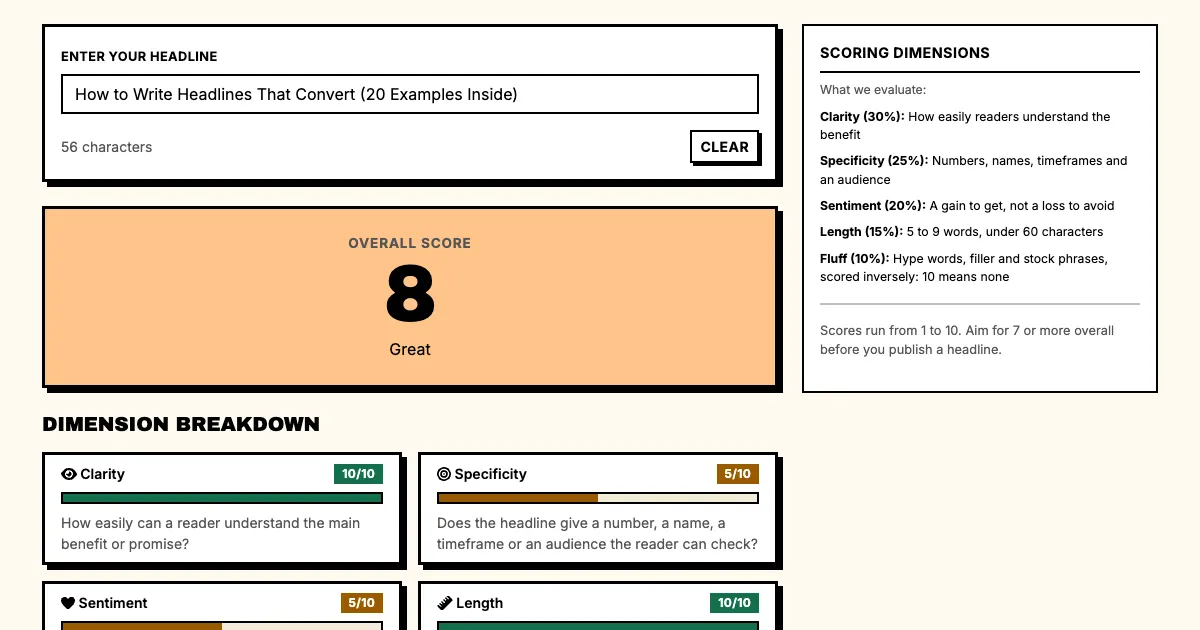
"How to Write Headlines That Convert (20 Examples Inside)"
It matches the query intent exactly. Someone searching "how to write headlines" wants a how-to guide, and this headline promises one.
2. The "Best [solution]" formula
Own the category.
Before:
"Our Headline Tool"
After:
"Best AI Headline Generator: 20 Variations in 30 Seconds"
It names the category and the benefit. "Best" claims authority, and "20 Variations in 30 Seconds" proves speed.
3. The "Problem + solution" formula
Acknowledge their pain.
Before:
"Write Better Headlines"
After:
"Stop Writing Headlines That Flop. Try These 20 Instead."
It names the problem ("headlines that flop") and offers a solution ("try these 20 instead"). Naming the pain point makes the promise feel relevant.
4. The "Comparison" formula
Help them decide.
Before:
"Headline Tool Comparison"
After:
"Copy.ai vs Jasper vs Punchd: Which Generates Better Headlines?"
This names the decision your reader is making. People search for comparisons before committing, so be the comparison they find.
5. The "How-to" formula
Teach them something.
Before:
"Headline Tips"
After:
"How to Write Headlines for Google Ads: A Step-by-Step Guide"
It promises a process. "Step-by-step guide" implies full coverage, and naming the platform ("Google Ads") targets the right audience.
6. The "List" formula
Promise scannable value.
Before:
"Headline Examples"
After:
"15 Headline Formulas That Actually Convert (With Examples)"
Lists are scannable, and a number in the title tells searchers how much they'll get. "15" sets an expectation and "With Examples" promises proof.
7. The "Vs. [alternative]" formula
Position against alternatives.
Before:
"Try Our Tool"
After:
"Why Our Headline Tool Beats Writing Headlines by Hand"
It names the alternative outright, so anyone who has been writing headlines by hand will find the comparison relevant.
8. The "Result" formula
Promise a specific outcome.
Before:
"AI Headline Writer"
After:
"Get Headlines That Score 40% Higher on A/B Tests"
It names a metric. "40% higher" is specific, and "A/B tests" implies data-driven decision-making.
9. The "Free" formula
If you offer a free option, lead with it.
Before:
"Generate Headlines Online"
After:
"Free Headline Generator: 20 Variations Per Request"
This pairs the "free" hook with a specific feature. "Free" lowers the barrier and "20 variations" shows the value.
10. The "Industry" formula
Target by vertical.
Before:
"SaaS Headlines"
After:
"SaaS Headlines for Pricing Pages: 15 Examples That Convert"
It narrows the audience: "SaaS" targets a specific buyer and "Pricing pages" a specific use case. The more specific, the more relevant.
11. The "Review" formula
Aggregate opinions.
Before:
"Headline Tool Reviews"
After:
"Best Headline Generators Reviewed: Features, Pricing, and Results"
It promises a comparison across several dimensions, and "Features, pricing, and results" covers what buyers want to compare.
12. The "Case study" formula
Show evidence.
Before:
"Headline Examples"
After:
"How One Marketer Got 3x More Clicks With AI-Generated Headlines"
It leads with a result. "3x more clicks" is specific, and "One marketer" makes it feel achievable for the reader.
13. The "Tutorial" formula
Offer a process.
Before:
"Learn Headline Writing"
After:
"The 5-Step Headline Writing Process That Doubles Click-Through Rates"
It promises a repeatable process. "5 steps" implies simplicity and "Doubles CTR" implies measurable impact.
14. The "Tool" formula
Name the mechanism.
Before:
"Headline Software"
After:
"AI Headline Generator: Stop Writing Headlines Manually"
It names the technology ("AI") and the pain it solves ("stop writing manually"). Users who want automation respond to the word "stop."
15. The "Urgency" formula
Create time-sensitive relevance.
Before:
"Headline Tool Sale"
After:
"Limited Time: 50% Off Headline Generator - Launch Special Ends Friday"
It names the discount, the timeframe and the end date, and "Ends Friday" makes the urgency real. For launch campaigns, our product launch headlines guide has 16 more formulas by phase.
What does a full search funnel headline set look like?
Headlines by search intent:
| Intent | Example query | Headline formula |
|---|---|---|
| Informational | "how to write headlines" | "How to Write Headlines That Convert" |
| Commercial | "best headline tool" | "Best AI Headline Generator: 20 Variations" |
| Transactional | "headline generator" | "Free Headline Generator: 20 Variations" |
| Local | "headline tool near me" | N/A for online tools |
Multi-Stage FAQs
Q: What's the difference between SEM and SEO headlines?
A: SEM headlines are constrained by character limits (30 characters per headline in a Google responsive search ad). SEO headlines can be longer (about 60 chars) but still have to match query intent. Both need to be specific; SEM headlines also need to be scannable, and SEO headlines need to cover the topic in full.
Q: How do I write headlines for long-tail keywords?
A: Match the query intent directly. If the query is "headline generator for e-commerce", your headline should contain that phrase. Long-tail searches are specific, so your headlines should be too.
Q: Should I use keywords in my headlines?
A: Yes, when they fit naturally. Google still looks at keyword relevance, but don't stuff keywords in at the expense of readability. The best headlines solve the searcher's problem in the terms they searched with.
Q: How do I test SEM headlines?
A: Run A/B tests with 2-3 variations and let each run for 100+ clicks before deciding. Test one variable at a time: the hook, the offer or the call to action.
Q: What's a good CTR for search ads?
A: 5%+ is good for first position and 3-5% is typical. Below 2% usually means your headlines aren't relevant to the query, so match them to search intent as well as to keywords.
Q: How many headlines should I test?
A: Test 2-3 at a time, with one hypothesis at a time. Too many variations spread your data thin.
Q: Should I use dynamic keyword insertion?
A: Yes, when your ad group has tight keyword themes, because then dynamic insertion can improve relevance. Still test it against static alternatives, since dynamic isn't always better.
Q: How do I handle low search volume keywords?
A: Expand your keyword list with broader terms that include your niche keywords. A slightly broader term can put you in front of more buyers who are also interested in your specific solution.
What should you do now?
- List your top 10 search queries (by volume and intent)
- For each query, write a "before" headline and an "after" headline using the formulas above
- Check character limits for SEM ads (30 chars per headline)
- Run A/B tests on your top 3 queries
- Track CTR and conversion rate separately
Sources
- Google Search Central: title links
- Google Ads Help: responsive search ads
- Wikipedia: Search advertising
Need headlines for your search campaigns? The AI headline generator writes 20 variations from one brief, for the search intent you're targeting.