Product launch headlines create buzz when they state what is new, who it is for and why it matters now. The 16 formulas below cover teasers, launch day and the weeks after, each with a before-and-after rewrite.
Your product launch is weeks away. You've built something great and have a waiting list of eager users, and when you send the launch email, you want its headline to stand out in a crowded inbox.
Most product launch emails fail because they try to say too much. Their headlines read "Introducing Our New Product" when they should name the specific change the product makes possible.
What makes a product launch headline create buzz?
Launch headlines work best when they build anticipation without revealing everything. A movie trailer works the same way: it shows you enough to want more and doesn't give away the ending.
Your headline should promise a specific outcome and make readers curious enough to click, without turning into a full product description. For a developer tool or an API, that means the result first and the mechanism later, as our guide to the technical product landing page explains.
Before launch day, put the page itself through a 5-second test. If a stranger can't say what's new after five seconds, the headline needs another pass.
Which 16 launch headline formulas work best?
1. The "It's here" formula
Short and direct, for launch day.
Before:
"Our New Product Is Available"
After:
"It's here. The headline tool that generates 20 variations in 30 seconds."
It confirms the moment everyone's been waiting for. "It's here" is a trigger phrase that creates immediate urgency.
2. The "Before you launch" formula
Help them prepare for their own launch.
Before:
"New Product Announcement"
After:
"Before you launch next week, you need these headlines."
This positions your tool as part of their launch prep. Anyone launching something needs headlines, so the timing fits.
3. The "Wait is over" formula
Reward patience.
Before:
"New Feature Available"
After:
"The feature you requested is live. Here's how to use it."
It acknowledges that users have been waiting, and "The feature you requested" is more powerful than "our new feature."
4. The "Early access" formula
Create exclusivity.
Before:
"Limited Release"
After:
"You've got early access. Here's your exclusive first look."
Early users feel special because they got in before everyone else. Psychologists call this pull scarcity: access that is limited feels more valuable, and early users will want to protect it.
5. The "Launch checklist" formula
Help them prepare.
Before:
"Launch Day Checklist"
After:
"The 5 headlines every product launch needs (and how to get them)."
It offers a concrete list, which is easy to scan and promises specific value. "5 headlines" is better than "our headlines."
6. The "Beta invitation" formula
Get users into beta.
Before:
"Join Our Beta Program"
After:
"We built this for you. Want early access before we launch?"
This makes the beta feel personal. "We built this for you" implies you've been listening, and "Want early access" feels like an invitation instead of a sign-up form.
7. The "Reveal" formula
Build suspense.
Before:
"Big News"
After:
"Tomorrow we're announcing something that changes how you write headlines."
It sets a specific timeframe and makes a specific promise. "Something that changes" on its own would be vague; "changes how you write headlines" is concrete.
8. The "Social proof" formula
Show demand.
Before:
"Product Launch"
After:
"2,000 marketers signed up before we launched. Here's what they got."
It shows momentum. A number like "2,000 marketers" is social proof, and early sign-ups validate the decision for latecomers.
9. The "Launch week" formula
Create a series.
Before:
"New Feature Announcement"
After:
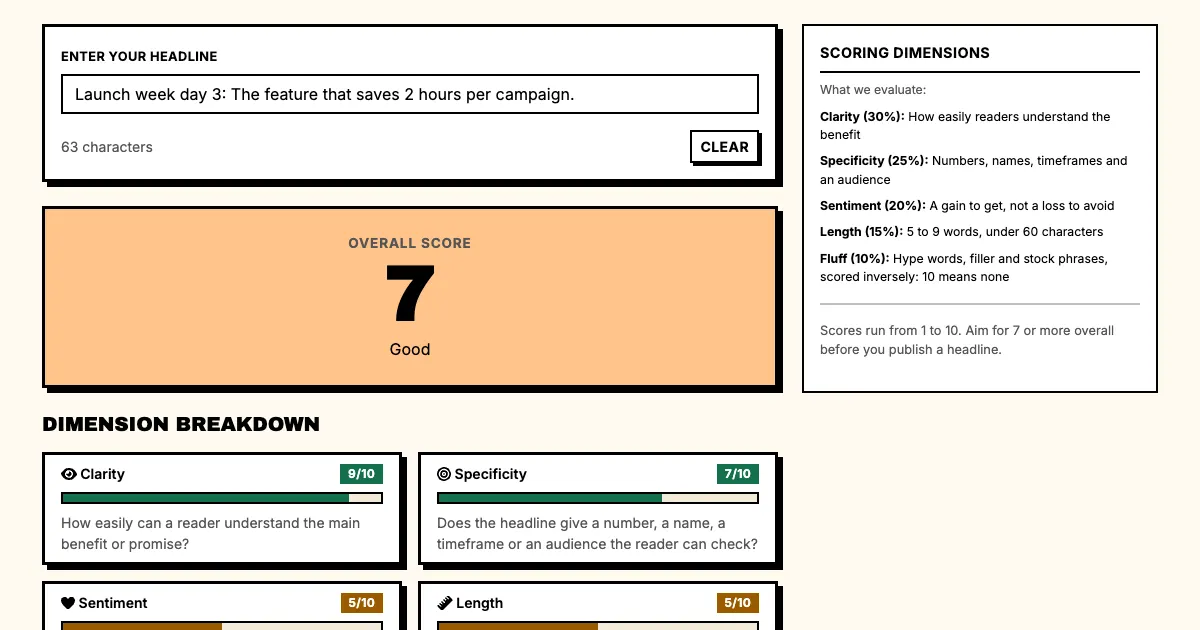
"Launch week day 3: The feature that saves 2 hours per campaign."
A series creates a narrative. Users who follow it feel like they're part of something bigger than a product release.
10. The "Transformation" formula
Show the before and after.
Before:
"Better Headlines Now Available"
After:
"Your headlines just got 40% better. Here's what's new."
It promises improvement, and "40% better" is specific. Specific numbers beat vague claims every time.
11. The "Behind the scenes" formula
Build trust through the story.
Before:
"Product Update"
After:
"We spent 6 months building this. Here's what we learned."
It shows vulnerability and effort. Users connect with stories of struggle and progress in a way they don't with feature lists.
12. The "Launch special" formula
Create urgency with a launch discount.
Before:
"Launch Discount Available"
After:
"Launch special: 50% off for the first 100 sign-ups. Use code LAUNCH24."
It names the discount, the limit and the code, and every specific detail makes the offer feel more real.
13. The "Customer story" formula
Lead with evidence.
Before:
"Product Launch"
After:
"How one marketer got 3x more clicks with headlines generated in 30 seconds."
It leads with a result. "3x more clicks" is specific, "In 30 seconds" is concrete, and the user story makes the claim feel real.
14. The "Comparison" formula
Position against competitors.
Before:
"Our New Product"
After:
"We built this because [competitor] was too slow and too expensive."
It names a specific frustration with a specific alternative. Buyers who are frustrated with that competitor will feel seen.
15. The "Future pacing" formula
Show what success looks like.
Before:
"New Feature Available"
After:
"Imagine writing 20 headlines before your coffee gets cold."
It uses a sensory detail. Everyone has let a coffee go cold, and that makes the time savings feel real.
16. The "Thank you" formula
Show gratitude.
Before:
"Product Update"
After:
"Thank you for waiting. Your patience just paid off."
It acknowledges that users have been waiting, and "Your patience paid off" tells them that waiting was a good decision.
What does a full launch email sequence look like?
Headlines by launch phase:
| Phase | Goal | Headline formula |
|---|---|---|
| Pre-launch | Build anticipation | "Something big is coming" |
| Beta | Get users | "You have early access" |
| Launch day | Convert | "It's here" |
| Post-launch | Retain | "Thank you for waiting" |
Multi-Stage FAQs
Q: How early should I start building anticipation?
A: 2-4 weeks before launch is optimal. Start earlier and you risk losing momentum; start later and you miss the chance to build a waiting list.
Q: Should I tease the product or announce it directly?
A: Tease for awareness and announce for conversion. Early awareness emails can be vague ("Something big is coming"), while launch day emails should be specific ("It's here. Here's what you get.").
Q: How many launch emails should I send?
A: 3-5 across the launch week works best, spaced 2-3 days apart. Send more and you're spamming; send fewer and you miss the momentum window.
Q: What about post-launch follow-up?
A: Send a "here's what you missed" email to non-openers 48 hours after launch, then shift to a weekly cadence so you don't go silent after launch day.
Q: How do I handle a delayed launch?
A: Be transparent. Send a single honest email that explains the delay, apologizes briefly and gives a new date, without over-explaining. Users respect honesty more than perfection.
Q: Should I offer a launch discount?
A: Yes, if you can afford it. A launch discount rewards early adopters and lowers the barrier to trial. Just make sure it has a clear end date.
Q: How do I measure launch success?
A: Track pre-launch list growth (target: 1,000+ on waitlist), launch day opens (target: 50%+ open rate), launch day conversions (target: 3-5% of list) and first-week activations (target: 40%+ of new sign-ups).
Q: What if my launch flops?
A: Don't panic. A launch can fail while the product still succeeds. Send a "we're iterating" email, show users you're listening and ask for feedback, then build the next launch on what you learned.
What should you do now?
- Map out your launch timeline (2-4 weeks before to 1 week after)
- For each phase, write 3 potential headlines using the formulas above
- Pick the strongest one for each phase
- Run each launch email through the free subject line tester to catch spam triggers
- Build your launch sequence
- Test headlines against each other before launch day
Sources
Need headlines for your product launch? The AI headline generator writes 20 variations from one brief, for whichever launch phase you're in.