A technical product landing page should lead with the outcome and keep the architecture one layer down. Visitors buy the result, then check the details, so order the page that way.
Why should a technical product have a simple landing page?
B2B SaaS products are complex: APIs, integrations, enterprise security, custom workflows. You know your product inside out, and your prospects don't.
The mistake most technical products make is bringing that complexity to the landing page. They show technical diagrams, list API endpoints, and explain their architecture.
Buyers don't care about your architecture. They care about their problem.
What goes wrong when a landing page gets too technical?
When your landing page gets too technical, two things happen.
First, you lose non-technical stakeholders: marketing managers, CEOs, directors. They need to understand the value, not the architecture.
Second, you attract the wrong customers, technical people who want to evaluate your API before they buy your solution.
Neither group converts well.
Technical landing page copy: before and after examples
Before: "Our REST API supports OAuth 2.0 authentication with JWT tokens. Webhooks enable real-time event streaming with HMAC-SHA256 signature verification."
After: "Connect to Salesforce, Hubspot, and 48 other tools. Your data syncs in real time. No manual exports needed."
The first version reads like documentation. The second states a benefit.
Before: "SOC 2 Type II compliant with end-to-end AES-256 encryption and SAML SSO support for enterprise identity providers."
After: "Enterprise-grade security. Your IT team will approve it on the first try."
The first version lists compliance terms. The second addresses the buyer's actual concern, which is approval.
Before: "Custom workflow automation with conditional branching, loop support, and parallel execution for complex business logic."
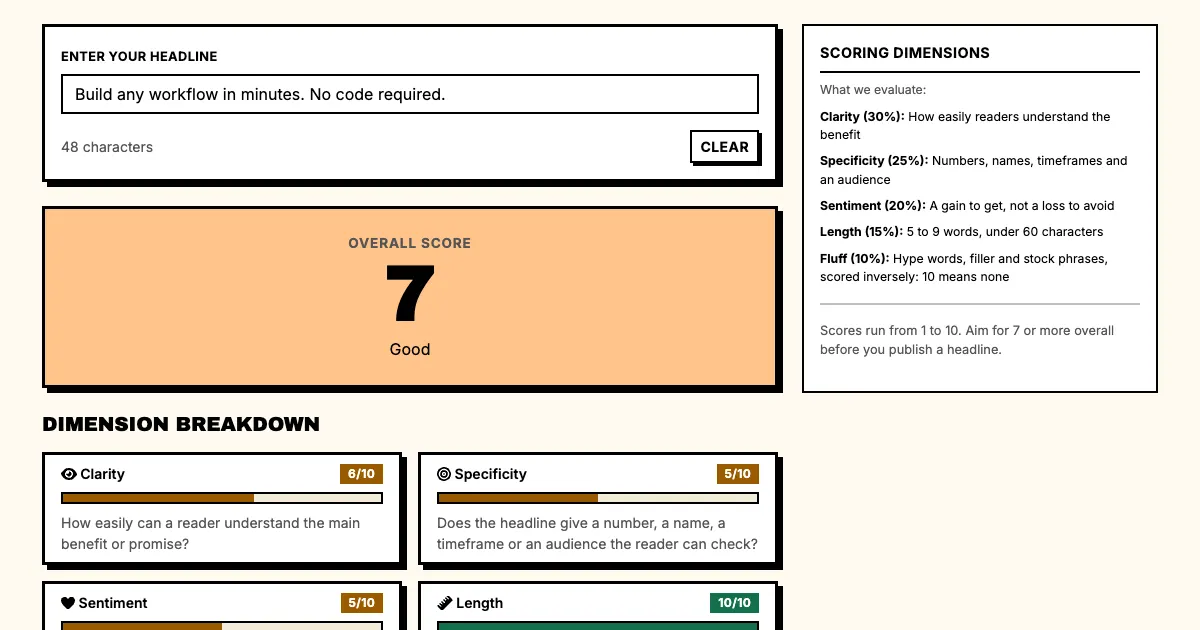
After: "Build any workflow in minutes. No code required."
The first version is developer-speak. The second tells non-technical buyers they can use it.
What is the layered approach?
Instead of one page for everyone, use layers.
Layer 1: The value layer (for everyone)
The headline, subheadline, main CTA, and social proof. Keep it simple: state the problem and offer the solution.
These SaaS landing page headlines show what a strong value layer leads with.
Layer 2: The feature layer (for evaluators)
A features section with more detail that still focuses on benefits. Explain what things do, not how they work.
Layer 3: The technical layer (for engineers)
A separate docs page with the API reference and integration guides. It gives technical buyers what they need without cluttering your conversion path.
The same three layers work for a feature announcement, where product launch headlines carry the value layer.
How do you simplify your feature copy?
- List your top 5 features
- For each feature, write one sentence explaining the outcome
- Delete the technical details
- Move technical details to a separate "Documentation" page
For example:
Feature: "GraphQL API with rate limiting and caching" Outcome: "Pull data from any app. Build custom dashboards. No coding required."
If step 2 stalls, our free value proposition generator turns your audience, problem and outcome into statements you can start from.
Which technical sections need simplifying?
Integration lists
List outcomes instead of integration names.
Instead of: "Integrates with Salesforce, Hubspot, Marketo, Mailchimp, Slack, and 45+ other tools"
Try: "Your entire stack, connected. All your tools talk to each other automatically."
Security sections
Address the concerns behind the compliance standards rather than listing the standards.
Instead of: "SOC 2 Type II, GDPR compliant, HIPAA ready, ISO 27001 certified"
Try: "Your security team will sign off on day one. We handle the compliance so you don't have to."
API sections
Show what's possible, and leave the code snippets out.
Instead of: "REST API with OAuth 2.0, GraphQL endpoint, webhooks"
Try: "Build anything on top of our platform. Our API connects your entire tech stack."
What is the 10-year-old test?
It's a simple filter for technical content: can a 10-year-old understand your headline? If not, simplify it.
Your headline shouldn't require a technical background to parse. It should speak to the problem, not the solution.
For the headline itself, our guide on how to write landing page headlines goes into more depth.
Sources
FAQ: Technical landing pages
Q: Should I hide technical details from the landing page?
A: No. Move them one layer down: outcome in the headline, proof in the subheadline, architecture in a section below the fold.
Q: How do I write for both engineers and buyers?
A: Lead with the outcome for the buyer and link to a technical page for the engineer. One page cannot serve both in the headline.
Q: What is the 10-year-old test?
A: Read the headline to someone outside your industry. If they can repeat what the product does, the headline is clear enough.
What should you do now?
Complex products need clear messaging, and Punchd helps you find it. Generate 20 headline variations, test them with the 5-second rule, and pick the clearest one.