If you want to know how to write landing page headlines that convert, name the outcome, the person it is for and the objection it removes, in under 12 words. The structures and formulas below show how to get there from any product.
Why are landing page headlines hard?
A landing page headline has one job: make the right person keep reading. That's harder than it sounds, because the right person is skeptical.
They've been burned by overpromised software before, and they've added tools to their stack that nobody used. Your headline gets about three seconds to get past that. The 5-second test is a quick way to check whether it does.
Most landing page headlines fail because they describe the product instead of the person. They use feature language where the reader wants outcomes, and they make vague promises where a specific one would land.
What makes landing page headlines different?
Landing page headlines differ from other headlines in three ways.
- They have more room. Unlike email subject lines or Google title tags, a landing page headline has space for a full sentence or two, so use it.
- They serve a specific goal. Every landing page has one, and the headline has to support it. A landing page for a free trial needs a different headline from one for a demo request, and the call to action below it should name the same goal.
- They face more competition. The visitor has already clicked and is now evaluating the page, one click away from leaving. Your headline has to keep them there.
What is the structure of a high-converting headline?
The best landing page headlines contain three elements.
Element 1: Who it's for
Name the audience. "For [specific audience]" makes the headline relevant to the right reader straight away.
Weak: "Analytics for your business"
Strong: "Analytics for SaaS founders who need to know what customers do"
The strong version names a specific person (a SaaS founder) and a specific problem (needing to know what customers do).
Element 2: What it does
Promise a clear outcome.
Weak: "Improve your metrics"
Strong: "See exactly when customers are about to churn"
"Improve your metrics" is vague. "See exactly when customers are about to churn" names a clear, specific outcome.
Element 3: Why it's different
Set the product apart from the alternatives.
Weak: "The best analytics tool"
Strong: "The analytics tool that predicts churn before it happens"
Nobody can prove "the best". "Predicts churn before it happens" is a specific differentiator.
Which landing page headline formulas convert?
Formula 1: The outcome statement
"[Specific outcome] for [specific audience]"
Example: "Cut your churn by 30% in 60 days for SaaS teams"
The outcome is specific, the audience is named, and the timeframe adds urgency.
Formula 2: The problem-solution
"Stop [problem] with [solution]"
Example: "Stop losing customers to bad onboarding with automated triggers"
It names the problem and a clear solution, so a reader with that problem recognizes it at once.
Formula 3: The transformation
"Turn [problem state] into [outcome state]"
Example: "Turn your onboarding chaos into customer loyalty"
The before and the after are both clear enough for the reader to picture.
Formula 4: The objection handler
"For [specific audience] who [specific objection]"
Example: "For SaaS teams who can't afford a customer success manager"
The headline names the objection and answers it. A reader who has had that objection sees themselves in it.
Formula 5: The social proof anchor
"[Specific result]: [proof or social signal]"
Example: "Cut churn by 40%: the same approach used by 200+ SaaS companies"
The result is specific, and the social signal makes it credible.
Which psychological triggers work on landing pages?
These triggers work in any headline, and our guide on how to write headlines shows them on other platforms.
Loss aversion
People feel losses more intensely than equivalent gains.
Example: "Stop losing 30% of customers to bad onboarding"
Use it when your audience is living with the problem right now. Loss aversion works best when the pain is real.
Specificity
Specific promises are more credible than vague ones.
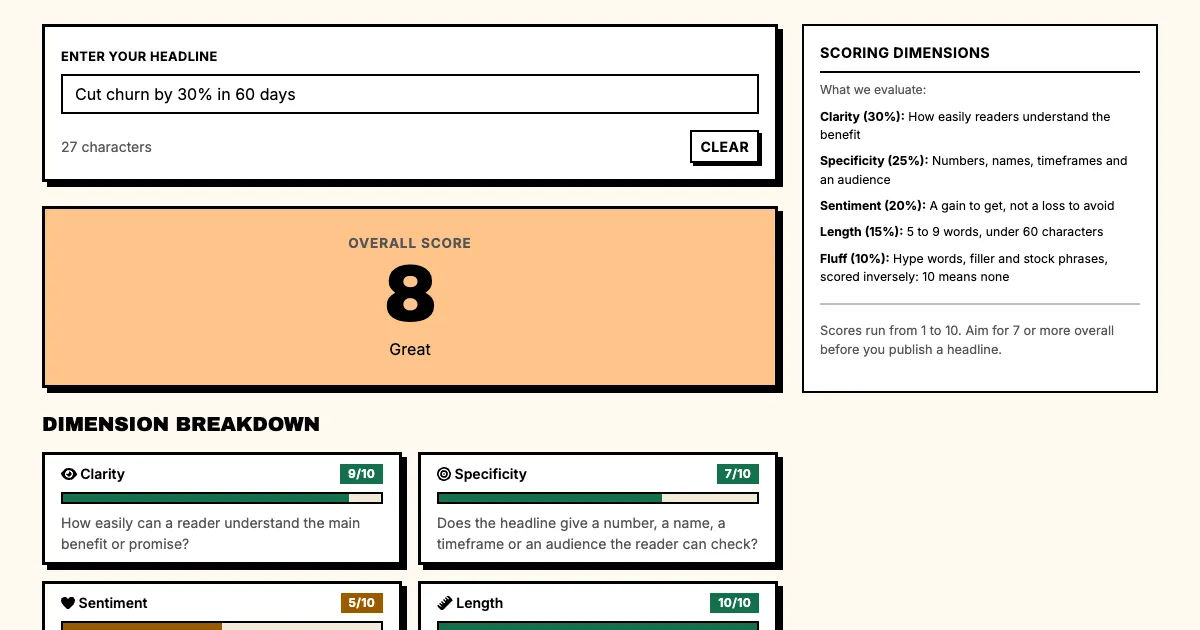
Example: "Cut churn by 30% in 60 days" vs. "Reduce churn"
Use it in every headline.
Urgency
Urgency pushes the reader to act.
Example: "Start cutting churn before your next billing cycle"
Use it when the problem is costing the buyer something. False urgency destroys trust.
Authority
Named companies and specific credentials add credibility.
Example: "Built on the same framework that scaled Stripe"
Use it only when your authority signals can be verified. Fabricated authority destroys trust once someone finds out.
What are the common landing page headline mistakes?
Mistake 1: Feature descriptions
"Our tool uses AI to analyze headlines" describes a feature. It doesn't tell the buyer what they'll get, so write the outcome instead. For a complex product, our guide to the technical product landing page shows how to keep the details one layer down.
Mistake 2: Vague promises
"Get better results" can't be verified and won't be remembered. Promise a specific outcome.
Mistake 3: Speaking to everyone
"The best solution for any business" speaks to no one. Name the specific audience you serve.
Mistake 4: Leading with the product name
"Acme helps teams collaborate" makes Acme the hero. The buyer should be the hero of your headline.
FAQ: Landing page headlines
Q: Should my landing page headline match my ad headline?
A: Yes, when possible. Keeping the ad and the landing page consistent reduces cognitive friction: the reader sees the promise they clicked on and doesn't have to reorient.
Q: How many headlines should I test?
A: Write at least five, test your top two or three, and track which one drives the most conversions.
Q: Should the headline be the same as the H1?
A: Usually, yes. When the title tag, the H1 and the headline agree, there's less confusion and the core message gets repeated. The meta description under your title in search results should make the same promise.
Q: What comes first: the headline or the subheadline?
A: Write the headline first. The subheadline supports it, and if you can't write a good headline, the subheadline won't save it.
What should you do now?
The headline is the most important piece of copy on your landing page, so give it the time it deserves:
- Find your best-performing landing page.
- Score your headline on audience identification, outcome clarity, and differentiation.
- Write five alternative headlines using the formulas in this guide, or get 20 drafts from our AI headline generator.
- A/B test your top two against your current headline.
- Track conversion rate changes.
Sources
- Wikipedia: Landing page
- Nielsen Norman Group: first impressions
- Nielsen Norman Group: F-shaped reading pattern
Generate conversion-focused headlines. Try the AI headline generator: one punch writes 20 headlines.