A SaaS landing page headline converts when it combines an outcome, a timeframe and an objection it removes. The 20 teardowns below score headlines from well-known SaaS brands against those three elements.
Why are SaaS landing page headlines different?
Search headlines compete in an index, so they need keywords and have to answer a query. Landing page headlines compete for attention: they need a clear promise, and that promise has to match the ad or search result that sent the visitor, a principle called message match.
A landing page headline has one job: make the right person keep reading. That person has a problem, has probably tried other solutions and is weighing your product against the alternatives, including doing nothing. Your headline has about three seconds to cut through that skepticism.
Most landing page headlines fail because they treat the headline as a feature description. They describe what the product does and leave out what the buyer gets, the feature dump that tops our list of landing page mistakes.
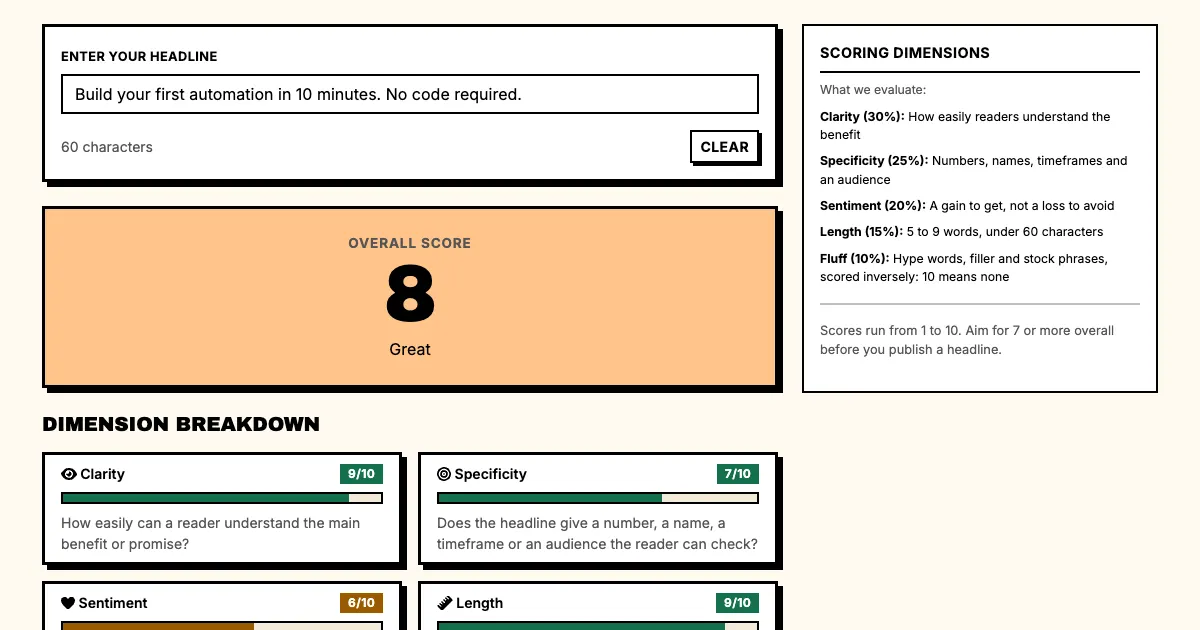
Here is what the Outcome+Timeframe+Objection (OTO) framework does to the Zapier headline from the list below:
Before: "Automate your work. Spend less time moving data."
After: "Build your first automation in 10 minutes. No code required."
The rewrite adds a timeframe and removes an objection. The 10 minutes is a placeholder: use the time your own onboarding data supports.
What is the OTO framework for landing page headlines?
Every high-converting landing page headline contains at least two of these three elements:
- Outcome: what specific result does the buyer get?
- Timeframe: when do they get it, and how long does it take?
- Objection: what problem does it solve that alternatives don't?
Headlines that nail all three are rare. Two out of three makes a strong headline, and one element alone usually reads as a category label.
20 SaaS landing page headline examples, scored
1. Stripe
Headline: "Online payment processing for internet businesses"
OTO analysis:
- Outcome: Accept payments online
- Timeframe: None
- Objection: None
Verdict: Functional but forgettable. It describes the category and leaves out the benefit, so it's accurate without creating any urgency.
2. Slack
Headline: "Where work happens"
OTO analysis:
- Outcome: Work gets done
- Timeframe: None
- Objection: None
Verdict: It leads with the brand and leaves the benefit implied. "Where work happens" suggests that work is scattered elsewhere, but the promise is vague: what kind of work, and what does "happens" mean?
3. Notion
Headline: "Your wiki, docs, and projects. All in one place."
OTO analysis:
- Outcome: Everything organized in one place
- Timeframe: None
- Objection: Scattered tools
Verdict: Strong objection handling. "All in one place" goes straight at the pain of tool fragmentation: it names a specific frustration and promises to end it.
4. HubSpot
Headline: "The CRM platform to grow better"
OTO analysis:
- Outcome: Grow better
- Timeframe: None
- Objection: Growing is currently hard
Verdict: "Grow better" is vague. Better than what, or than now? The promise is implied but never specific, and a buyer who isn't already feeling growth pain won't connect with it.
5. Calendly
Headline: "Easy scheduling. Skip the back-and-forth."
OTO analysis:
- Outcome: Easy scheduling
- Timeframe: None
- Objection: Back-and-forth frustration
Verdict: Two strong elements. "Easy scheduling" is a clear outcome, and "Skip the back-and-forth" names a specific frustration and promises to remove it. A timeframe would make it stronger.
6. Intercom
Headline: "The Customer Communications Platform"
OTO analysis:
- Outcome: Better customer communications
- Timeframe: None
- Objection: None
Verdict: Category positioning. It tells the buyer what Intercom is and nothing about what they'll get.
7. Figma
Headline: "Design, prototype, and gather feedback all in one place"
OTO analysis:
- Outcome: Design, prototype, and get feedback
- Timeframe: None
- Objection: Scattered design workflow
Verdict: Strong because it lists specific outcomes the buyer can picture, and "all in one place" handles the objection of fragmented tools.
8. Zapier
Headline: "Automate your work. Spend less time moving data."
OTO analysis:
- Outcome: Automate work, spend less time on data
- Timeframe: None
- Objection: Manual data movement
Verdict: Two clear outcomes. "Automate your work" is a category promise, while "Spend less time moving data" is a specific, tangible benefit. A timeframe would make it stronger.
9. Loom
Headline: "Async video messaging for work"
OTO analysis:
- Outcome: Async video messaging
- Timeframe: None
- Objection: Synchronous meeting pain
Verdict: "Async video messaging" is a feature description with no clear outcome. What does the buyer accomplish with async video? The headline is accurate but creates no desire.
10. Airtable
Headline: "Connect everything. Organize anything."
OTO analysis:
- Outcome: Organized workflows
- Timeframe: None
- Objection: Disconnected data
Verdict: "Connect everything" is vague (connect how?) and "Organize anything" is broad. Both sound good and give the buyer no specific outcome to picture.
11. Monday.com
Headline: "Where teams meet to plan, track, and deliver"
OTO analysis:
- Outcome: Teams that plan, track, and deliver
- Timeframe: None
- Objection: None
Verdict: It describes what teams do and promises no specific outcome. Every project management tool helps teams plan, track, and deliver, so what's different here?
12. Asana
Headline: "The work management platform for your organization"
OTO analysis:
- Outcome: Better work management
- Timeframe: None
- Objection: None
Verdict: "Work management" is vague, and every tool claims to help with it. Accurate but forgettable.
13. Linear
Headline: "The issue tracking tool you'll enjoy using"
OTO analysis:
- Outcome: Enjoyable issue tracking
- Timeframe: None
- Objection: Existing tools are painful
Verdict: Strong objection handling. "Issue tracking tool you'll enjoy using" implies that existing tools are painful, and a promise of enjoyment is unusual enough to remember.
14. Buffer
Headline: "Build your brand. Grow your audience."
OTO analysis:
- Outcome: Brand building and audience growth
- Timeframe: None
- Objection: None
Verdict: Two clear outcomes, but "build your brand" and "grow your audience" are both vague. What does building a brand actually mean, and what does audience growth look like?
15. Mixpanel
Headline: "Product analytics that tell you who to act on"
OTO analysis:
- Outcome: Know who to act on
- Timeframe: None
- Objection: Analytics without direction
Verdict: Strong because it's specific. Most analytics tools show you data; this headline promises direction, and "who to act on" is an outcome buyers can picture.
16. Webflow
Headline: "Build better business websites. No coding required."
OTO analysis:
- Outcome: Better business websites
- Timeframe: None
- Objection: Coding complexity
Verdict: "Build better business websites" is a clear outcome, and "No coding required" handles the biggest objection for non-technical users. The headline is specific about who it's for and what they get, the same plain-language move a technical product landing page needs.
17. ActiveCampaign
Headline: "Marketing automation that doesn't require a team of experts"
OTO analysis:
- Outcome: Marketing automation
- Timeframe: None
- Objection: Complexity and resource requirements
Verdict: Strong because it addresses two objections at once. Most marketing automation requires technical expertise, and this headline promises you won't need it.
18. Drift
Headline: "Revenue acceleration powered by conversations"
OTO analysis:
- Outcome: Revenue acceleration
- Timeframe: None
- Objection: None
Verdict: "Revenue acceleration" is a strong outcome, but "powered by conversations" is vague. What kind of conversations, and how do they accelerate revenue?
19. Hotjar
Headline: "See how visitors really use your site"
OTO analysis:
- Outcome: Understanding visitor behavior
- Timeframe: None
- Objection: Not knowing how visitors use your site
Verdict: Strong objection handling. "See how visitors really use your site" implies that existing analytics don't show the full picture, and "really" does a lot of work by suggesting hidden insight.
20. Segment
Headline: "The customer data platform that respects your privacy"
OTO analysis:
- Outcome: Customer data management
- Timeframe: None
- Objection: Privacy concerns
Verdict: "Respects your privacy" is a strong differentiator in a data-centric category. It names a specific concern (privacy) and promises to address it.
What do the best SaaS landing page headlines have in common?
Across all 20 examples, the strongest headlines have three things in common.
They handle objections specifically, with phrases like "Skip the back-and-forth", "No coding required" and "you'll enjoy using". Each phrase names a frustration the buyer recognizes as their own.
They make tangible promises, such as "Spend less time moving data" or "Product analytics that tell you who to act on". Headlines like these let the buyer picture the outcome.
They're honest: the best landing page headlines only make promises the product can actually keep. Overpromising gets the initial click and pays for it in long-term churn.
The promise also has to survive the SaaS pricing page, where buyers check it against what they will pay.
FAQ: SaaS landing page headlines
Q: What does OTO stand for?
A: Outcome, Timeframe, Objection: the result the buyer gets, how fast, and the doubt the headline removes.
Q: Do I need all three elements?
A: Outcome always. Timeframe and objection raise the score, but a clear outcome alone beats a vague headline with all three.
Q: How long should a SaaS landing page headline be?
A: Six to twelve words. Long enough for the outcome, short enough to read in three seconds.
What should you do now?
- Find your three best competitors' landing pages.
- Copy their headlines into a spreadsheet.
- Rate each headline on Outcome (0-3), Timeframe (0-3), and Objection (0-3).
- Identify which headlines score 4 or higher.
- Apply their winning patterns to your own headlines.
The point of the exercise is to learn which promises already work in your category, then find the ground nobody has claimed.
Sources
Need headline variations for your landing page? Our AI headline generator writes 20 at once, and the free headline grader scores each on clarity, specificity, sentiment, length and fluff.