An email subject line gets opened when it is specific, under 60 characters and promises something the reader wants. The techniques below, from questions to personalization, work as long as the email keeps that promise.
Why do good emails go unopened?
When an email with great content goes unopened, the subject line is at fault. It is the most important sentence in your email, and if it fails, nothing else in the email matters.
Yet many people write the subject line in seconds after spending hours on the email body, which is backwards. The same techniques work for newsletters, campaigns, one-on-one outreach and onboarding emails.
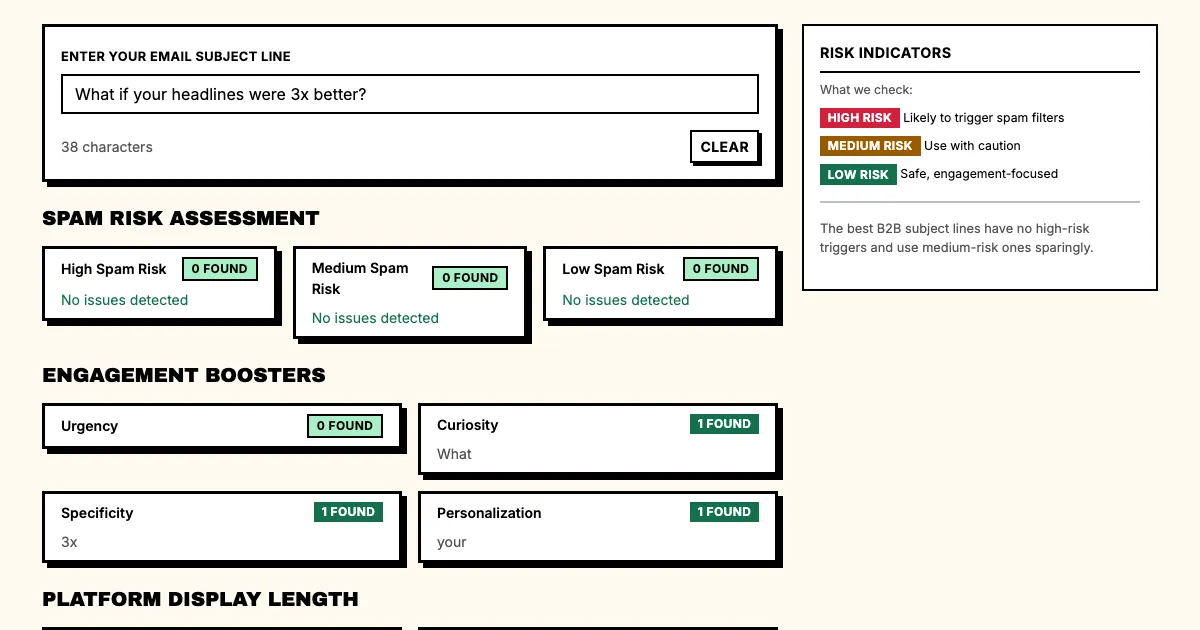
How do email clients display subject lines?
How much of your subject line shows depends on the client:
- Gmail desktop: 70 characters
- Gmail mobile: 40 characters
- Outlook desktop: 60 characters
- Outlook mobile: 35 characters
- Apple Mail: 65 characters
So your subject line has to work anywhere from 35 to 70 characters. Our guide to headline length covers the limits on other channels.
What is the subject line formula?
The best subject lines follow a simple formula:
[Curiosity/Question/Emotion] + [Specific Detail] = Opens
Examples:
- "Are you making this headline mistake?" (question + specific mistake)
- "The real reason your emails aren't getting opened" (curiosity + specific reason)
- "Your weekly headline ideas are inside" (specific detail + what it is)
The specific detail is what separates good subject lines from mediocre ones. "Weekly ideas" is vague, "Your weekly headline ideas" is specific, and "10 headline ideas for this week" is better still.
Which email subject line techniques work?
Technique 1: Ask a question
A question engages the reader, who has to think about the answer. Our guide to question headlines covers when a question beats a statement.
Weak: "New headline ideas for you"
Strong: "What if your headlines were 3x better?"
To answer it, the reader has to form an opinion.
Technique 2: Create a curiosity gap
Withhold information to create tension, the idea behind every curiosity gap headline.
Weak: "Headline writing tips"
Strong: "The headline formula most marketers ignore"
"Most marketers ignore" makes the reader want to know what's being ignored.
Technique 3: Use specific numbers
Numbers make a subject line specific and credible.
Weak: "Tips for better headlines"
Strong: "7 headline formulas that doubled our open rate"
"7" and "doubled" are specific enough that the reader can picture the outcome.
Technique 4: Trigger urgency
Urgency pushes the reader to act.
Weak: "Our latest newsletter"
Strong: "Last chance: This week's headline ideas expire tonight"
"Last chance" and "expire tonight" tell the reader they'll lose something if they don't act.
Technique 5: Personalize
Personalization makes emails feel less like broadcasts.
Weak: "Weekly marketing tips"
Strong: "[First Name], your competitors are reading this"
The personalized opener ("[First Name]") and the social proof ("your competitors") make the email relevant to the reader.
What does not work in subject lines?
Trigger words that get you filtered
Some words trigger spam filters or promotional tab placement:
- "Free" (often)
- "Buy now"
- "Earn money"
- "Act now"
- Excessive exclamation points
- ALL CAPS
Our free subject line tester flags words like these before you send.
Misleading subject lines
Your subject line must match your content. If you promise "free templates" and deliver a sales pitch, you destroy trust. The same rule holds for search marketing headlines: the page has to deliver what the headline promised.
Too clever
Puns, wordplay, and excessive cleverness can backfire when they leave the reader confused instead of curious.
What are the best subject line formulas?
For newsletters
"[Number] things worth knowing this week"
Example: "5 things worth knowing about headlines this week"
For educational content
"[Question]: [answer or hint]"
Example: "Are your subject lines too long? Here's the fix"
For promotional emails
"[Specific outcome] for [specific audience]"
Example: "Free headline templates for SaaS marketing teams"
For re-engagement
"We miss you: [specific offer]"
Example: "We miss you: here's what you missed in headlines"
How do you test subject lines?
Always test your subject lines. What works in theory often fails in practice.
For an A/B test, split your list 50/50, send variation A to one half and variation B to the other, and use the winner for the full send.
What to test:
- Question vs. statement
- Long vs. short
- Personalized vs. generic
- With number vs. without
- Curious vs. direct
FAQ: Email subject lines
Q: How many characters should an email subject line be?
A: 40-50 characters. That length shows in full on desktop clients, and on mobile the first 35 to 40 characters carry it, so put the key words first.
Q: Should I use emojis in subject lines?
A: Test them. Emojis can increase open rates with some audiences and decrease them with others, and B2B audiences tend to prefer text-only subject lines.
Q: Should I personalize subject lines?
A: Yes, if you have the data. "[First Name]" personalization can increase open rates, but generic personalization ("Hey you") feels fake.
Q: How many subject lines should I test?
A: At least two. Write your top three and A/B test the best two.
What should you do now?
- Look at your last five email subject lines.
- Score each on curiosity, specificity, and urgency.
- Rewrite the weakest using the techniques in this guide.
- A/B test your rewritten subject line against your original.
- Track open rates to see which approach works.
Sources
- Nielsen Norman Group: writing headlines, page titles and subject lines
- Wikipedia: CAN-SPAM Act of 2003
- Wikipedia: Email marketing
Generate email subject lines that get opened. Try Punchd: analyze subject lines for open rate potential.