A question headline works when the reader wants the answer and the page gives it. It fails when the question is vague or the answer is obviously no.
Why do questions create engagement?
A statement makes a claim, and the reader can agree or disagree with it. A question makes the reader think about the answer. They stop being someone who is told something and start taking part, and that small effort is what gets them invested.
The best question headlines also suggest that the reader might not know the answer. Compare "What is a landing page?", which assumes the reader doesn't know, with "Are you making these common headline mistakes?", which suggests they might be making them. That doubt creates curiosity and some urgency.
When do question headlines work?
For awareness audiences
Awareness audiences are just learning about a problem, and a question that names it creates recognition. "Is your onboarding killing your retention?" works for someone who suspects their onboarding has issues but hasn't confirmed it.
For educational content
A question that the article answers sets up a contract with the reader. "How do I write headlines that convert?" tells them the page will answer exactly that, and answer it directly.
For email subject lines
Subject lines run on curiosity. A question opens a small curiosity gap, and the reader closes it by opening the email.
In onboarding emails, ask about the step the user is stuck on. They already know your product, so the question reads as help instead of a pitch.
When do question headlines fail?
For decision audiences
Decision audiences have already decided they want a solution, so what they need is to be told what to do next. "Ready to cut churn?" is weaker than "Cut churn by 30% in 30 days."
The statement works as a value proposition headline: it names the outcome and the timeframe.
When overused
If every headline on your site is a question, none of them stands out. Mix question headlines with statement headlines.
When generic
"Is your business ready for the future?" could apply to any business at any time. A specific question gets specific engagement: "Is your onboarding causing your churn problem?"
5 question headline formats with examples
Format 1: The problem question
"Are you making these [category] mistakes?"
Example: "Are you making these headline mistakes?"
It works when the mistakes are specific and recognizable, so a reader who has made them sees themselves in the headline.
Format 2: The outcome question
"Does your [problem] mean you need [solution]?"
Example: "Does your high churn mean you need better onboarding?"
Use it when the link between problem and solution is clear. A reader with high churn wants to know whether better onboarding is the answer.
Format 3: The number question
"Which [category] is costing you [specific outcome]?"
Example: "Which of these headline mistakes is costing you clicks?"
This one fits when there are several options and the reader wants to find out which one applies to them.
Format 4: The contrast question
"Is [alternative A] or [alternative B] better for [specific use case]?"
Example: "Is question or statement format better for email subject lines?"
Use it for comparison content, where the reader is choosing between options and wants the answer.
Format 5: The rhetorical question
"Can you really afford to [inaction cost]?"
Example: "Can you really afford to keep losing customers to bad onboarding?"
It only works when the cost of doing nothing is real and specific. A reader who is losing customers feels that cost.
What are the common question headline mistakes?
Mistake 1: Vague questions
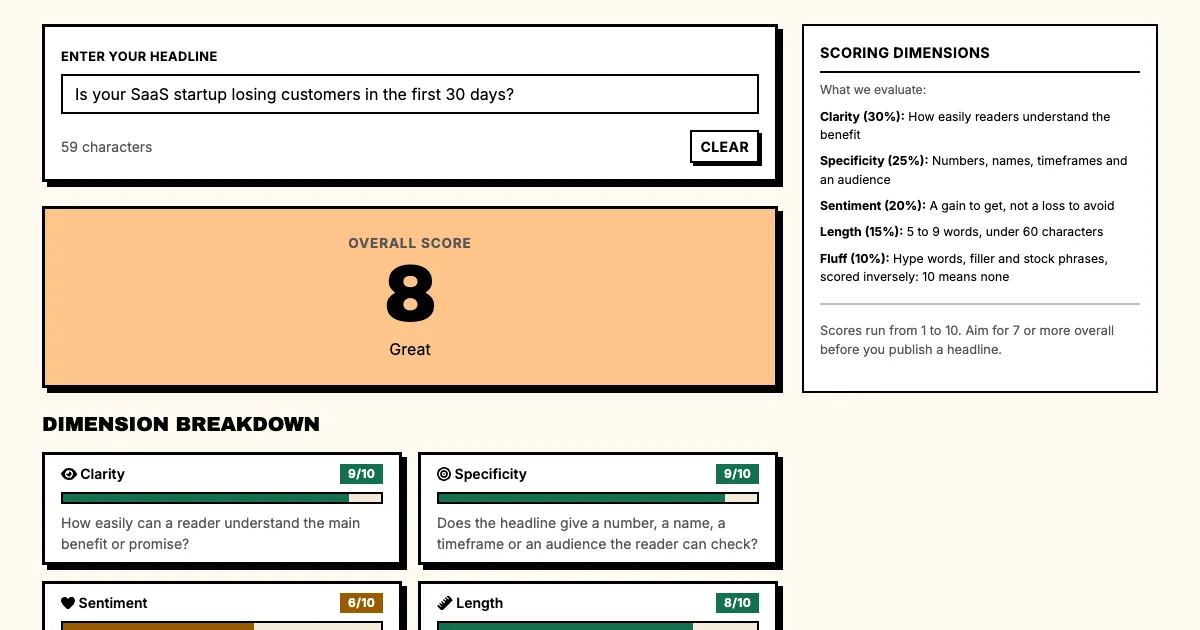
The vague "Is your business struggling?" becomes "Is your SaaS startup losing customers in the first 30 days?", which names the business, the problem and the timeframe. Our live headline rewrites apply the same fix to five more weak headlines.
Mistake 2: Questions without answers
A question headline promises an answer, and the content has to deliver it. If the answer is vague, the reader feels cheated.
Mistake 3: Questions that sound salesy
"Are you ready for the best onboarding tool ever?" reads as the setup for a pitch. A question should sound like you actually want to know the answer.
FAQ: Question headlines
Q: Do question headlines hurt SEO?
A: No. A question that matches how people search can rank well and can earn a featured snippet when the page answers it directly.
Q: What kind of question works best?
A: One the reader has asked themselves and cannot answer. Yes-or-no questions with an obvious answer do not work.
Q: Should the page answer the question in the first sentence?
A: Yes. A question headline earns the click, and an answer right under it earns the reader's trust.
What should you do now?
- Identify one piece of educational content on your site.
- Write a question headline that the content will answer.
- Write three alternative statement headlines for the same content.
- Show each to five people in your target audience.
- Track which headline creates the most engagement.
Sources
Generate question headlines alongside other formats: our AI headline generator writes 20 headlines in one punch.