Headline analyzer tools score a headline on traits linked to clicks, such as clarity, emotion, length and power words. The four tools compared below differ in what they score and in whether they help you fix the result.
Why do you need a headline analyzer?
Writing great headlines is hard, and evaluating them objectively is even harder. When you write a headline, you're emotionally attached to it and you know what you meant, and that attachment clouds your judgment.
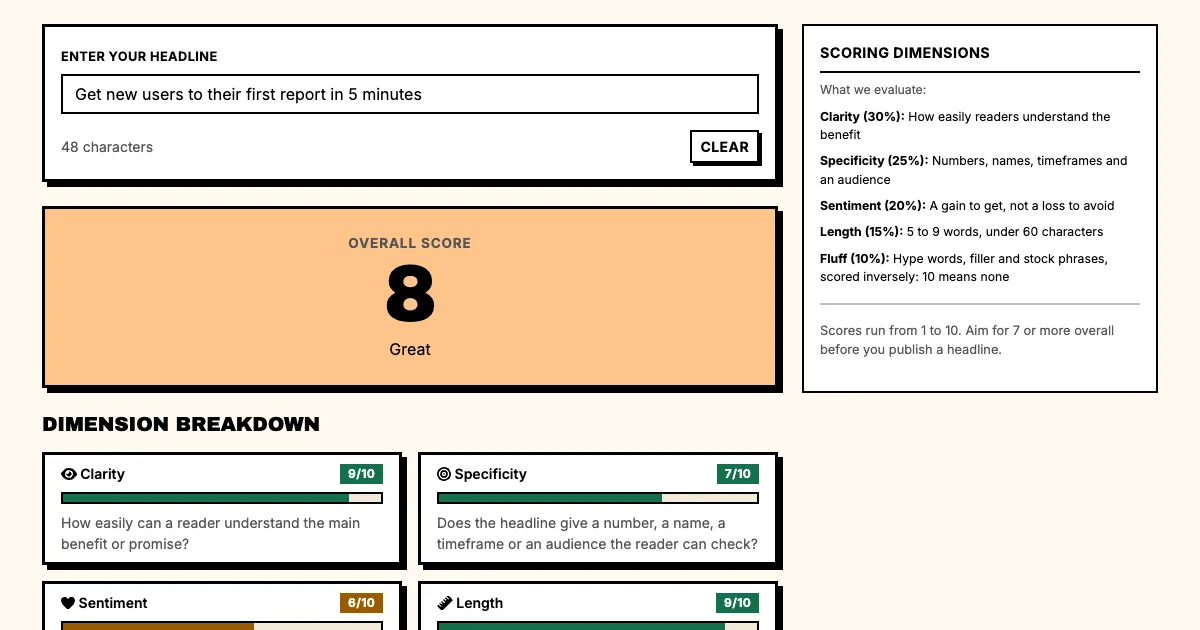
A headline analyzer removes the emotion. It scores your headline against consistent criteria and tells you where it's strong and where it's weak. "Improve your onboarding" names no result, for example, while "Get new users to their first report in 5 minutes" names one with a timeframe.
What should headline analyzer tools score?
The best headline analyzers score across multiple dimensions:
- Clarity: can the reader understand the promise immediately? Vague headlines score low.
- Specificity: does it give a number, a name, a timeframe or an audience? Headlines any competitor could use score low.
- Sentiment: does it promise something the reader gets? Headlines built on what to avoid score lower.
- Length: does it fit platform requirements? Headlines that are too long or too short score low.
- Fluff: is it free of hype words and stock phrases? Headlines full of "ultimate" and "game-changing" score low.
Tools that only give an overall score, without dimension-level analysis, tell you what's wrong but not why.
Punchd Headline Analyzer
URL: punchd.ai/tools/headline-grade
Cost: Free
Scoring dimensions: Clarity, specificity, sentiment, length, fluff
Punchd's free headline analyzer scores your headline on those five dimensions and combines them into one weighted grade. Hype words such as "unlock" and "ultimate" cost points, and numbers, names, timeframes and a named audience earn them.
Punchd's paid generator writes 20 headlines at a time by the same rules. We like that each dimension score tells you exactly where to improve. It's best for SaaS teams who want to write and grade headlines by one set of rules.
CoSchedule Headline Analyzer
URL: coschedule.com
Cost: Free (limited), paid plans from $15/month
Scoring dimensions: Overall score, clarity, sentiment, power words, length
CoSchedule provides an overall headline score with dimension-level breakdowns. Its score has been around longest and has the most benchmarks behind it.
The limit is that the tool is part of a broader content calendar, where headline analysis is a secondary feature. Our CoSchedule alternative comparison goes through the difference feature by feature.
Sharethrough Headline Analyzer
URL: sharethrough.com
Cost: Free
Scoring dimensions: Overall quality score, fluency, meaning
Sharethrough uses natural language processing to evaluate headline quality. The NLP approach is interesting because it evaluates semantic quality as well as surface metrics. It doesn't score conversion potential, emotional triggers, or platform fit, so treat it as a quality checker rather than a conversion tool.
MonsterInsights Headline Analyzer
URL: monsterinsights.com
Cost: Free
Scoring dimensions: Overall score, emotional triggers, length, power words
MonsterInsights provides headline scoring with recommendations. It's free and accessible, and the emotional trigger scoring is useful. It isn't designed specifically for SaaS, though, and the recommendations are generic.
How do you get the most out of headline analyzer tools?
Score a batch of generated headlines
Most teams use headline analyzers to grade headlines they wrote. A better use is to generate 20 headlines, score all 20 with the analyzer and pick the best ones.
Combine multiple analyzers
Different analyzers catch different problems. Use Punchd for conversion-focused analysis and Sharethrough for NLP quality, then compare the scores.
Don't trust scores alone
A score of 8/10 doesn't guarantee a headline will perform. Treat scores as a guide and use your judgment alongside them. A question headline and a command can both score well and still suit different situations, as our guide to the types of headlines explains.
Iterate based on scores
If your headline scores low on specificity, add a number, a name, a timeframe or an audience. If its fluff score is low, replace each hype word with the fact it stands for. Each dimension score tells you what to improve next.
How are headlines scored?
Read headline analyzer scores like this:
| Score | Interpretation | Action |
|---|---|---|
| 9-10/10 | Strong headline | Test against alternatives |
| 7-8/10 | Solid headline | Minor improvements possible |
| 5-6/10 | Average headline | Significant revision needed |
| Below 5/10 | Weak headline | Rewrite from scratch |
FAQ: Headline analyzers
Q: Are free headline analyzers any good?
A: Yes. The best free tools (like Punchd's) score across multiple dimensions without requiring a subscription.
Q: Should I use multiple analyzers?
A: Yes, because each analyzer has different strengths. Use Punchd for conversion scoring and a secondary tool for NLP quality checking.
Q: How accurate are headline analyzer scores?
A: Scores reflect what's known about headline effectiveness, but they don't predict your specific audience's response. Use them as guidance.
Q: Should I trust the score or my gut?
A: Trust both. If your gut says a headline is strong and the score is low, find out why. If the score is low because of a fixable issue (length, hype words, no specifics), fix it.
What should you do now?
- Pick your best current headline.
- Run it through three headline analyzers.
- Compare the scores and recommendations.
- Identify the dimension with the lowest score.
- Rewrite to improve that dimension.
- Re-score the rewritten headline.
Use the analyzers to inform your decisions, and keep the final call yourself.
Sources
Grade your headline for free. Try Punchd's Headline Analyzer: score it on clarity, specificity, sentiment, length and fluff.