An ad headline has to earn a click inside a strict character limit: 30 characters on Google, about 70 on LinkedIn and 40 on Meta. Write the benefit first, add one trigger and test at least two variations per ad group.
Why are ad headlines hard to write?
Paid ads are immediate, and you pay per click. Every headline that doesn't get clicked costs you money.
Most ad headlines are written too fast. They fill the character limit without creating any urgency, and they describe the product instead of speaking to the person reading.
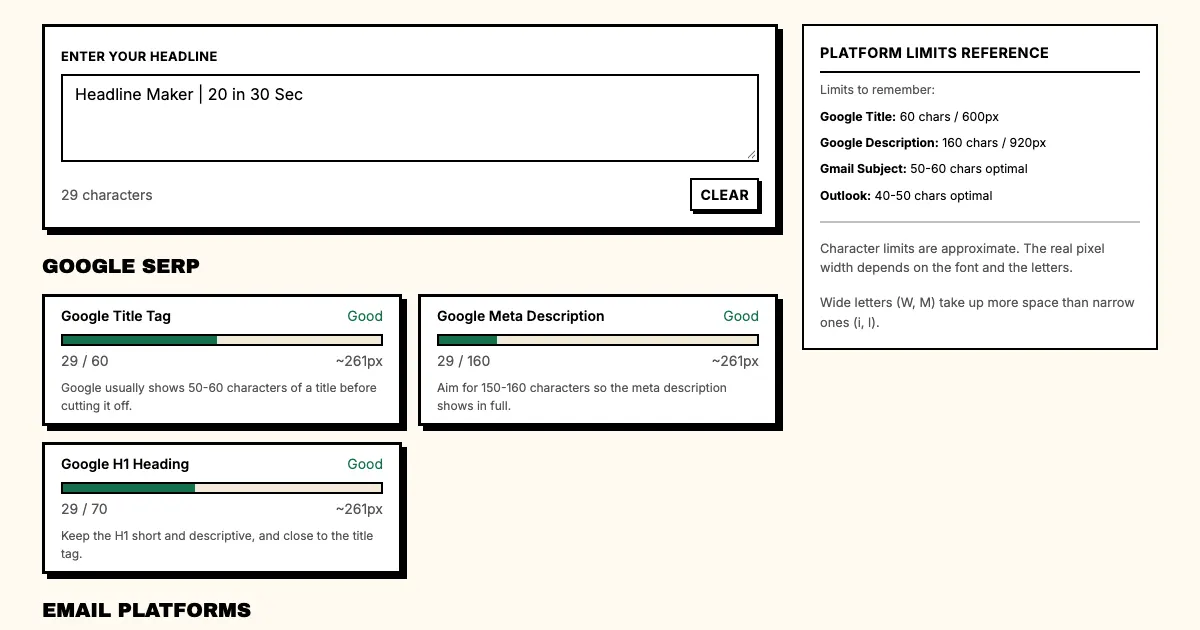
What are the character limits per platform?
Google Ads
- Headline limit: 30 characters each (up to 15 headlines, up to 3 shown at once)
- Description limit: 90 characters each (up to 4 descriptions, up to 2 shown at once)
Google Ads headlines compete in a small space, so every character matters. The description works like a short meta description: it confirms what the headline promised.
Formula: "[Keyword] | [Specific Benefit]"
Example: "Headline Maker | 20 in 30 Sec"
The vertical bar (|) is a standard Google Ads separator. Use it between the keyword and the benefit.
LinkedIn ads
- Headline: 70 characters before it gets cut off (200 maximum)
- Introductory text: 150 characters before it gets cut off
LinkedIn audiences are professional, so headlines should be credible and specific.
Formula: "[Professional outcome] for [professional audience]"
Example: "Generate headlines that convert for B2B marketing teams"
Facebook/Instagram ads
- Primary text: 125 characters
- Headline: 40 characters
- Link description: 25 characters
Facebook ads have more room but more competition for attention. The primary text (body copy) matters as much as the headline.
Formula: "[Emotion] + [Specific outcome]"
Example: "Finally, headlines that get clicks"
Which psychological triggers work in paid ads?
Specificity
The more specific the claim, the more believable it feels.
Weak: "Generate headlines fast"
Strong: "Generate 20 headlines in 30 seconds"
The numbers ("20," "30 seconds") add credibility and tell the reader exactly what they're getting.
Urgency
Paid ads reward action, and urgency gets people to act.
Weak: "Try our headline generator"
Strong: "Start generating headlines now, free for 14 days"
With "Start now" and "free for 14 days", the reader doesn't have to weigh whether to try it later.
Social proof
Social proof reduces perceived risk. Buyers don't want to be the first to try something.
Weak: "The best headline tool"
Strong: "Used by 500+ SaaS marketing teams"
"500+ teams" implies validation, so the buyer doesn't have to trust the brand alone.
Problem naming
A headline that names the problem gets recognized, and recognition drives clicks.
Weak: "Better headline tool"
Strong: "Stop losing clicks to bad headlines"
"Stop losing clicks" names a specific problem, and a reader who is losing clicks recognizes themselves immediately.
What are the best ad headline formulas?
The Google Ads formula
"[Primary keyword] | [Specific benefit]"
Example: "Headline Analyzer | No Signup"
This format works for Google because it includes the keyword, which helps ad relevance (part of Quality Score), and a clear benefit.
The LinkedIn formula
"[Professional outcome] for [professional audience]"
Example: "Cut ad click costs with headlines that convert"
On LinkedIn it offers a professional outcome (cut costs) to a professional audience (people who care about ad performance).
The Facebook formula
"[Emotion] + [Specific outcome]"
Example: "Finally, headlines that get clicks without the guessing"
On Facebook, "finally" triggers the emotion and the rest of the line gives a specific outcome.
How do you test ad headlines?
A/B test your ad headlines with the same A/B testing framework you use for page headlines. What works in theory often fails in practice.
Test variables:
- Question vs. statement
- Specific vs. vague
- Loss framing vs. gain framing
- With number vs. without
- Brand mention vs. no brand
Run each test for at least 100 clicks per variation. The more clicks, the more reliable the data.
What to measure:
- Click-through rate (CTR)
- Cost per click (CPC)
- Conversion rate (CVR)
- Cost per acquisition (CPA)
What are the common ad headline mistakes?
Mistake 1: Keyword stuffing
"Headline generator tool for SaaS headline writing" is keyword stuffing, and it's unreadable.
Write for humans first. Google rewards a good user experience over keyword density, in ads and in the organic title tags below them.
Mistake 2: No differentiation
"SaaS tool" describes every SaaS tool. Replace generic category language with specific benefit language.
Mistake 3: Weak CTAs
"Click here" and "Learn more" are weak, vague CTAs. Specific action language like "Start your free trial" and "Get 20 headlines now" is stronger.
Mistake 4: Ignoring mobile
Most Facebook and LinkedIn traffic comes from mobile, where ad copy needs to be concise and scannable. Test how your ad headlines display on mobile before launching, and use our free headline length checker to count characters as you type.
FAQ: Ad headlines
Q: Should ad headlines match landing page headlines?
A: Yes, when possible. This message match between the ad and the landing page improves Quality Score (Google) and reduces bounce rate.
Q: How many ad variations should I test?
A: At least two. Write your top three headlines and test the best two.
Q: Should I use the same headlines across platforms?
A: No. Each platform has different character limits and audiences, so adapt your core message for each one.
Q: How often should I update ad headlines?
A: Review them monthly. Ad creative fatigue sets in, and headlines that worked three months ago may be tired now.
What should you do now?
- Pick your top-performing ad campaign.
- Run your headline through a headline analyzer.
- Write five alternative headlines using the formulas in this guide.
- A/B test your top two against your current headline.
- Track CTR, CPC, and conversion rate changes.
Paid ads are expensive, and every headline that improves CTR reduces your cost per click, so keep testing.
Sources
- Google Ads Help: responsive search ads
- LinkedIn Marketing Solutions Help: single image ad specifications
- Meta: ads guide
Generate ad headlines that get clicked. Try the AI headline generator: one punch writes 20 headlines.