The benefit vs feature difference is simple: a benefit headline states what the buyer gets, and a feature headline states what the product does. Benefits convert better because buyers compare outcomes, not functions.
What is the feature trap?
Most SaaS headlines fall into the feature trap: they describe what the product does instead of what the buyer gets.
"Analytics dashboard" is a feature. "Know exactly when customers are about to churn" is a benefit.
"Email automation" is a feature. "Send the right email at the right moment without thinking" is a benefit.
The trap is easy to fall into because product teams know their features intimately, and features are concrete and easy to describe. Benefits are abstract and require understanding the buyer's world. Buyers, though, pay for outcomes.
Why do benefits outperform features?
When a buyer evaluates a SaaS product, they're asking one question: "What will this do for me?"
A benefit answers that question directly. A feature leaves the buyer to make the translation, and most buyers won't. They'll move on to a headline that answers the question for them.
That gives benefit headlines three advantages. The buyer sees the value immediately, and the headline does the feature-to-benefit translation, which lowers the cognitive load. Benefit headlines also stand out, because most SaaS competitors describe the same features while fewer describe the same benefits.
A benefit headline states the outcome outright. A curiosity gap headline holds it back to earn the click, which suits blog posts better than landing pages.
How do you turn a feature into a benefit?
The translation takes three steps:
- Name the feature, and be specific. "Automated email sequences" is a feature. "A/B testing for email subject lines" is more specific.
- Identify the outcome. What does the feature enable? "Automated email sequences" enables sending emails at scale without manual work.
- Name the emotional impact. What does the outcome feel like? "Sending emails at scale without manual work" feels like time savings and reduced stress.
As a formula: feature → enabling action → emotional outcome.
Example: "Analytics dashboard" → "See exactly what your best customers do" → "Make decisions with confidence"
Example: "Project collaboration tools" → "Keep your team aligned without the meetings" → "Ship faster without the chaos"
The same translation sits at the core of value proposition headlines, which put the main benefit of the whole product in one line. For a first draft, the free value proposition generator turns your audience, problem and outcome into benefit-led statements.
What do feature and benefit headlines look like side by side?
Automated reporting
Feature headline: "Automated Reporting"
This describes a feature, and the buyer has to figure out what "automated reporting" means for them.
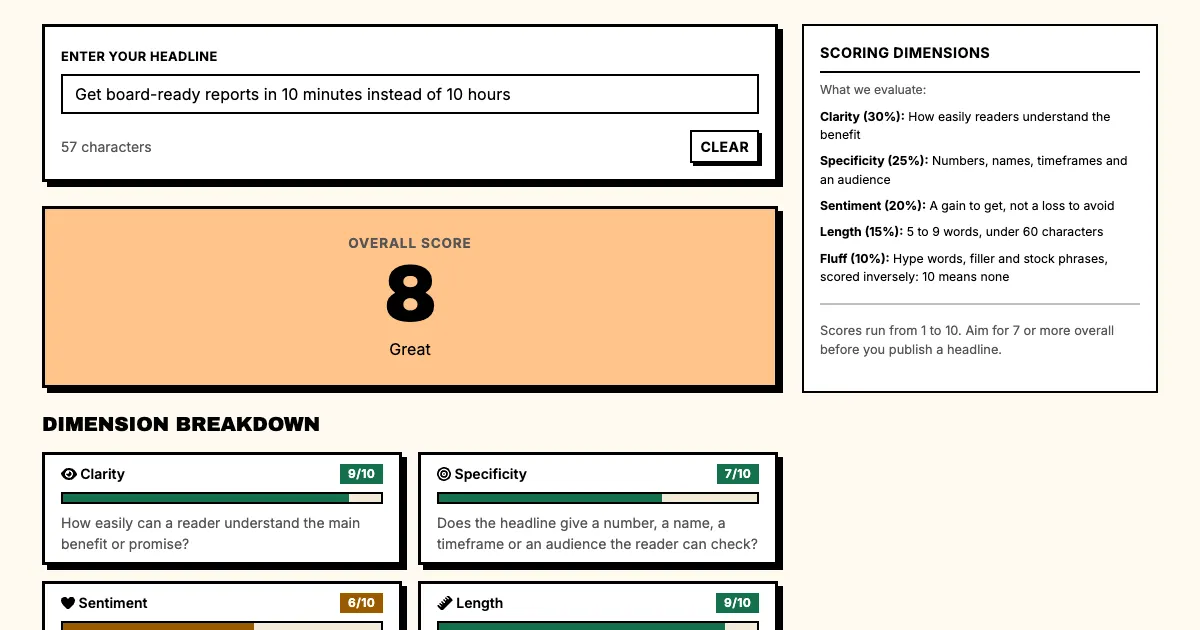
Benefit headline: "Get board-ready reports in 10 minutes instead of 10 hours"
This translates the feature into a benefit. The time comparison ("10 minutes instead of 10 hours") makes the benefit concrete.
Real-time notifications
Feature headline: "Real-Time Notifications"
This describes a feature that could mean anything.
Benefit headline: "Know when customers need attention before they know themselves"
Here the buyer can picture the specific outcome.
Team collaboration
Feature headline: "Team Collaboration"
This describes a category, and every SaaS product claims to enable team collaboration.
Benefit headline: "Where remote teams stop missing each other"
This names a specific problem (remote teams missing each other) and implies a solution (an organized shared space).
What are the common mistakes in benefit headlines?
Mistake 1: Vague benefits
"Get better results" is a promise, not a benefit: better how, and by how much? "Increase email open rates by 25%" is a benefit.
Mistake 2: Generic benefits
"Save time" and "increase efficiency" are generic; they appear in every SaaS headline. A specific benefit ("Cut your Monday standup from 45 minutes to 15") is more compelling.
Mistake 3: Feature-laden benefits
"Get our automated, AI-powered analytics dashboard" is still mostly feature language. "Know exactly which customers are about to churn" is benefit language, even if the mechanism is sophisticated.
Mistake 4: Benefits without proof
"Cut churn by 40%" is a strong benefit. Without a source, it's an unverifiable claim. With data, it's a credible promise.
FAQ: Benefit headlines
Q: When should I use feature language?
A: When your audience is technical and already understands the category. "Webhook support" and "REST API integration" are features that developers search for directly. For broad audiences, benefit language always converts better.
Q: Can I combine features and benefits?
A: Yes, in the right order: the benefit first to create interest, then the feature for credibility. In "Cut churn by 40% using predictive AI", the benefit comes first and the feature provides the mechanism.
Q: What if my features are the differentiator?
A: Then put the feature into your benefit as its mechanism. In "Ship code without breaking production using automated testing", the benefit is shipping confidently and the feature is the mechanism.
What should you do now?
- List your top five features.
- For each feature, write one sentence describing the enabling action.
- For each enabling action, write one sentence describing the emotional outcome.
- Combine the emotional outcome with the feature to create a benefit headline.
- Test the benefit headline against your current feature headline.
Sources
- Wikipedia: Value proposition
- Wikipedia: Unique selling proposition
- Nielsen Norman Group: first impressions
Generate benefit-focused headlines from your product features. Punchd's AI headline generator writes 20 headlines per punch.