An emotional headline makes a professional buyer feel the cost of the problem or the relief of the solution before the logic kicks in. B2B buyers decide with emotion and justify with data, so emotion belongs in the headline.
Why does emotion belong in B2B copy?
B2B buyers are professionals, and the usual picture is that they decide on data, ROI and business requirements without letting emotion drive the choice. In practice, every purchasing decision has an emotional side: the feeling of solving a painful problem, the relief of removing friction, the confidence of picking the right tool and the fear of picking the wrong one.
Emotion fits professional copy because wanting to solve real problems, reduce frustration and get results is part of being a professional. Our primer on copywriting psychology covers the principles behind these feelings, from loss aversion to social proof.
The hard part is using emotion honestly. Cheap manipulation ("You'll regret not buying this!") backfires, while genuine emotion ("Finally, onboarding that actually works") builds trust.
Which emotions drive SaaS headlines?
Relief
Relief is one of the strongest emotions in SaaS copy. It speaks to the frustration of a problem that hasn't been solved yet.
Example: "Finally, an analytics tool that doesn't require a data scientist"
"Finally" signals that the problem has been around for a while, and a reader who has struggled with data science complexity recognizes it right away.
Use it when your product solves a frustrating problem that competitors haven't solved well.
Confidence
Confidence is the feeling of knowing you're making the right choice. Headlines that build it reduce purchase anxiety.
Example: "Built on the same framework that scaled Stripe and Notion"
Named companies give the reader a reference point. A reader who is unsure can point to those companies and feel confident.
It suits a risk-averse buyer who needs validation before committing.
Urgency
Urgency is the feeling that delay has a cost. It gets the reader to act before they move on.
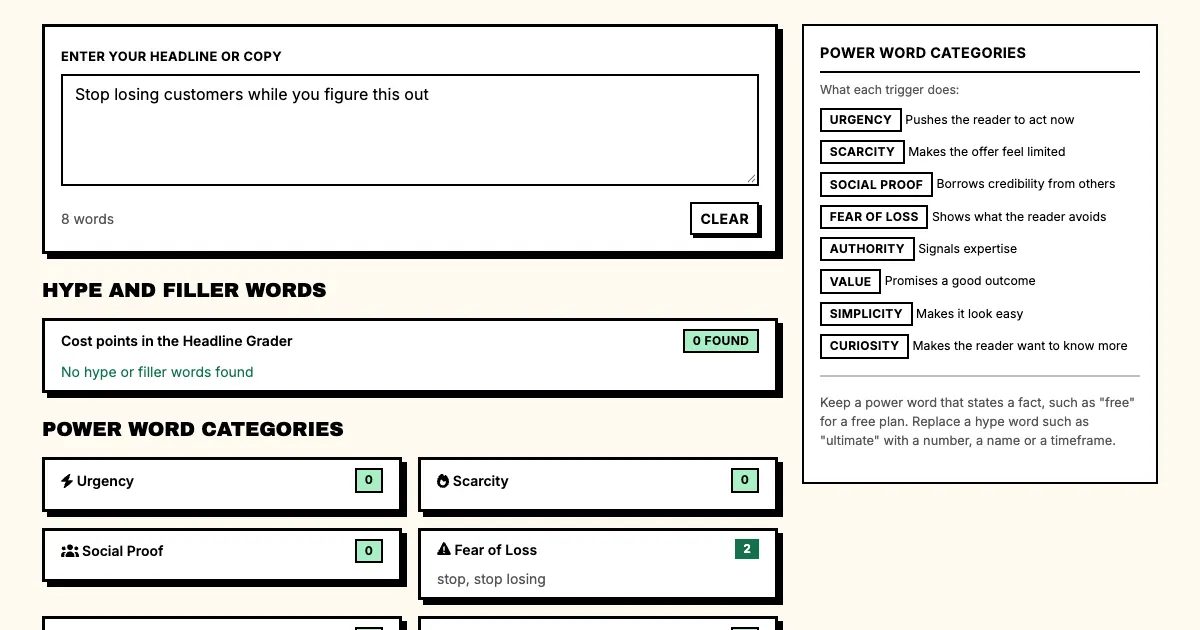
Example: "Stop losing customers while you figure this out"
"Stop losing customers" names the ongoing cost of inaction, and a reader who is losing customers feels the urgency at once.
Save it for problems that are costing the buyer something right now; it doesn't suit awareness-stage content.
Curiosity
Curiosity is the desire to resolve uncertainty, and it drives clicks and engagement.
Example: "The onboarding metric most SaaS companies ignore"
"Most SaaS companies ignore" raises two questions: why is it ignored, and is our company ignoring it? The reader clicks to find out.
Use it when your content has a specific, surprising insight to deliver.
Pride
Pride is the feeling of doing something well. Headlines that appeal to it drive adoption among teams that want to excel.
Example: "The headlines your competitors will try to copy"
"Your competitors will try to copy" appeals to the wish to be ahead, which motivates a reader who wants to outpace competitors.
It fits a competitive buyer who wants to outpace peers.
Fear
Fear is the feeling that something bad is about to happen. Used ethically, it creates urgency; used to manipulate, it creates distrust.
Example: "The pricing mistake that's costing you 20% of signups"
"20% of signups" is a specific cost, and a reader who suspects they're making a pricing mistake feels the fear.
Use it when the fear is real and specific and you offer a solution with it. False fear creates anxiety instead of action, and our guide to negative vs positive headlines shows when naming the loss beats naming the gain.
How do you write emotional headlines without faking it?
Rule 1: Make the emotion specific
"Your customers are unhappy" is vague. "Your best customers are about to churn" is specific, and specific emotion creates recognition.
Rule 2: Connect emotion to outcome
Emotion without an outcome is manipulation. "You'll feel relieved" is vague. "Cut your support tickets in half so your team can focus on real problems" ties the relief to a specific outcome.
Rule 3: Match emotion to audience
B2B buyers in different roles respond to different emotions. A CEO responds to the fear of losing customers, a product manager to the pride of building something great.
Rule 4: Don't overdo it
Use one emotion per headline. "Exciting, urgent, confidence-building news about your rapidly growing business" tries to trigger three emotions and triggers none.
Single power words such as "stop" (urgency) or "proven" (confidence) often carry the emotion on their own. Paste a draft into the free power word checker to see which triggers it already pulls.
FAQ: Emotional headlines
Q: Which emotion converts best in B2B?
A: Relief from a felt pain, followed by fear of falling behind. Pure excitement rarely works for professional buyers.
Q: Can an emotional headline still sound professional?
A: Yes. Name the business cost of the problem in plain words; the stakes carry the emotion, so you don't need emotional adjectives.
Q: How do I know if the emotion fits my audience?
A: Read your support tickets and sales calls. The words customers use for their problem are the emotion to use.
What should you do now?
- Identify the primary emotion your product resolves.
- Write three headlines that trigger that emotion.
- Show each headline to five people in your target audience.
- Ask: "Does this headline make you feel [emotion]?"
- Keep the headline that creates the strongest emotional response.
Our 50 ranked headline examples show several of these emotions at work.
Emotion is what makes copy memorable; without it, you're only describing features.
Sources
Grade your headlines on emotional resonance. Use the Headline Grader: score headlines on clarity, specificity, sentiment, length and fluff.