These 50 SaaS headline examples are ranked from strongest to weakest, with the reason for each grade. Copy the patterns in the top tier and avoid the ones at the bottom.
How were these headlines ranked?
The 50 headlines are real, taken from live SaaS landing pages, email subject lines and ad campaigns.
Each one is scored from 1 to 10 for conversion potential, based on how well the headline:
- Creates recognition for the target audience
- Makes a specific, defensible promise
- Handles objections or creates urgency
- Stands out from category noise
The scores come from copywriting principles, not A/B test data, so your own audience may respond differently. Use the examples as inspiration and as benchmarks for your own headlines, and paste yours into the free headline analyzer for an instant score.
Tier 1: The strongest headlines (9-10/10)
These headlines get specificity, urgency and the promise right, so the right buyer stops and reads.
1. "See exactly where your best customers drop off"
Score: 10/10. "Exactly" promises precision, and "where your best customers drop off" names a specific, painful problem. The buyer can picture the insight right away.
2. "Cut your churn in half before your next billing cycle"
Score: 10/10. "In half" is a specific, dramatic outcome, and "before your next billing cycle" adds urgency that doesn't feel artificial. The promise is fast and measurable.
3. "Stop answering the same support questions every week"
Score: 10/10. "Every week" and "stop answering" make the problem feel urgent, and "the same support questions" is specific enough that every support team leader recognizes themselves. It's a loss frame done well; see negative vs positive headlines for when to use one.
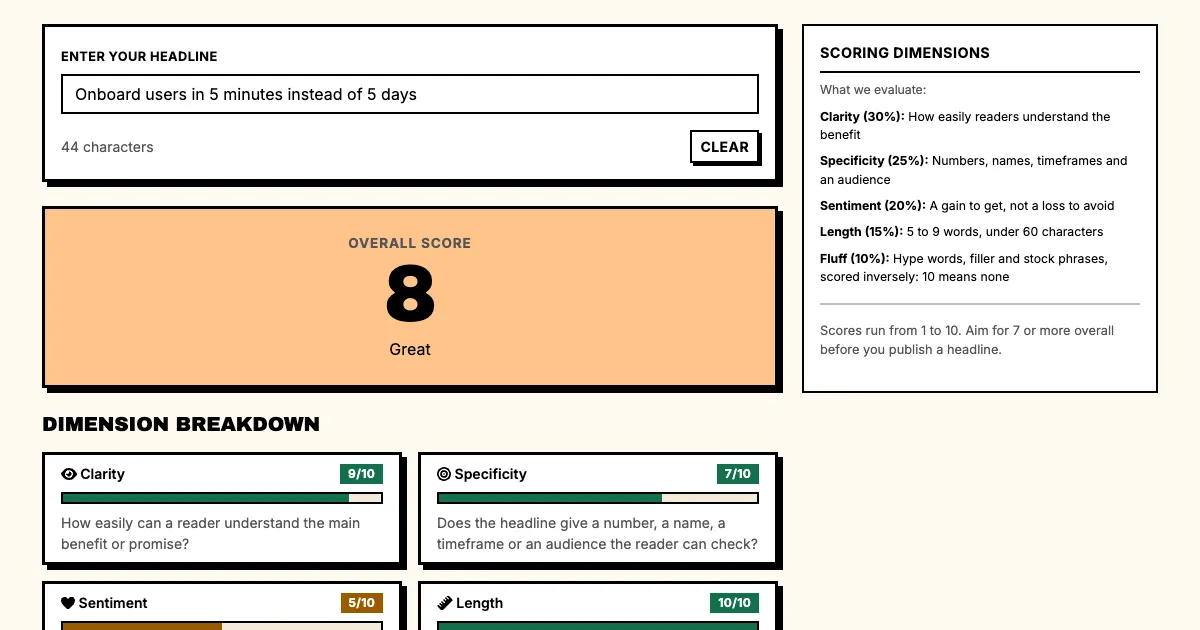
4. "Onboard users in 5 minutes instead of 5 days"
Score: 9/10. It's a before/after comparison, and "5 minutes vs 5 days" is a dramatic change that still sounds believable because the contrast is specific.
5. "The only CRM with built-in call intelligence"
Score: 9/10. "The only" claims exclusivity, and "built-in call intelligence" is a specific differentiator. It sticks because it claims something no competitor can match.
6. "Your team will actually use this project management tool"
Score: 9/10. "Actually use" implies that most project management tools go unused. That's the biggest unspoken objection to adoption, and the headline addresses it honestly and specifically.
7. "For startups who need Series A metrics without a data team"
Score: 9/10. "For startups" qualifies the audience precisely, "Series A metrics" signals the stage, and "without a data team" removes the biggest barrier to getting those metrics.
8. "Real-time alerts when your customers are about to churn"
Score: 9/10. "Real-time" adds urgency, and "when your customers are about to churn" names a specific, high-stakes event. The implication is that without this tool, you'd never know.
9. "Generate reports your board actually wants to see"
Score: 9/10. "Actually wants to see" implies that most reports get ignored. The headline names a specific frustration (boring board reports) and promises a specific fix.
Tier 2: Strong performers (7-8/10)
These are solid headlines: they create some recognition and make a promise. Each loses points for vagueness somewhere.
10. "The customer success platform for SaaS"
Score: 8/10. "Customer success platform for SaaS" is clear category positioning, but it's generic.
11. "Automate your marketing. Grow your revenue."
Score: 8/10. Two clear promises, and both "automate" and "grow" are about outcomes. "Grow your revenue" is vague, though.
12. "Close deals 40% faster with AI-powered forecasting"
Score: 8/10. "40% faster" is a specific number and "AI-powered forecasting" is a credible mechanism. "Close deals" is vague: what kind of deals?
13. "The project tracker that doesn't require a PhD to use"
Score: 8/10. "Doesn't require a PhD" is funny and memorable, and it answers a real objection (complexity). The category ("project tracker") is generic.
14. "Ship code faster without breaking production"
Score: 8/10. "Ship code faster" is a clear outcome and "without breaking production" addresses a real fear. Non-technical buyers may not connect with "ship code."
15. "The Zapier alternative that actually scales"
Score: 8/10. "Zapier alternative" is clear positioning, and "actually scales" points at a real limitation of the competitor. The promise itself ("scales") is vague.
16. "See which features your power users love"
Score: 8/10. "Power users" is specific audience language and "which features they love" is a specific insight you can act on. It isn't urgent enough.
17. "Turn your help docs into a self-service support hub"
Score: 8/10. "Turn into" suggests a transformation and "self-service support hub" is a specific outcome. "Help docs" is a bit dry.
18. "The email tool built for teams who hate email"
Score: 8/10. "Who hate email" gets instant recognition; this headline knows its audience. It loses points because the alternative, "teams who love email," would be an unusual audience.
19. "Know why customers cancel before they hit cancel"
Score: 8/10. "Know why customers cancel" is a specific insight worth having, and "before they hit cancel" adds urgency, though that phrase is a bit awkward.
20. "For customer success teams who need better retention data"
Score: 7/10. "Customer success teams" is specific and "better retention data" is a clear need, but "better" is vague.
21. "Analytics that tell you what to do next"
Score: 7/10. "What to do next" is a clear promise, but so many headlines use "tell you what to do next" that it no longer sets anyone apart.
22. "The all-in-one workspace for remote teams"
Score: 7/10. "All-in-one" and "remote teams" make it relevant to the target audience. "Workspace" is generic.
23. "Automate reporting so your team can focus on strategy"
Score: 7/10. "Focus on strategy" is a clear benefit. "Automate reporting" is vague: what reports?
24. "Better customer insights in under 10 minutes"
Score: 7/10. "Under 10 minutes" is a specific timeframe and "better customer insights" is a clear outcome, but "better" is vague.
25. "The support tool that makes customers love you"
Score: 7/10. "Makes customers love you" is an emotional outcome, but "support tool" is generic and "love you" is a stretch. Our guide to emotional headlines shows how to tie a feeling to a concrete result.
Tier 3: Solid but forgettable (5-6/10)
These headlines are accurate but create little urgency or recognition. They describe the product and promise no outcome.
26. "AI-powered customer support automation"
Score: 6/10. "AI-powered" and "customer support automation" are both category-adjacent, and "automation" is vague.
27. "The modern CRM for modern sales teams"
Score: 6/10. Saying "modern" twice gives it rhythm, but the word doesn't mean anything specific.
28. "Streamline your workflows with intelligent automation"
Score: 6/10. "Streamline" and "intelligent" are positive words, but "workflows" is vague and "intelligent" is overused.
29. "The platform that helps you understand your customers"
Score: 6/10. "Understand your customers" is a clear goal. "Helps you understand" is passive.
30. "All your data in one place"
Score: 6/10. It addresses a real pain (disconnected data), but it's been used so many times it sounds cliché.
31. "Powerful analytics without the complexity"
Score: 6/10. "Without the complexity" handles an objection. "Powerful analytics" is generic.
32. "The smarter way to manage projects"
Score: 5/10. "Smarter way" implies an improvement on the status quo, but "manage projects" is vague and "smarter" is meaningless.
33. "The tool teams use to get more done"
Score: 5/10. Nothing works here. "Get more done" is the vaguest possible promise; this headline could describe a hammer.
34. "Your all-in-one business solution"
Score: 5/10. "All-in-one" adds some relevance, but "business solution" is completely generic.
35. "The future of customer engagement"
Score: 5/10. "Future" and "engagement" are positive words, but neither means anything specific.
36. "Transform the way you work"
Score: 5/10. "Transform" sounds ambitious. "The way you work" is vague: what way?
37. "Built for teams who move fast"
Score: 5/10. "Move fast" speaks to a specific type of team, but the headline never tells the buyer what they'll get.
38. "Enterprise-grade features for teams of all sizes"
Score: 5/10. "Enterprise-grade" signals quality. "Teams of all sizes" creates no urgency.
39. "The CRM your team will actually use"
Score: 6/10. "Actually use" implies that most CRMs go unused, which makes it memorable. The category ("CRM") is generic.
40. "Real-time collaboration for modern teams"
Score: 5/10. "Real-time" and "collaboration" are both clear concepts, but "modern teams" is vague.
Tier 4: Weak and vague (3-4/10)
These headlines name a category and promise no outcome. Each could describe dozens of products.
41. "The leading project management software"
Score: 4/10. "Leading" sounds positive, but "project management software" is generic and "leading" is unverified.
42. "Smarter workflows, better results"
Score: 4/10. "Smarter" and "better" are positive comparatives, and both are vague.
43. "The platform for modern teams"
Score: 4/10. "Modern teams" adds some relevance, but "platform" and "modern" are both generic.
44. "Everything you need to succeed"
Score: 4/10. "Everything you need" sounds comprehensive. "Succeed" is vague and unmeasurable.
45. "The smarter solution for your business"
Score: 3/10. "Smarter solution" sounds positive, but "your business" is completely generic and "smarter" is meaningless.
46. "Powerful features, intuitive design"
Score: 3/10. Two positive adjectives, both overused and unverified.
47. "The next generation of productivity tools"
Score: 3/10. "Next generation" sounds innovative but means nothing, and "productivity tools" is generic.
48. "Built for scale, designed for success"
Score: 3/10. "Built for scale" sounds technical. "Designed for success" is corporate jargon.
49. "The complete solution for modern businesses"
Score: 3/10. "Complete solution" sounds comprehensive but is overused, and "modern businesses" is vague.
50. "Empowering teams to achieve more"
Score: 3/10. "Empowering" sounds positive. "Achieve more" is vague enough that this headline could describe any product ever made.
What do the best headline examples have in common?
Across all 50 headlines, the winners are specific. "See exactly where your best customers drop off" beats "better customer insights" every time, because specificity creates credibility. Our SaaS headline data from 1,000 headlines points the same way.
They are also honest. Headlines that promise specific outcomes ("cut churn in half") earn more trust than vague claims ("get better results"), and headlines that are honest about tradeoffs and address objections ("without a data team") outperform the ones that ignore them.
The losers lean on filler words. "Modern," "smarter," "powerful," "intelligent" and "next-generation" show up in weak headlines because they're easy to write and impossible to verify.
The losers also describe categories. "CRM," "project management," "analytics" and "productivity" name options without making anyone want one.
FAQ: SaaS headline examples
Q: Can I copy these headlines?
A: Copy the structure and write your own words: swap in your own outcome, timeframe and objection.
Q: How were the examples graded?
A: On the four traits listed at the top: recognition, a specific promise, objection handling and standing out. The free Headline Grader scores related traits automatically: clarity, specificity, sentiment, length and fluff.
Q: Why do some short headlines score low?
A: Because short is not the same as clear. A two-word headline with no benefit scores lower than a ten-word headline with one.
What should you do now?
- Find your three best headlines.
- Score each one on specificity, promise clarity, and objection handling.
- Identify which elements are weak.
- Rewrite the weak elements using specific language.
- Test the rewritten headline against your original.
The gap between a 6 and a 9 is specificity, so spend the rewrite on the words that state your promise exactly.
Sources
Want 20 headline variations for your landing page? Try the AI headline generator, then grade the ones you like on clarity, specificity, sentiment, length and fluff.