The choice between negative vs positive headlines comes down to timing: negative framing wins when the pain is felt now, positive framing wins when the buyer is already comparing options. A negative headline names the problem to avoid, a positive one names the gain to get, and the strongest headlines often use both.
What are the two ways to frame a headline?
Positive framing is about what the buyer gains. "Cut your support tickets by 40%" is about the reduction in tickets.
Negative framing is about what the buyer avoids. "Stop answering the same support questions every week" is about ending a frustrating routine.
Both describe the same outcome, but they trigger different psychological responses. Knowing when to use each is one of the highest-return skills in writing headlines that get clicks.
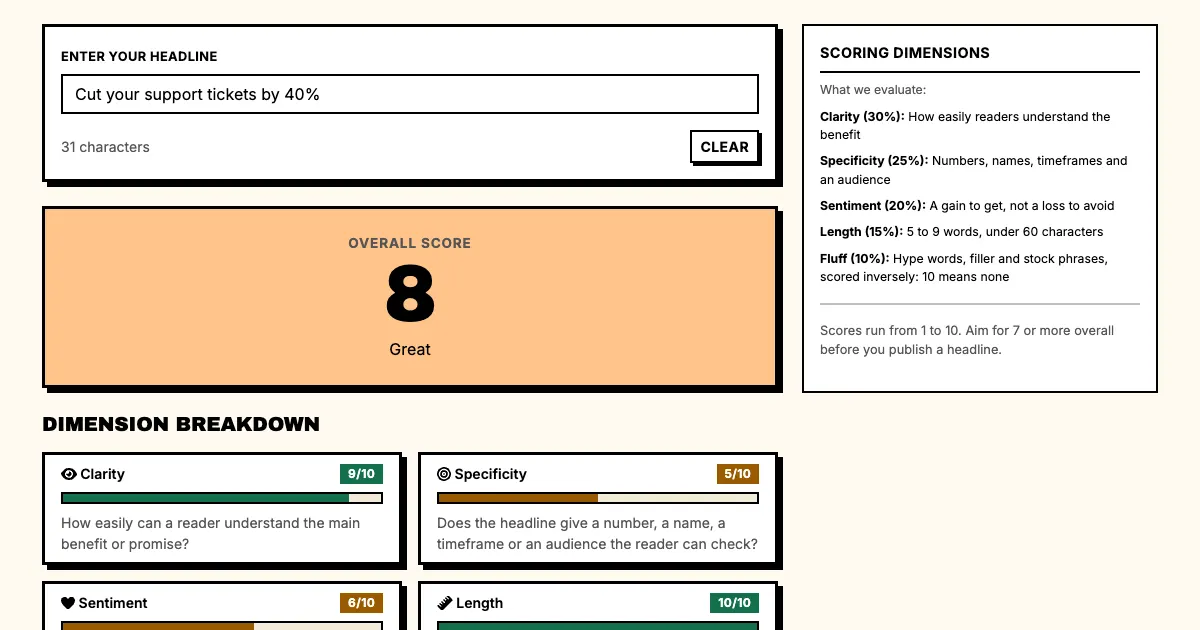
What is the psychology behind negative and positive framing?
Positive framing
Positive framing activates the brain's reward system. "Gain $100" feels good, because the brain processes gains as immediately valuable.
Positive framing works well when:
- The buyer is already motivated to act
- The outcome is clearly desirable
- You want to show what's unique about your product
Negative framing
Negative framing taps into loss aversion. "Avoid losing $100" feels more urgent than "Gain $100." Research consistently shows that losses loom larger than gains.
Negative framing works well when:
- The buyer is hesitant to act
- The problem is actively costing them something
- You want to create urgency around a specific pain point
When should you use positive framing?
When targeting motivated buyers
Buyers who already have the problem and are looking for a fix respond to positive framing. They've decided they want a solution, and now they want to know why yours is the best option.
"Cut your churn by 30% with our automated retention system" works for buyers who already know they have a churn problem.
When the outcome is desirable
Some outcomes are plainly good. "Your team will actually use this tool" is a positive outcome that needs little explanation.
When differentiating your product
Positive framing is the natural way to state what's unique. "The only CRM with built-in call intelligence" names one specific differentiator.
When should you use negative framing?
When the problem is active
If the buyer is living with the problem right now, negative framing gets immediate recognition. "Stop losing customers in your first 30 days" works for a buyer who is watching customers churn.
When creating urgency
Loss aversion is stronger than the pull of a gain, so negative framing creates urgency. "Don't let another customer slip through the cracks" is more urgent than "Help customers succeed."
When addressing skepticism
Skeptical buyers respond to negative framing because it shows you understand their situation. "The onboarding mistake that kills retention" tells them you know that onboarding failures are common and painful.
Can one headline combine negative and positive framing?
Yes, and the best headlines often do. They name the problem (negative) and promise the solution (positive).
"Stop losing customers to bad onboarding. Start growing with a retention system that works"
This headline uses negative framing for the problem ("stop losing customers") and positive framing for the solution ("start growing").
The pairing works because it speaks to the fear and the hope at once. A buyer who's losing customers feels the fear, and a buyer who wants to grow feels the hope.
The same pairing works on demo request pages, where a hesitant buyer needs to see both the cost of waiting and the payoff of booking.
What are the common headline framing mistakes?
Mistake 1: Only using positive framing
Some writers default to positive framing because it feels optimistic, and they miss the urgency that loss aversion creates.
Mistake 2: Only using negative framing
Negative framing on its own creates fear with no hope attached. The reader feels the problem, doesn't see the solution and closes the page without acting.
Mistake 3: Vague framing
"Improve your results" is vague positive framing, and "Stop wasting time on manual reporting" is vague negative framing. Either frame needs the numbers and names you see in strong headline examples to work.
FAQ: Headline framing
Q: Is negative framing manipulative?
A: Not when the problem is real and the solution is delivered. It becomes manipulative when the fear is invented.
Q: Which frame works better for ads?
A: Negative framing often wins the click; positive framing often wins the conversion. Test both on the landing page.
Q: Can one headline use both frames?
A: Yes: name the problem, then the gain ("Stop losing leads. Book 3x more demos.").
What should you do now?
- Take three of your current headlines, or draft new ones with the AI headline generator.
- Rewrite each one with positive framing.
- Rewrite each one with negative framing.
- For each headline, combine both framings.
- Show all variations to five people in your target audience.
- Track which framing creates the strongest response.
The right frame depends on the buyer and the moment, so A/B test both headlines with your own audience.
Sources
Compare positive and negative framing. Use the Headline Grader to score each version on clarity, specificity, sentiment, length and fluff.