There are 10 types of headlines, from benefit statements to guarantees, and each one fits a different audience and funnel stage. Pick the type first, then write the words.
Why does the headline type matter?
A headline that works in email won't work on a landing page, and one that drives clicks won't necessarily drive conversions. The right type depends on three things:
- The audience's stage. Awareness audiences need recognition, consideration audiences need trust and decision audiences need urgency.
- The platform. Google displays 50-60 characters before truncating. Email subject lines show 40-50 characters. Landing page H1s have more room but compete for attention differently.
- The goal. Clicks, signups and shares each call for a different headline type.
1. Benefit statements
Benefit statements lead with what the buyer gets, in direct, outcome-focused terms. On a homepage, a benefit statement often doubles as the value proposition headline.
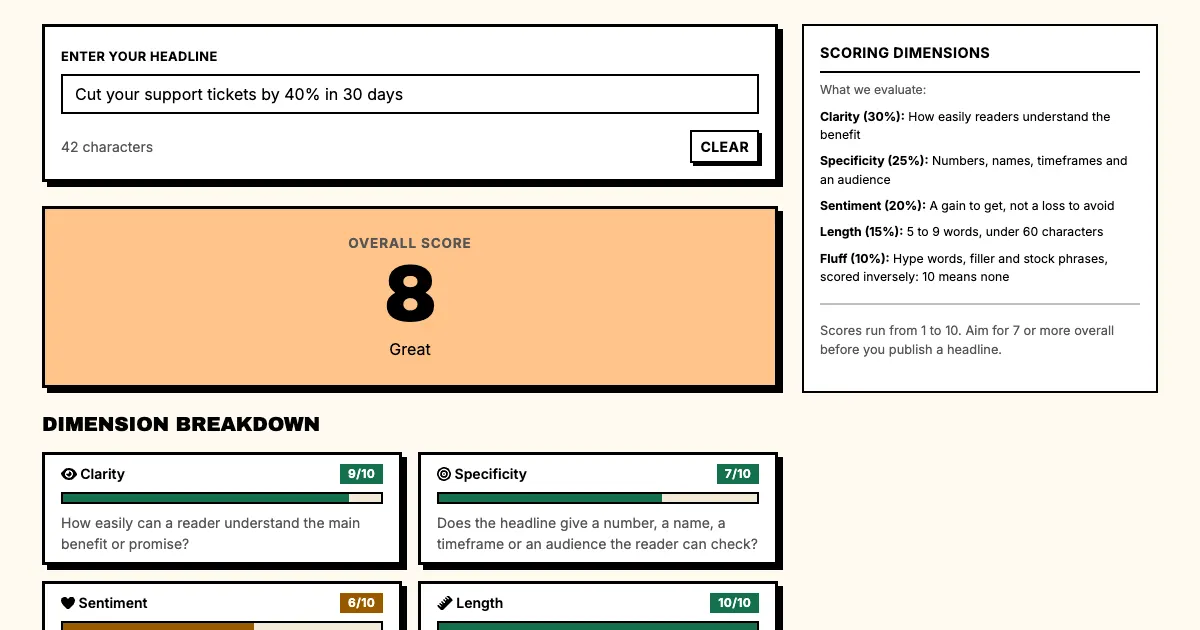
Example: "Cut your support tickets by 40% in 30 days"
Best for: Consideration-stage landing pages, feature pages, comparison content.
The buyer sees the value right away and doesn't have to interpret what they'll get. The number ("40%") and the timeframe ("30 days") make it specific.
Avoid them when your benefit is vague. "Improve your workflow" is an aspiration, not a benefit. Make the benefit concrete.
2. Problem acknowledgment
Problem acknowledgment headlines name the pain before presenting the solution, so the reader feels seen.
Example: "Tired of onboarding flows that kill your retention?"
Best for: Awareness-stage content, email subject lines, social ads.
The reader recognizes the problem and thinks "that's me," and that recognition drives engagement.
Avoid them when the problem is vague. Nobody recognizes themselves in "Having issues?" Make the problem specific enough that only your target audience recognizes it.
3. Questions
Question headlines play on curiosity: the reader wants the answer.
Example: "Is your pricing page costing you conversions?"
Best for: Consideration-stage content, blog posts, email sequences.
A question implies that the answer matters. The reader already has an opinion on the topic, and the question makes them examine it.
Avoid generic questions: "What is SaaS?" creates no urgency. The best question headlines suggest the reader might be doing something wrong.
4. Command statements
Command statements tell the reader what to do, directly and with urgency.
Example: "Stop using generic onboarding emails"
Best for: Decision-stage content, CTAs, notification copy.
A command creates urgency without explaining itself. The reader either agrees and acts or disagrees and considers an alternative, and either way they've engaged.
Avoid commands that push too hard. "Buy now" creates pressure without context. A command works best with a reason attached.
5. Fear appeals
Fear appeal headlines warn about a bad outcome and imply that doing nothing has a cost.
Example: "The onboarding mistake that's costing you 30% of signups"
Best for: Awareness-stage content, educational content, email subject lines.
Fear appeals tap into loss aversion: the pain of losing something is stronger than the pleasure of gaining something. A good fear appeal makes the reader feel the real cost of not acting.
Avoid fear that isn't credible. "You might be doing everything wrong" creates anxiety instead of urgency. Fear appeals work when the cost is specific and the solution is clear.
6. Social proof statements
Social proof headlines borrow credibility from other buyers by showing that others have already validated the choice.
Example: "Used by 500+ SaaS companies to improve retention"
Best for: Decision-stage content, pricing pages, signup CTAs.
Social proof lowers perceived risk. If 500 companies use the product, it must be safe, and the reader doesn't have to be the first to try something new.
Avoid vague proof like "Trusted by thousands." Numbers and named companies add credibility.
7. Curiosity gaps
Curiosity gap headlines hold back information, so the reader feels the answer is worth having.
Example: "The real reason your headlines aren't converting"
Best for: Awareness-stage content, blog posts, social media.
The gap creates tension the reader wants to resolve, and the implied promise ("the real reason") makes resolving it feel worthwhile.
Avoid them when you can't deliver on the implied promise. "The truth about everything" creates skepticism instead of curiosity. Curiosity gaps work when you have a specific, surprising answer.
8. Comparison hooks
Comparison hook headlines set two approaches side by side, which makes the reader evaluate their own.
Example: "Why most onboarding flows fail (and what the best ones do differently)"
Best for: Consideration-stage content, comparison content, educational content.
The reader weighs their current approach against the alternative, and the contrast makes both clearer.
Avoid a biased comparison. Comparison hooks work best when you compare approaches instead of attacking competitors.
9. Numbered lists
Numbered list headlines promise structured, digestible content and a sense of completeness.
Example: "7 headline formulas that doubled our CTR"
Best for: Educational content, blog posts, resource pages.
The reader knows how many items they'll get. "7 ways" feels more manageable than "everything you need to know."
Avoid an arbitrary number. "5 things you might not know" creates no urgency if the 5 things aren't notable. Make the number mean something.
10. Guarantee statements
Guarantee headlines lower perceived risk: they promise an outcome and offer compensation if it isn't achieved.
Example: "Reduce churn by 20%, or get your money back"
Best for: Decision-stage content, pricing pages, trial CTAs.
A guarantee removes the biggest objection to trying a new product, because the buyer can try it without risk. It has to be credible and easy to claim.
Avoid a guarantee nobody believes. "Double your revenue or your money back" sounds good but isn't credible. Guarantee something you can deliver.
Which headline type fits which funnel stage?
| Funnel stage | Best headline types |
|---|---|
| Awareness | Problem acknowledgment, curiosity gaps, fear appeals |
| Consideration | Benefit statements, questions, comparison hooks |
| Decision | Commands, social proof, guarantee statements |
What should you do now?
- Pick three important pages on your site.
- Note the current headline type for each page.
- Determine which funnel stage each page targets.
- Write headline variations in a different type for each page and test them.
- Measure engagement and conversion changes, and keep testing until each page has the type that fits it.
FAQ: Headline types
Q: Which headline type converts best?
A: Benefit statements, on most SaaS landing pages. The other types win in specific places: questions in email, social proof on pricing pages, fear appeals for security products.
Q: Can I mix two types in one headline?
A: Yes. A benefit statement with a number is also a specificity headline; a question with a stat is also social proof. Mix two at most.
Q: How do I pick the type for a page?
A: By funnel stage. Awareness pages take curiosity and problem types, consideration pages take benefits and comparisons, decision pages take guarantees and social proof.
Sources
Generate headlines in multiple formats: our AI headline generator writes 20 headlines in different styles in one punch.