A value proposition headline states a specific outcome, the person it is for and the constraint it removes, without leading with price. It justifies a premium because the buyer sees the worth before the cost.
Why are value propositions hard to write?
A value proposition headline has one job: make the buyer believe that the outcome is worth the cost. That's harder than it sounds.
Most buyers have been burned by SaaS products that overpromised and underdelivered. They've paid for tools that gathered dust in their app drawer, so they arrive skeptical. Your headline has to get past that and convince them that your specific promise is worth your specific price.
Value also depends on how the buyer perceives it, a core idea of copywriting psychology. A $100/month tool that saves 10 hours of work is cheap, and a $100/month tool that saves 1 hour of work is expensive.
The price is the same and the value is different, which is why the headline has to name the specific value you deliver.
What are the three components of a value proposition headline?
Component 1: Specific outcome
Name a specific outcome, such as "cut your support ticket volume by 40%." "Improve efficiency" and "save time" are too vague.
Specificity creates credibility. Vague promises ("better results") don't make anyone believe you, and specific numbers do.
The outcome is what the buyer gets, not what you built. Our guide to benefit vs feature headlines shows how to turn one into the other.
Component 2: Specific audience
Name a specific audience, such as "B2B SaaS companies with 20-50 employees." "Businesses" and "teams" could be anyone.
Specificity creates relevance. When buyers see themselves in the headline, they believe you understand their situation.
Component 3: Specific constraint (optional but powerful)
The headline should also address a constraint or objection: what the buyer is struggling with right now, on top of what they get.
"Cut churn for SaaS companies without a dedicated customer success team" identifies the constraint (no customer success team) along with the audience (SaaS companies) and the outcome (cut churn).
4 value proposition headline formats with examples
Format 1: The outcome-forward statement
"For [audience]: [specific outcome]"
Example: "For SaaS founders who need Series A metrics: churn analysis in under 5 minutes"
It leads with the audience and gives the outcome right after.
Format 2: The transformation statement
"Turn [problem state] into [outcome state]"
Example: "Turn your onboarding chaos into customer loyalty"
The before and after implies the value: the reader sees the change your product makes.
Format 3: The objection handling statement
"For [audience] who [constraint]"
Example: "For product teams who can't wait for engineering: real-time analytics now"
It speaks to the specific constraint your buyer is facing.
Format 4: The investment-return statement
"The [category] that [delivers specific outcome] for [investment]"
Example: "The onboarding tool that cuts churn by 30% for $99/month"
It ties the investment directly to the return, which makes the value proposition concrete.
What are the common value proposition headline mistakes?
Mistake 1: Leading with price
Price should never be the lead. "Affordable pricing" says nothing about value. It signals that you compete on price, which usually signals that you're the cheaper option.
Mistake 2: Vague outcomes
"Get better results" is a hope. A value proposition names a specific outcome ("cut churn by 25%").
Mistake 3: Generic audiences
"For businesses who want to grow" is a wish. A value proposition names a specific audience ("For SaaS companies between Series A and Series B").
Mistake 4: Forgetting the constraint
A headline that ignores the constraint misses its biggest opportunity. The constraint is where the value comes from: if your buyer didn't have it, they wouldn't need your product.
FAQ: Value proposition headlines
Q: Should my value proposition headline mention price?
A: Rarely. Price is part of the value proposition, but the outcome should lead. Price can appear later in the value proposition, but it should never be the hook.
Q: How specific should the outcome be?
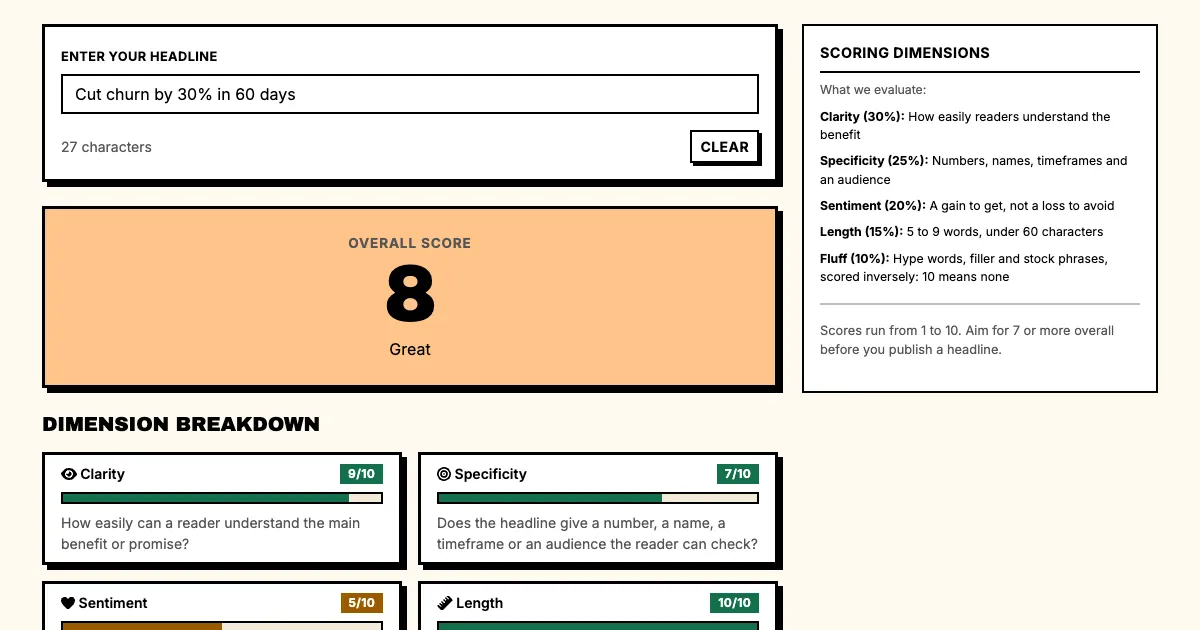
A: As specific as you can credibly promise. "Cut churn" is a category; "Cut churn by 30% in 60 days" is specific. If you have data to support the number, use it.
Q: What if my audience is too broad?
A: Then your value proposition is too broad. Break your audience into segments and write a value proposition headline for each one; "For startups," "For enterprise teams," and "For agencies" may need different headlines.
Q: How do I test value proposition headlines?
A: Show them to five people in your target audience and ask: "Does this headline make you believe that this product is worth [your price]?" If the answer is no, the headline isn't getting the value across.
What should you do now?
- Write one sentence describing your most specific outcome.
- Write one sentence describing your most specific audience.
- Write one sentence describing your most specific constraint.
- Combine all three into a value proposition headline.
- Test the headline against your current headline on a landing page.
Sources
- Wikipedia: Value proposition
- Harvard Business Review: Customer value propositions in business markets
- Wikipedia: Unique selling proposition
Generate value proposition headlines from your product details with our free value proposition generator.