A demo request headline books meetings when it promises a specific outcome of the call and lowers the effort of showing up. The 13 formulas below turn a generic "Book a Demo" into a call the buyer wants to attend.
Your demo request form collects leads, and many of them go cold. They saw your demo page and clicked "Book a Demo," then didn't show up.
The cause is usually the headline, because it sets expectations for the call. Promise a generic "product tour" and you get leads who want a tour. Promise a "30-minute ROI workshop" and you get leads who want to see results.
Why do people request a demo?
A demo request is a high-intent action. Someone who asks for a demo has moved past awareness and is in consideration mode, checking whether your solution solves their problem.
So your headline has to set the right expectations and promise specific value. Done well, it filters out time-wasters and attracts serious buyers.
Which 13 headline formulas book demos?
1. The "ROI workshop" formula
Position the demo as a business investment.
Before:
"Book a Product Demo"
After:
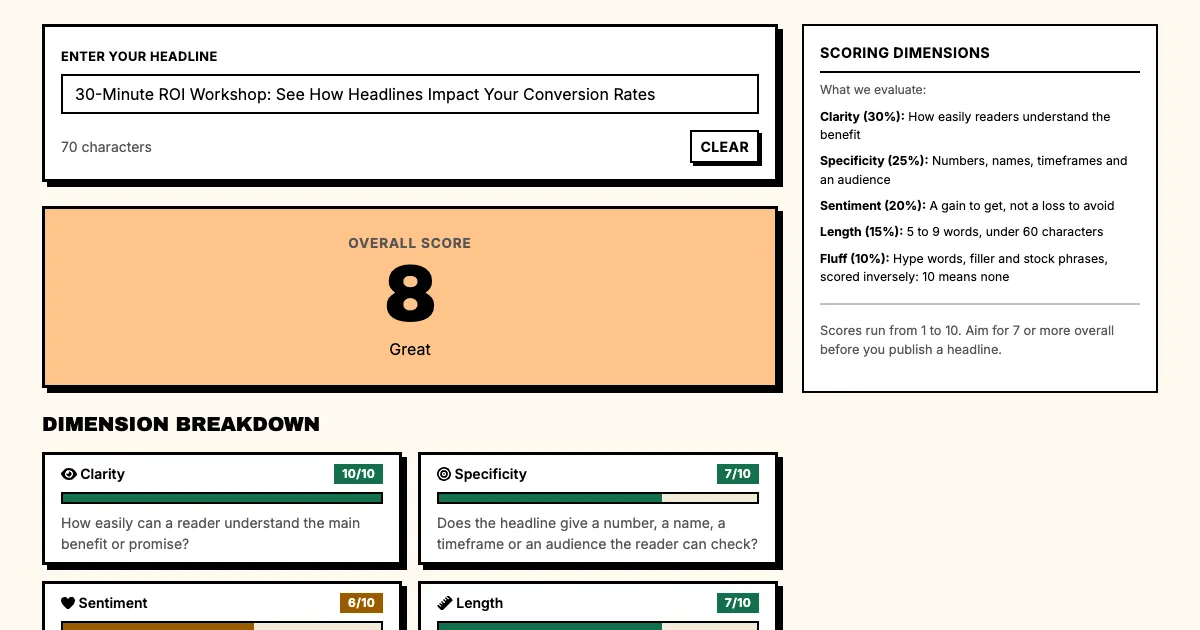
"30-Minute ROI Workshop: See How Headlines Impact Your Conversion Rates"
This reframes the meeting from a product tour into an ROI workshop. The prospect invests their time to learn about their own return.
2. The "Personalized demo" formula
Promise relevance.
Before:
"Schedule a Demo"
After:
"Your Personalized Demo: We'll Review Your Landing Page Headlines Live"
The demo is now about them. "Your landing page" ties it to their own context, and "Live" implies real-time analysis instead of a canned presentation.
3. The "No pitch" formula
Remove the fear of a sales pitch.
Before:
"Talk to Sales"
After:
"No Pitch. Just Headline Analysis. 30 Minutes. Your Site."
Many buyers avoid demos because they don't want to be sold to. "No pitch" tells them outright that they won't be.
4. The "Expert session" formula
Promise expertise.
Before:
"Book a Demo"
After:
"30 Minutes With a Headline Expert: Get Feedback on Your Campaign"
This presents the meeting as access to an expert. Buyers who want professional guidance respond to the word "expert."
5. The "Quick win" formula
Promise a fast result.
Before:
"Request a Demo"
After:
"In 30 Minutes, You'll Leave With 5 Headline Ideas for Your Next Campaign"
It promises a specific deliverable. "5 headline ideas" is tangible, and they can take those ideas and use them right away.
6. The "Your choice" formula
Let them pick the focus.
Before:
"Product Demo"
After:
"Pick Your Focus: Onboarding, Headline Generation, or Team Collaboration"
The prospect decides what the call covers. That agency makes the demo feel more relevant to their situation.
7. The "Customer story" formula
Show them someone like them succeeded.
Before:
"See a Demo"
After:
"How [Competitor] Doubled Their CTR: A 30-Minute Walkthrough"
This leads with a case study. "Doubled CTR" is a specific result, the competitor's name makes it concrete, and a walkthrough implies hands-on learning. It borrows social proof, one of the core levers of copywriting psychology.
8. The "No commitment" formula
Lower the barrier to entry.
Before:
"Book a Sales Call"
After:
"No Commitment Required. 30 Minutes. See If We're a Fit."
"No commitment" promises there's no obligation, which takes pressure off and lowers the psychological cost of booking.
9. The "Live analysis" formula
Promise real-time insight.
Before:
"Product Demo"
After:
"Live Analysis: We'll Review Your Best Landing Page and Give You 5 Headlines"
It promises live analysis of their actual content, their own landing page, plus a specific deliverable: 5 headlines.
10. The "Comparison" formula
Help them evaluate options.
Before:
"Demo Request"
After:
"Not Sure If We're Right? Here's What We Do (And What We Don't)."
This acknowledges that the prospect is still evaluating. Buyers comparing solutions respond to an honest account of what you don't do.
11. The "Technical deep dive" formula
Promise technical depth.
Before:
"Book a Demo"
After:
"API Deep Dive: How to Integrate Headline Generation Into Your Workflow"
Use this for technical buyers who want to understand implementation. "API" signals technical depth, and "Integrate" tells them the call is about their workflow.
12. The "Executive briefing" formula
For enterprise buyers.
Before:
"Schedule a Meeting"
After:
"Executive Briefing: How Fortune 500 Teams Use AI Headlines"
It signals exclusivity. "Executive briefing" implies C-level content, and "Fortune 500" adds social proof from the top of the market, so use it only when such teams really are your customers.
13. The "Try before you buy" formula
Offer a low-commitment trial.
Before:
"Start Free Trial"
After:
"See It In Action: Generate 20 Headlines Before You Talk to Sales"
The trial comes before the sales call. Prospects try it first and talk to sales only if they want to, and that order reduces friction.
What does a full set of demo headlines look like?
Match the formula to the prospect persona:
| Persona | Primary concern | Headline formula |
|---|---|---|
| Marketer | Time to results | "5 headline ideas in 30 minutes" |
| Director | Team efficiency | "How teams collaborate on headlines" |
| VP | ROI | "30-minute ROI workshop" |
| Founder | Speed | "Generate 20 headlines before lunch" |
Launching a new feature? Point your product launch headlines at the same demo page, so the launch traffic lands on a call that matches the announcement.
Multi-Stage FAQs
Q: How long should my demo be?
A: Aim for 30 minutes. That's long enough to cover value, answer questions and build rapport, and short enough to fit into busy calendars.
Q: Should I offer multiple demo formats?
A: Yes. Some prospects want a live demo, others a recorded walkthrough, and some a written proposal, so offer more than one format to match those preferences.
Q: What should I ask in the demo request form?
A: Keep it short: name, email, company and one open-ended question ("What's your biggest headline challenge?"). Every extra form field is one more reason to quit before submitting.
Q: How do I follow up after a demo request?
A: Send a confirmation email immediately, a reminder 24 hours before, and a follow-up 48 hours after if they didn't show. Each message should give them something useful on top of the reminder.
Q: Should I offer a recorded demo instead of live?
A: Recorded demos work for early-stage evaluation and live demos for late-stage qualification. Offer both and let prospects choose.
Q: How do I reduce no-shows?
A: Send calendar confirmations immediately, then reminders 24 hours and 1 hour before the call. If the time doesn't work for them, offer to reschedule.
Q: What if my demo slots are full?
A: Offer an on-demand option: record a full walkthrough and send it right away with a "watch now, talk later" offer. That keeps the leads who can't wait for a live slot.
Q: How do I qualify demo requests?
A: Add one qualifying question to the form, such as "What's your monthly budget?" or "How many team members will use this?" The answer tells you whether they're worth your time.
What should you do now?
- Audit your current demo request page headline
- Write 3 alternatives using the formulas above, and match the button text to each with the free CTA generator
- Test the alternatives with different audience segments
- Track booking rates, show rates, and conversion rates separately
- Iterate based on which headlines attract the highest-quality leads
Sources
Need headlines for your demo request page? Our AI headline generator writes variations for each prospect persona in your funnel.