Headline variations let one core headline work in ten formats: keep the promise and change the length, the audience cue and the intent for each channel. This guide shows the method with one SaaS headline adapted for landing pages, email, ads and social posts.
Why is one headline not enough?
Your landing page H1 is different from your email subject line. Your LinkedIn post headline differs from your Google title tag, and your ad headline differs from your social media caption. Each platform has its own length limits, context and audience.
You don't have to write 10 headlines from scratch for that. Adapt one core headline into 10 formats instead, one for each channel in your content distribution plan.
What is a core headline?
Start with one core headline that captures your primary message. It's your anchor, and every variation comes from it.
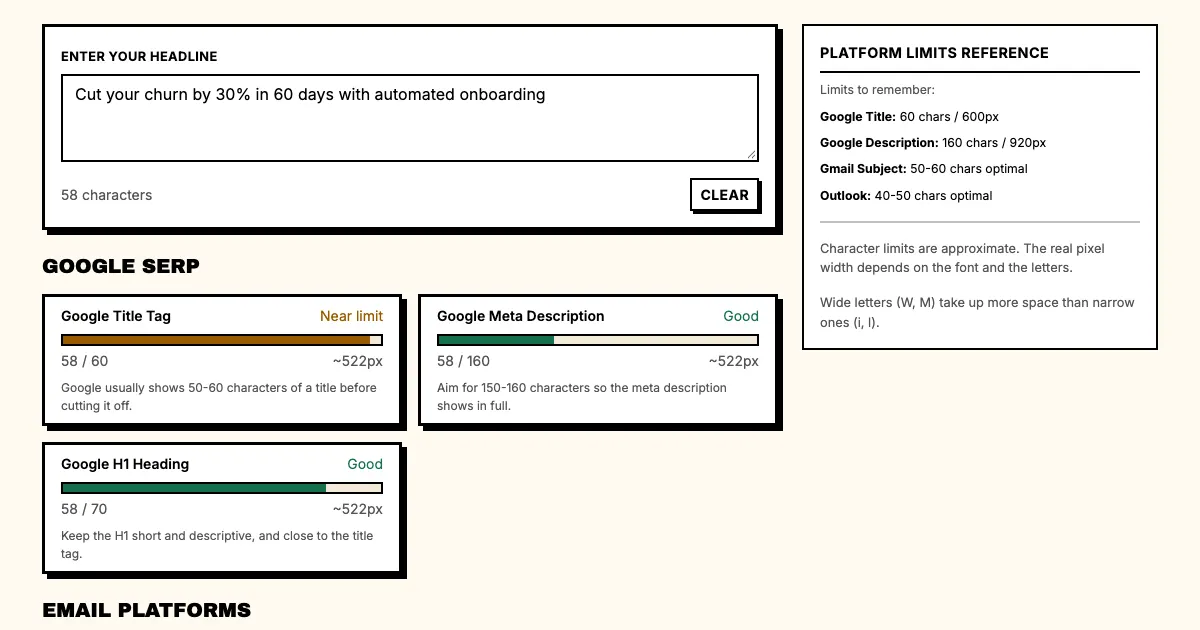
Core headline: "Cut your churn by 30% in 60 days with automated onboarding"
This headline is too long for most formats, but its core message (churn reduction, specific number, mechanism) can be adapted. Keep the number in every version you can: our SaaS headline data shows why specific numbers carry more weight than emotional language.
How do you write headline variations for each length?
Full version (landing page H1)
"Cut your churn by 30% in 60 days with automated onboarding"
This version is for landing pages with room for a full sentence.
Condensed version (Google title tag)
"Cut Churn by 30% in 60 Days | Automated Onboarding"
Google usually shows only the first 50-60 characters of a title, so this version cuts the non-essential words and keeps the core message.
Subject line version (email)
"Are you losing 30% of customers to bad onboarding?"
The question makes readers curious enough to open, and the specific number ("30%") adds credibility.
Social version (LinkedIn)
"Stop losing customers to bad onboarding. Here's the fix"
LinkedIn posts have more room, but they have to stop the scroll. This one does it with a command ("stop") and a hook ("here's the fix").
Ad version (short)
"Cut Churn 30%: Free Trial"
Paid ads need very short headlines, so this version drops everything except the core benefit and the CTA.
How do you adapt a headline for the audience?
For founders
"Cut churn before your next board meeting"
This version adds a timeframe that matters to founders (board meetings).
For marketing teams
"Cut your churn by 30% with our onboarding framework"
Calling the solution a framework appeals to marketers who think in terms of processes.
For customer success teams
"Stop losing customers in the first 30 days"
Here the focus is the stage customer success teams care most about: the first 30 days.
How do you adapt a headline for search intent?
Each intent suits one of the types of headlines: a how-to for awareness, a comparison for consideration and an offer for the decision.
Awareness intent
"How to identify customers who are about to churn"
The question format matches how people search while they're learning about a problem.
Consideration intent
"Onboarding tools compared: which cuts churn by 30%?"
Comparison language matches how people search when they're evaluating solutions.
Decision intent
"Try our churn-cutting onboarding tool free for 14 days"
Trial language matches the searches of people who are ready to try a solution.
What should every variation keep?
When you adapt a headline, check each version against four questions:
- Length: does it fit the platform's character limits?
- Clarity: does the core promise come through?
- Urgency: does it create pressure to act?
- Platform fit: does it match the platform's context and conventions?
FAQ: Headline variations
Q: How many variations should I create per headline?
A: At least three: long form (landing page), medium form (email) and short form (ad). Go up to 10 if you're running multi-channel campaigns.
Q: Should I test variations?
A: Yes. Variations with the same core message still perform differently on different platforms, so test your headlines on each one.
Q: Can variations have conflicting messages?
A: No. Length and format change from one variation to the next, but the core message stays the same in all of them.
What should you do now?
- Pick your best-performing headline.
- Write three variations: long form, medium form, short form.
- Test each variation on its target platform.
- Track which variations drive the most engagement.
- Build a variation library for your top headlines.
Sources
- Nielsen Norman Group: writing headlines, page titles and subject lines
- Google Search Central: title links
- Wikipedia: Content marketing
Need the variations written for you? The AI headline generator writes 20 from one brief, and the free headline length checker shows how each one fits Google, email and ads.